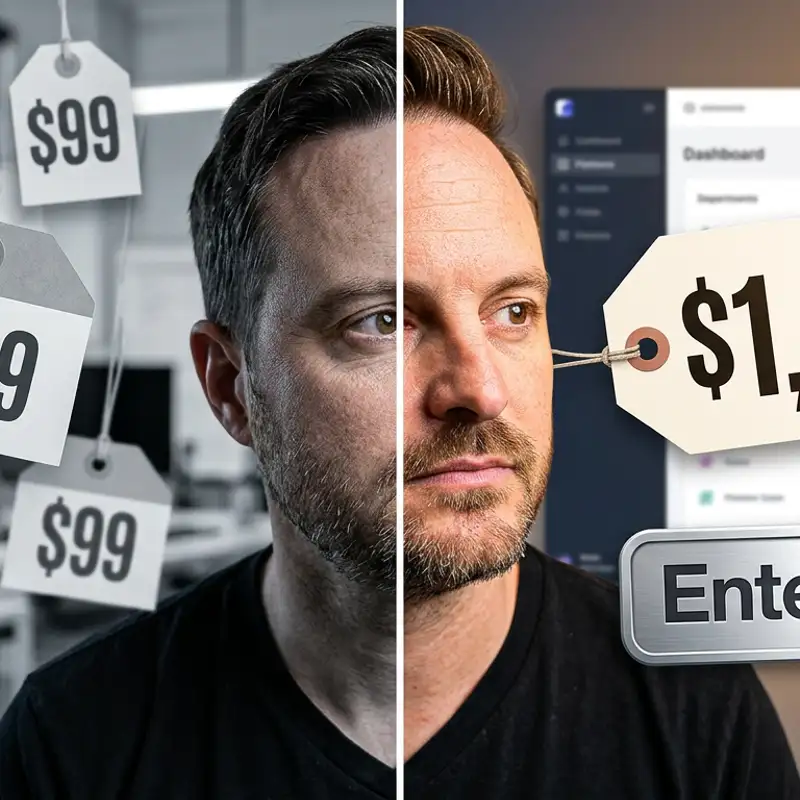
E02 w/ Rob Walling: $1M ARR, how to expand into a new market
Download MP3Jason Cohen (00:00)
The star of today's episode of Smart Bear Live is a founder who's bootstrapped a $1 million a year business as a digital nomad. He's now looking at a flat growth curve and a potential new juicy market segment, but he's not quite sure how to go to there.
Jason Cohen (00:13)
So we're gonna help him.
Jason Cohen (00:15)
And who is we, you might ask?
Jason Cohen (00:17)
I'm Jason Cohen, I'm known online as Smart Bear.
Jason Cohen (00:19)
I've run and founded two unicorns in the past 25 years, both bootstrapped and funded, and I've been writing about startups for most of that time.
Jason Cohen (00:26)
And joining me to help our star founder is Rob Walling.
Jason Cohen (00:30)
So Rob has more experience understanding and helping Bootstrap software founders than probably anyone else on Earth because he's done it himself and then he's helped thousands of startups over 20 years. He's done it through his blog and then his podcast, Startups for the Rest of Us, which has about 80 billion episodes. I checked to make sure that number was right. He's written five books. He runs MicroConf, which is definitely the best conference for Bootstrap software founders. And then together with Einar Volsett, he runs TinySeed. Rob does a lot of stuff.
Jason Cohen (00:59)
Which is one of the very few funds that make sense for companies that have the bootstrapper mindset, the bootstrapper culture, bootstrapper goals, but they want to take just like a little bit of money from someone who understands and can help.
Jason Cohen (01:10)
So I'm a proud investor and mentor at Tiny Seed and a proud speaker at MicroConf.
Jason Cohen (01:14)
And Rob was an angel investor in my company, WP Engine, and that did well. So we have a long history together, professionally and personally, and I'm thrilled to sit by him today. So welcome, Rob.
Rob (01:23)
Thanks so much, it's my pleasure to be here.
Jason Cohen (01:25)
So together, Rob and I are going to help the star of the show, Jesse Schoberg, with his company DropInBlog. Now Jesse's living the life that a lot of people wish they had. His company makes over a million dollars a year, which he bootstrapped with two co-founders and runs as a digital nomad. He moves from Barcelona to Bangkok and maybe everywhere in between and maybe not. I'm not sure. I guess he'll tell us. He's got thousands of customers, so that's nice, with a low churn of two percent per month. So I guess that means they like it.
Jason Cohen (01:53)
And he's got a fully distributed workforce, which also supports his nomadic lifestyle. So he's got a product with high margins, people that love it, and he builds it while living anywhere in the world. So it's pretty badass. And so what is this great product? DropInBlog is exactly what it sounds like. It's a perfect name. You drop it in into any website. So say you already have a website for your product or service, and you want to add a robust blog inside the existing site style and layout for things like content marketing or AI visibility, SEO,
Jason Cohen (02:20)
Stuff like that. And so you can just throw it in there. It's really easy. So it's a great idea. It's got 10 years of execution behind it, thousands of happy customers. And so, of course, what's the problem with that? Sounds pretty good. So the problem is that growth has been tapping out in the last few years in the segment of customers that got him to this point. And so Jesse does see a new cohort of customers that looks promising and might result in a stronger business model. There's been some pricing changes recently, but he's still not quite sure how to shift into that segment and make it scalable.
Jason Cohen (02:50)
So Jesse, first of all, welcome. And second of all, I just wanna say out loud, it's brave of you to come out here as the star of the show today and put all your challenges on the table so that other people can learn or even commiserate with you. So thank you. And Rob and I will try to make it worth it by making a lot of progress today on that.
Jesse Schoberg (03:06)
Well hey, thanks a lot for having me and that was a very flattering intro. I feel like I mean that sounded pretty cool. I I don't know if we need to do this, but
Jason Cohen (03:12)
Yeah.
Jesse Schoberg (03:14)
appreciate that and I appreciate both you guys' time. This is great. And just looking forward to digging in and seeing what we can do for the next chapter of the company, which me and my cofounders and team are very excited to go on and I think we got some ideas here. So after watching episode one,
Jesse Schoberg (03:29)
the other week I'm ready to get the punches in. So so
Jason Cohen (03:32)
That's right. We gotta start punching.
Jason Cohen (03:33)
Like enough enough Mr. Nice Guy.
Jason Cohen (03:36)
So actually maybe you can start by filling in a little of the detail of the current situation, like who's this current segment of customers that makes up your current customer base? What's the new segment that you're seeing that you wanna shift into and stuff like that.
Jesse Schoberg (03:47)
You bet. So we started like most bootstrap founders, you know, we're self-serve only and we've got these approachable plans for other smaller companies, very product led, etc. And we did that. We're very good at SEO, kind of dog fooding our own product as well, And as usual, which of course we didn't know when we started, but now we do know because of
Jesse Schoberg (04:07)
friendly folks like the both of you creating content, explaining about things like running out of marketing channels and tapping out to max MRR, et cetera. Eventually over time, that segment, which is fairly broad actually, our product does kind of work in many scenarios. I mean it is a blogging platform that is I feel like our only real differentiate is we're more targeted at business bloggers that are trying to actually do content marketing versus personal bloggers that are that are you know telling their their theirs thoughts or whatever.
Jason Cohen (04:36)
Well, 'cause personal bloggers don't have
Jesse Schoberg (04:36)
you it's not a medium, right?
Jason Cohen (04:37)
a a a corporate website that they're trying to drop it into, right? Yeah. But I bet there's some businesses that are better than others, right? 'Cause
Jesse Schoberg (04:40)
Exactly, exactly. So so that was ki kind of our only thing.
Jason Cohen (04:44)
like if I'm a restaurant, I'm maybe I'm unlikely to even think about that. So I bet you
Jesse Schoberg (04:49)
Right.
Jason Cohen (04:49)
I bet there's even better segments. I mean, even besides the the not pivot, but even besides the expansion you're thinking about.
Jesse Schoberg (04:56)
Yeah, I mean our our popular segments have always been course creators, so we do very well with like ThinkIffic and Teachable. and then also e-commerce, so we do well with Shopify and BigCommerce and Big Cartel and these, as well as like the general website builders, Framer, Webflow, this kind of stuff. And of course like the custom sites, right? So this is kind of our our quote problem is that we're we're tech nerds and we build all the stuff and we make it really great and and whatever, but then we're kind of everywhere, right? But so then it's like
Jesse Schoberg (05:26)
In in the new world, we're we're like building the React framework and we're building the this and that and and all of this kind of stuff. but yeah, eventually it's like still the same problem. SEO is the channel, self-serve coming in. And so I guess I could say briefly a couple of years ago we start to notice this, and what we decided is that
Jason Cohen (05:46)
When you say notice this, notice what?
Jesse Schoberg (05:48)
W notice that the growth is tapping out and that the you know the churn is catching up to the the the growth amount. but then at the same time, we were playing around with this product called Apollo and there's other ones that do it that do this de-anonymization stuff. So you put a script on your website and it says like tells you who's visiting the site. Not like the person, but it'll say like
Jason Cohen (06:07)
Okay. Yeah.
Jesse Schoberg (06:10)
three people from WP Engine came to your website last month. And
Jason Cohen (06:12)
Yeah, yeah. Mm-hmm.
Jesse Schoberg (06:14)
and so we were looking at these stats and about
Jesse Schoberg (06:16)
Five percent of our visitors were from like huge companies. And we had nothing to sell them because our largest plan was ninety-nine dollars a month. And they and our all of our messaging was, you know, we're the the friendly, small, like bootstrappy guys, you know, and that big companies
Jason Cohen (06:33)
But what was the conversion rate on the on that five percent?
Jesse Schoberg (06:36)
zero. That's the point. And so
Jason Cohen (06:38)
Right,
Jason Cohen (06:38)
but it's only five percent and half of the people in the world work at a big company. That's a real stat. So if half the people in the
Jesse Schoberg (06:44)
R I guess the
Jason Cohen (06:46)
world work at a real company and only five percent come to the website and don't buy, that just means they're not they're not good customers.
Jesse Schoberg (06:51)
But
Jesse Schoberg (06:52)
but my thought is that they were just there were people that were interested that were in this segment and we had sold none. So then I was like, and then it's like so
Jason Cohen (07:00)
Well you say people,
Jason Cohen (07:02)
okay, it's it's one out of twenty. Like so who cares? Like
Jesse Schoberg (07:07)
Yeah. Well we did 'cause we were tapped out on the other one and we were just trying to figure out what the hell to do.
Jason Cohen (07:11)
So you
Jason Cohen (07:11)
were tapped out because you feel there's no more no more opportunity in small business to drop a blog into a website.
Jesse Schoberg (07:18)
More of the marketing channels we were good at, we were pretty maxing on.
Jason Cohen (07:22)
No, no, I know. And so and so therefore
Jason Cohen (07:23)
a channel that's so an opportunity that was only 5% of what you're currently getting was better than any other idea you had to also grow by 5% in some other channel for your existing base that you're actually good at. Like in other words, if it's 5%, it's like, all we grow 5% if we captured all of them. We could we grow 5% more, which is not actually significant. And you're saying that would be easier to to to to go to a new market segment that you don't.
Jason Cohen (07:50)
that that you're not successful in your brand or product in, it would be better to go there for a five percent lift rather than trying to just go to a our existing customer segment where our product and brand is right and try to get a pri five percent lift just in marketing or or sales or something.
Jesse Schoberg (08:05)
Well, I wasn't trying to get a five percent lift. I was trying to validate that these customers exist and would be interested in our product, which we could sell at a higher price point, which would open up new marketing channels that we weren't using to get to them.
Jason Cohen (08:17)
Okay, but you know they're not interested
Jason Cohen (08:18)
in the current one because there's zero is zero conversions. So I guess what you're if I'm trying to interpret what you're saying, you're hoping that that 5% wants to pay 10 times more for a different product, then
Jesse Schoberg (08:28)
Yeah.
Jason Cohen (08:29)
it would be 50% of your revenue and now we're cooking. But but the current product
Jesse Schoberg (08:32)
Yeah. And so that's what we did.
Jason Cohen (08:34)
they don't want. Because you said it was zero conversions. That means I don't want it. Right? Okay.
Jesse Schoberg (08:38)
Right. So let me finish
Jesse Schoberg (08:39)
then the so maybe you're right, and we could have had this conversation then, and maybe I wouldn't have done this, but I didn't know what to do because we we had maxed out we couldn't
Jason Cohen (08:47)
No, I understand.
Jesse Schoberg (08:48)
move the needle. So we updated our brand, we rewrote all the copy on our website to attract more of this customer base, and then we created some plans that were for those people, and then they started selling. Not a ton, but they did start selling.
Jesse Schoberg (09:07)
And we we also start started doing demos for those, etcetera.
Jason Cohen (09:07)
So I'm I'm glad. I'm glad they sell, but let me ask
Jason Cohen (09:10)
this. How did you know, given that the current brand and product they didn't want, and you didn't normally sell to them because even just the amount of traffic is only 5%. So you know you barely so you don't know anything about them other than they don't want what you had. How did you figure out what to say and what to sell at what price point? Maybe you did some research or something. So like how did you figure out what it is that this new segment might want?
Jesse Schoberg (09:34)
Yeah, we we basically started doing a lot of demo calls and so before we
Jason Cohen (09:37)
good.
Jesse Schoberg (09:37)
didn't we didn't do any demos and that was of course back to the we're the self serve only or whatever. Well that line starts flattening out and all of a sudden I can do a demo, you know. I could so we we we just put the button on and just said, Book a demo and then of course these type of customers are the ones who book demos, not regular people 'cause they don't want to. And then we failed for a while. You know, they they would
Jesse Schoberg (09:59)
You know, still not work or whatever. And then we started to learn what they wanted, and we slowly shaped that business plan by asking them when we were on the demos.
Jason Cohen (10:03)
And how did you learn what they wanted? Okay, so that it was a demo,
Jason Cohen (10:08)
but although that's a sales call normally, you were treating it as like kind of a combo sales call. I hope I get this sale, but I need to learn from this too. Okay.
Jesse Schoberg (10:15)
Yeah. Yeah. And then
Jesse Schoberg (10:17)
when they basically then and then as they it's we started learning what they would want, then it would convert more or we would like hear their fears or whatever. And then of course I
Jason Cohen (10:23)
Yeah. Yeah.
Jesse Schoberg (10:25)
interviewed as many people as I knew that wasn't that many that knew something about the segment. So we started adding things more related to them like invoicing and audit logs and stuff that these kind of businesses want, basically.
Jason Cohen (10:37)
Okay, and and and so what were like the top one or two things that unlo that you think were the unlock with this segment? Like you you just said you just mentioned two, are those like the key things or what what was like the really key things?
Jesse Schoberg (10:47)
Y
Jesse Schoberg (10:49)
yeah, I think I think it's generally a combination of those and then of course it has like more users and stuff. so but I think it's it's the
Jason Cohen (11:00)
No, that that's good for you
Jason Cohen (11:01)
because there's more there's more seats to sell. What my question is, what is it that you figured out? If I do this, they'll be super thrilled. So like doing invoices or POs instead of credit card, that's just that's not thrilling them, that's just covering a bar that they have, which is great. And like even the auto
Jesse Schoberg (11:15)
Yeah, yeah.
Jason Cohen (11:16)
trail, it's not thrilling them, it's just covering a bar they have. In the cono model you'd say it's just like night n just has to have it.
Jesse Schoberg (11:19)
Yeah. Yeah. I think the other
Jesse Schoberg (11:22)
one is that we're including white glove migrations for those guys.
Jason Cohen (11:26)
Okay.
Jesse Schoberg (11:27)
and they need that because they they're worried about their SEO breaking and they have, you
Jason Cohen (11:31)
Right, right, right.
Jesse Schoberg (11:31)
know, 300 posts or whatever. So I feel like, yeah, those three are kind of the the big big ones that that kind of made them more interested in in those plans. And then we kind of sw
Jason Cohen (11:43)
Okay, so invoicing,
Jason Cohen (11:45)
audit logs, and and audit of what? Like who who edits the site? That kind of audit log? Okay.
Jesse Schoberg (11:49)
Yeah, yeah. It's basically just
Jesse Schoberg (11:51)
like a huge history of like who logged in and what IP and what they changed and stuff, yeah.
Jason Cohen (11:53)
Yeah, yeah, yeah. Okay,
Jason Cohen (11:55)
so auditing themselves, not their visitors. Yeah, yeah. And then and
Jesse Schoberg (11:58)
Right, right, right, right, yeah, yeah, yeah.
Jason Cohen (12:00)
then and then the onboarding, whether that's migration or installation, but just onboarding somehow. and that's
Jesse Schoberg (12:04)
Yeah. Yeah. Yeah. Yeah. Yeah. Yeah. Yeah.
Jason Cohen (12:07)
it.
Jesse Schoberg (12:09)
I mean there's some more stuff. Again, it's it's still a work in progress, which is partially reason I'm here. Yep.
Jason Cohen (12:12)
Yeah. So actually that's something I mean,
Jason Cohen (12:14)
not I'm not trying to solve anything, but just s something for for a side note. I didn't hear anything in there that's exciting or or that would like light someone up. Everything you told me was like, I just have to have this. I don't have a choice. or
Jesse Schoberg (12:26)
Yeah, yeah, yeah.
Jason Cohen (12:26)
it's useful. There's utility. obviously with whiteboarding with onboarding, of course. Like you're alleviating a fear. It's useful. Like that's great. Like there's that's nothing wrong with it, right? Like nothing
Jesse Schoberg (12:34)
Yeah. Yeah.
Jason Cohen (12:36)
you told me was was like exciting. so for example,
Jason Cohen (12:40)
you I I think you've described one of the values of the blog is is maybe this helps you get found by LLMs. So if you send something like, here's a big company, like they barely know how to do SEO, but but they have such a big brand that they just sort of appear, but they do not know what to do with LLMs. And so we can
Jesse Schoberg (12:55)
Mm.
Jason Cohen (12:55)
help them with that. And they're like, my God, if I could tell my boss that that that you know I'm do he me and Mark and I'm doing something to get in LLMs, even if like none of us really know how that works. But like if I can still tell that story. And I am trying, like
Jesse Schoberg (13:07)
Yep, yep.
Jason Cohen (13:08)
it's it's it's true. I'm trying like
Jason Cohen (13:09)
I've solidified my job for the next year or two, by the way. That's what I'm doing for my market. Like, if you told me that, I would say, if I'm a marketer at a big company and I want my job to not go away because big companies are in fact letting people go, aren't
Jesse Schoberg (13:21)
Right.
Jason Cohen (13:22)
they? Like, you just save my job for frick's sake. Like, like that sounds like freaking good. You didn't say that. Now, maybe you should take that and and say that. But that that's what I mean, is what I'm missing here. I'm not here, like I'm hearing useful stuff, and that's great, but like, where's the part where they're excited?
Jesse Schoberg (13:34)
Yeah. Well one thing that was really c one
Jesse Schoberg (13:37)
thing that was really confusing for me when we when we switch to these demo calls with these companies, these tend to be more with like the technical people, because they're
Jason Cohen (13:43)
Mm-hmm.
Jesse Schoberg (13:44)
the ones like trying to solve this problem at the big company.
Jason Cohen (13:46)
Right, right, right.
Jesse Schoberg (13:47)
And like those features are more like success, you know? But like what was tough on those calls and we're still have like trying to figure out is like all the features that we built for our self-serve customers, like
Jesse Schoberg (13:57)
the SEO stuff and the like like these kind of nice to havey things that are about the UX and things, a lot of times they don't care about that. And then they're like, but it it the blog goes inside of the existing site and it's gonna match and the SEO's gonna work.
Jason Cohen (14:10)
All right.
Jesse Schoberg (14:11)
And we're like, yeah, that's like our core product offering. And they're like, okay, good, good, good. You know. So
Jason Cohen (14:15)
Okay. So it
Jason Cohen (14:16)
could be that the that the customer is is technical and not the marketer. Even so, I would still ask. I mean, there's no such thing as a product that shouldn't delight a customer. And if we can't name even one thing. No, no, no, no, no, no. It satisf no, it satisfies a need they have.
Jesse Schoberg (14:26)
Right, right, right. And that part does from a technical side, but the of course we're trying to create this differentiating on the pricing. Yeah.
Jason Cohen (14:33)
No, no, no, it does not. It's because they already have the SEO. All you're doing is switching out some tech and bringing them back to where they already were, which is useful,
Jesse Schoberg (14:41)
Mm.
Jason Cohen (14:42)
but that is not delight. They're not going and telling
Jason Cohen (14:45)
Other people online, my God, this is so cool because of anything. An interaction with customer service. This brand is so neat. the design of this was just perfect. I can't believe how this was designed. Like linear. Linear is is project management. You it's just like a scrum shit. Like, but people are like, my God, the design. it's so fast. the keyword shortcuts, right?
Jesse Schoberg (15:06)
Mm-hmm.
Jason Cohen (15:06)
Right. Like none of that, those aren't even feel like it does the same as Jira, maybe even less. Right. But the design is is like, my God, people just just love it.
Jason Cohen (15:15)
So like there's no such thing as a product that couldn't delight people. So again, I'm not this isn't like a huge problem to solve. Again, this is an aside, but as an aside, like we we can get so far, especially with big companies, we get so far in in like where we're just ticking all the boxes. And of course you should, and that's good. But I would I would I would also think, especially because your whole thing right now is like, wait, how do I really thrive here in this new space? I was like, okay, well, part of thriving and not just not
Jesse Schoberg (15:39)
Yeah, the best delight one that we have.
Jason Cohen (15:41)
just not just having a product, but thriving is
Jason Cohen (15:44)
that generating that delight. I haven't heard that yet. So that's just something
Jesse Schoberg (15:46)
Delight.
Jason Cohen (15:47)
to to consider.
Jesse Schoberg (15:48)
Yeah, the best delight one that we have I in in the mind is we've been playing around with we we currently have a thing that people do like, which is they connect their Google Analytics and it shows a more easy to digest version of their Google Analytics in the panel. But then
Jason Cohen (16:01)
Mm-hmm.
Jesse Schoberg (16:02)
we've recently been playing around with the Google Analytics MCP. And so we are thinking if we we already are connected to their analytics, we could have like an ask analytics like in the panel, and then that's delight, right? Like you're you're
Jason Cohen (16:13)
For who? For
Jason Cohen (16:14)
whom is that delay?
Jesse Schoberg (16:16)
For the customer because
Jason Cohen (16:17)
No, for whom which
Jason Cohen (16:18)
which it the marketer or the engineer?
Jesse Schoberg (16:20)
I mean the marketer, and maybe the engineer as well, that he's on the call.
Jason Cohen (16:22)
Right. But you just told me you s wait, wait, wait, you just told me wait, you just told me you sell to engineers?
Jesse Schoberg (16:27)
Yeah.
Jason Cohen (16:28)
So which one is it? Or is it both? It can be both, but like you just you just told me that that my example of AI
Jesse Schoberg (16:32)
Yeah, you're right.
Jason Cohen (16:33)
wouldn't work 'cause it's the engineer. So like what is it?
Jesse Schoberg (16:36)
Yeah, yeah. I mean it is more the engineers for sure. Yep.
Jason Cohen (16:39)
Okay.
Jason Cohen (16:41)
But maybe it's maybe the marketer holds the purse. I mean, that's a that's actually an interesting question too.
Jesse Schoberg (16:46)
Yeah, it's one
Jesse Schoberg (16:46)
of the complicated parts of it that we've found so far.
Jason Cohen (16:49)
Who actually write approves the order?
Jesse Schoberg (16:54)
Hm usually that would
Jason Cohen (16:54)
Like you said invoice. Who signs that?
Jesse Schoberg (16:57)
well, like procurement, right? Like but somebody has to push it.
Jason Cohen (16:59)
Uh-huh. On behalf of of whom?
Jesse Schoberg (17:01)
Yeah, probably it's usually again, it goes both. It could be like the the marketing manager or it could be like the like someone in tech, CTO or someone who's pushing this through. Depends on like whose problem this got brought in. Like if it's the marketing person who's trying to solve it or if it's like the tech that got assigned to it, you know.
Jason Cohen (17:20)
Fair enough. Okay.
Jesse Schoberg (17:21)
Mm-hmm.
Rob (17:22)
If I can jump in on the delight versus kind of take your Jason. Yeah, you're, sick.
Jason Cohen (17:26)
Rob, just just this is your this is your show too. Just hit it anytime.
Rob (17:30)
You're saying table stakes versus delight, Jason. You're kind of, you know, breaking these things up, which I think makes a lot of sense. And what I want to say, I'm curious if this fits the rest of you, but you know, are any, any feature that we ever built that was delight was usually came from us. came from our innovation. Customers did not come up with that.
Jesse Schoberg (17:50)
Mm.
Rob (17:50)
on their own. Like I don't think anyone asks Linear, the product team, hey, can you make it so easy to use it? know, everything Jason described that Linear does, that's fucking internal, right? And superhuman, same thing. Like that was the secret sauce. That's why we say when you talk to customers to get ideas for features, they're gonna give you table stakes. They're not product people. They're gonna tell you what WordPress has, whatever, the insert other blogging platform. And it's like, cool. But to Jason's point, that's not delight. Well, how do you get that next 10 to...
Rob (18:18)
100 % of delight. It is going to have to be you, your team. Every once in a blue moon, some customer will say something accidentally that is like, that
Jesse Schoberg (18:26)
Mm-hmm.
Rob (18:27)
is actually a delight. But most of the time it really it's innovation, know.
Jesse Schoberg (18:31)
Yeah. Okay.
Jason Cohen (18:36)
I mean, even with the current base, let's let's just just think of one of your cu current customers that are not one of these, just the SMBs or whatever, the the you know, the who love you the most, why are they delighted?
Jesse Schoberg (18:52)
probably just our general like UX and ease of use. Like once it's set up, then it's solves all these problems for them. 'Cause they're trying to blog in in the crappy version of the blog that's in Shopify or in whatever platform they have that may or may not have something. And then they move
Jason Cohen (19:07)
huh. Yeah.
Jesse Schoberg (19:09)
to us and w we do have a beautiful product that is very easy to use and and and all of this stuff. So so they they
Jason Cohen (19:13)
Okay. Nice.
Jesse Schoberg (19:15)
are delighted that it's quit and they generally become raving fans and all that, right? Which is why we have a two percent churn, right? Like
Jesse Schoberg (19:21)
we do have a very well polished product that is is delightful to use. But
Jason Cohen (19:26)
So the one
Jason Cohen (19:27)
thing that comes to mind right away is that's that's incredibly strong. And I wouldn't lose I I wouldn't forget that. I wouldn't forget that that's your strength. That's something that delights people, or at least it's a big strength, it's a big asset that you've built up over ten years and is absolutely true. It's easy with enterprise customers or even mid sized customers to think, they're in a big company. That means they want it to look like workday or look like Amazon.
Jason Cohen (19:56)
In other words, hideous, but it has, you know, whatever features they need. No, they don't. They're human beings. They still want it to be simple and delightful to use. They do that now.
Jesse Schoberg (20:01)
All right. Yeah, yeah, exactly.
Jason Cohen (20:05)
There's check boxes they may need. you have to integrate with my login system because that's how we, you know, everyone logs in with LDAP or or Okta, whatever. Sure. Cause you have to, or there has to be roles and permissions, cause reasons. Okay. These
Jesse Schoberg (20:17)
Yep. Yep.
Jason Cohen (20:19)
are even they don't like that. Even they don't want that. They just don't have a choice. And it's part of the kinds of things you do.
Jason Cohen (20:26)
In order to just make the sale and it be be possible as an option, right? But nobody wanted that. I mean, as a as a user and nobody wanted it. Security
Jesse Schoberg (20:33)
Sure, sure, sure.
Jason Cohen (20:34)
team wanted it. But I mean, as a user, they didn't want that. it's a hoop they have to jump through too. So if this is a strength of yours that it's simple and and and approachable and easy, you wouldn't want like, enterprise has lots of needs and demands of various sorts. I guess we'll end up morphing away from this strength. I would, I would really fight against that.
Jason Cohen (20:53)
It may be that there's some enterprises you can't serve because it would ruin your UI to do it. Probably not a lot of that, but I mean, just in case, then I wouldn't build that.
Jesse Schoberg (21:01)
Mm-hmm.
Jason Cohen (21:02)
But if there's something where, yeah, okay, the login has to be enterprise stuff. All right, all right, whatever. Like, like, okay, but then pass
Jesse Schoberg (21:07)
Yeah, yeah, yeah.
Jason Cohen (21:08)
after that, you know, then I would I would do it because you're preserving
Jesse Schoberg (21:11)
Mm-hmm.
Jason Cohen (21:11)
the the the strength that you have for the end users who will love it and defend you when the budget consideration comes up again next year or whatever. Right.
Jesse Schoberg (21:19)
Yeah, yeah.
Jason Cohen (21:19)
and and so I would keep that in mind.
Jason Cohen (21:22)
And not allow yourself to be dragged into a like because I had to add a bunch of features for enterprise comma, you know, now my design is worse. I I wouldn't get trapped i by that idea.
Jesse Schoberg (21:32)
Yeah, I f
Jesse Schoberg (21:32)
I feel fairly comfortable with that statement and like it seems to be something that we all kind of have in mind when we're when we're building things. I mean we do like to make nice things. I guess the trick the problem here which you're pushing on, which is the like what we've had is like trying to make sure that
Jesse Schoberg (21:48)
They they feel good about like I want them in the higher end plans. I want to provide a value to them that puts them in the higher end plans. Like we have this kind of barbell thing happening because we have the self serve people and that and we need to just make sure that they I want them to land on the page and they will be delighted with the product, but I want them to be like, well, obviously we have to go with the expensive one, blah, blah, blah, blah, blah, because we can afford it and it has XYZ that we must have and that's it, and done and done and done. Like it and that's been sometimes hard. We're getting better with it, but yeah, anyways.
Jason Cohen (22:19)
It's hard putting both prices on the web at the same time. So how do you do that?
Jesse Schoberg (22:24)
what do you mean? we have a pricing table.
Jason Cohen (22:26)
Like if I go to a website and
Jason Cohen (22:27)
it says starting at five dollars a month and also we have a a ten thousand dollar a month plan,
Jesse Schoberg (22:31)
Yeah.
Jason Cohen (22:31)
you know, you kinda go blink, blink, blink, blink, blink, and you go, I d I don't understand. I don't I don't even understand who this company is. I don't think I want either one. That's the j that's generally
Jesse Schoberg (22:39)
Yeah.
Jason Cohen (22:39)
like I'm just confused and I don't know who you are. And so how do you handle that?
Jesse Schoberg (22:44)
well so far we've tried to figure out like what our like a differentiating thing was and with the most research we did the best we could find is the users. So that's our core like ladder item is the users. and then
Rob (22:56)
seats.
Jesse Schoberg (22:57)
that's kind of what yeah, seats. and we we had them in buckets.
Jason Cohen (22:59)
No, no, I'm just saying, I'm just saying I don't
Jason Cohen (23:01)
care how the plans are tiered. I'm saying if I go
Jesse Schoberg (23:03)
Mm-hmm.
Jason Cohen (23:03)
to a pricing page and it ranges from $20 a month to $20,000 a month on the page, I don't care how you've divvy that up. It's just I'm confused. That's not because things that are good for larger comp companies don't do that. And things that that are designed for SB don't do that. And so I don't know who you are. So how
Jesse Schoberg (23:21)
Right.
Jason Cohen (23:21)
do you like sometimes people, for example, have different brands altogether, or they'll have quite different pathways, or they'll say,
Jesse Schoberg (23:26)
Hmm. But isn't it
Jesse Schoberg (23:28)
pretty common to have a self serve side and and like a like a mid market side? I feel like I see all the time things that, you know, it's twelve dollars a a a month for this one and then that we have a seven hundred dollar plan by the time you get to the end of the thing.
Jason Cohen (23:40)
Yeah, maybe maybe
Jason Cohen (23:41)
seven hundred dollars a month, but not twenty. So you're thinking it it doesn't go up to something like twenty thousand. It stays around seven hundred.
Jesse Schoberg (23:47)
Yeah, so right now the top we have two plans on the top. What the one that we're really targeting is is three ninety nine if you pay annual or four ninety nine a month. And then we have a seven fifty that has the SSO but that's it. So that's what we're trying to go after there.
Jason Cohen (24:00)
Mm-hmm.
Rob (24:03)
which makes it a little easier, right? Because if you have
Jesse Schoberg (24:03)
So it Yeah, it's
Rob (24:06)
49, if we do monthly, you have 49, 199, 499, and 750. If anything,
Jesse Schoberg (24:12)
Exactly.
Rob (24:12)
I'm looking at your price on page. If anything, loose rule of thumb, if someone says, have no idea what to price things, I often say, well, figure out your lowest end plan, your entry level. 49, great. So with no other information, I'm like, then your next one is about 2X, sometimes three, but like 2X, so about 100. Next one's 2X, so about 200.
Rob (24:32)
Next one's 2x, about 400. Let's just start there, right? And that's how I would talk it through. You're at, I'm gonna round, but you're at 50, 200, all right, so that's 4x. All right, if that's working for you, that's fine. We could talk about it. There's always exceptions. But then your next one is 500 and next one is 750. 500 and 750 feel really close to me. You know I mean? And maybe that's
Jesse Schoberg (24:51)
Hmm. Yep.
Rob (24:54)
part, I guess I'm tapping in something else. Jason was saying having a $20 plan and $20,000 a month plan kind of looks weird. To me, just having seen
Rob (25:02)
Thousands of pricing pages this feels a little bit weird to me having a 500 and a 750 I think if you're go to the effort of having 750 it's 999 like it's a thousand, know that again
Jesse Schoberg (25:13)
Okay.
Rob (25:13)
without other information unless you tell me no, we have data and it's already working for us, right? Do you have many people on the thousand or on the 750?
Jesse Schoberg (25:19)
w that
Jesse Schoberg (25:21)
that plan we don't have a lot of data because it's just the main differentiator there is the SSO. So it it and so like we have no again, we're really targeting that business plan at the four ninety nine. So that plan we can do whatever we want. If anything, it's trying to anchor that one a little bit. yeah. Okay. Yeah.
Rob (25:38)
then I would, yeah, if it's an anchor, then I would bump it up even more. You know what I mean? I mean, that's the point of price anchoring.
Jesse Schoberg (25:45)
yeah, so so that one, yeah, no problem making any changes there.
Jesse Schoberg (25:48)
So
Jason Cohen (25:48)
Yeah,
Jason Cohen (25:48)
y you know, I I agree with that and
Jason Cohen (25:53)
It's it's not clear to me what the budget is in a larger company's marketing department for this, because marketing departments are quite strapped right now. They're always being
Jesse Schoberg (26:04)
Mm-hmm.
Jason Cohen (26:04)
asked to do more with less, like forever and ever. But I feel like if you if you were looking around and and wondering, like, where's the layoff slash silent layoffs? You know, the ones where you like you don't replace people who leave, kind of a thing. and where's it getting hit the most?
Jason Cohen (26:21)
It's not sales unless the company sales are low, but like generally, like sales team isn't and even in engineering, there's a little bit, but also we need engineers to make stuff.
Jesse Schoberg (26:31)
Mm-hmm.
Jason Cohen (26:32)
marketing is tough because the sense is like, well, AI can write that, and I'm not sure a lot of this is working anyway, kind of a
Jesse Schoberg (26:40)
Yeah.
Jason Cohen (26:40)
thing. And and it is true that like if you're a great content creator, AI is not capable of replacing what you do.
Jason Cohen (26:50)
Like that we like even not only we, but other people in even in our industry and and plenty of other technical products have really great technical, like kind of devrel cool technical content relationship people. And my God, that's so personal and so amazing and like AI is so far away from being that. Right. But for the person that just generates random ads and ad words already.
Jason Cohen (27:20)
Yeah, AI probably is just as good as that as as throwing spaghetti on the wall there, actually. Or writing crappy blog posts that r honestly no one wants to read on a corporate blog. Yeah, AI can write the same crappy blog post because you were crappy already. Right? And so AI can be just as crappy, you know, and in and in 40 languages. So marketing budgets are tight right now, is is the point. So on the other hand, people need to be found through AI, and like that's a hot thing. Again, that's why I kind of go there like.
Jason Cohen (27:49)
Personally, I I I actually don't love talking about AI. I still don't write about AI or do social media about AI. Like I still don't do that. I just wrote a book and there's nothing in about AI in it. So I'm probably wrong for that, but I just I don't care. But yet here I am saying you should be talking about AI because I think that's where how people keep their jobs now, especially
Jesse Schoberg (28:06)
Yep, yep, yeah.
Jason Cohen (28:07)
in marketing. And so I think again, you say they'll be delighted when they use the product. I would I would push back and say this will be on the the on the list of products that they don't hate.
Jason Cohen (28:19)
But almost no one loves any products that any software that they use. Like the software has to be really, really good to love it. Usually it's just a freaking thing you have to do for work. And so I believe you that, yeah, but on the column of stuff I curse all the time and hate and the column of like, yeah, I mean that's that's nice. Like you're on the
Jesse Schoberg (28:35)
Yeah.
Jason Cohen (28:35)
nice column. I believe you, right? When I use the word delight, I'm I'm trying to I'm on purpose trying to keep the bar high there.
Jason Cohen (28:43)
And and like maybe they'll be delighted, but probably it's just the next tool that they use that's that's better than the thing they absolutely hate. So relatively speaking, okay. But something like, I'm gonna keep my job now because of you. Do you see the difference between the the products designed to so like
Jesse Schoberg (28:55)
Yep. Yeah, I mean and that's where this
Jason Cohen (28:59)
that's what I would wanna see from you on that? Like I get it, if engineers are coming in, it's different. Okay, then then maybe maybe that's different. On the other hand, on the other hand, we could say this, but for the p you said there is a there is a a subset.
Jason Cohen (29:13)
Of where it is the marketer who ultimately wants this and is buying it. And they need their engineers, though, to vet it through the demo and make sure that it's gonna work. And sometimes not, maybe sometimes it's just engineers. Okay, but for the subset where it is the marketers, I just feel like you could probably go in with a much stronger positioning and message to them. It's quite literally your job is on the line because AI, and you're not writing content for them, but there's a reason why.
Jason Cohen (29:40)
Like i i it can they tell a story that keeps their job or e or even solidifies a job that that wasn't even their job before?
Jesse Schoberg (29:45)
Right, right. AI visibility
Jesse Schoberg (29:47)
stuff, tracking their mentions, showing how we connected that, et cetera, et cetera. And
Jason Cohen (29:52)
See,
Jason Cohen (29:52)
I'm going for yes, that you're now back to the how. How is it that they'll keep your job? Because they'll track mentions, because they'll get, you know, because that because AI will like mention them, hopefully, in the sort of AI SEO or whatever we're calling that.
Jesse Schoberg (30:04)
Yeah. Yeah.
Jason Cohen (30:06)
That's the how. But I think the key thing is everyone in marketing, everyone's job is is is on the line now. AI is the primary reason, but and
Jason Cohen (30:19)
And lack of of interest of like outsized performance is the other reason.
Jason Cohen (30:25)
So, like you said it yourself. We're already running Google Ads. We're kind of doing the best we can. So that's that. Right. So why would you hire another Google Ads person? And also maybe you can pay less or fire, have part time Google Ads people, because that doesn't really work that well anyway. So you just need to sort of keep it going and that's it.
Jesse Schoberg (30:41)
Mm-hmm.
Jason Cohen (30:41)
You see, that that's someone's job going away, or someone going to part time, or a full time going
Jesse Schoberg (30:45)
Right. Mm-hmm.
Jason Cohen (30:46)
away and and like a part time consulting firm showing up. You see? Like you already are saying it yourself. That's what everyone's saying.
Jason Cohen (30:54)
If you can explain to the marketer in three words, you're gonna keep your job because you're gonna be this critical person who gets this company visible in LLMs. I mean, that's what I'm talking about. Not just like you know, you won't hate this as much as you hate the current thing, which is true too, and and important. You know, not I'm not throwing it away,
Jesse Schoberg (31:15)
Yeah, yeah.
Jason Cohen (31:16)
but like.
Jason Cohen (31:17)
That to me, now we're talking like you like cause because the the real question here is how do you get like f a thousand of these customers? How do you get them
Jesse Schoberg (31:24)
Right.
Jason Cohen (31:25)
super interested and bought in to me, even on an emotional and personal level, besides the utility and stuff, which I agree? I think the utility of this is awesome. Like and I I said that at the top, I believe it. That's kind of why I'm glossing over it. Not because it's not true or not important. I just believe you already. You know, like going to the next step. Next step is, you know, how do we go way beyond it's useful to them?
Jason Cohen (31:46)
And get them stoked about it. I mean, I want them to be on their you know, they're they're a member of some random Slack channel of of marketing people or whatever, or the alumni lists of their last company,
Jesse Schoberg (31:55)
Yep. And they're like, look at this shit. Yeah.
Jason Cohen (31:58)
right? Right. The last alumni list of their last company with some friends. And I want them to say, dude, dude, dude. I just went to my boss and was like, dude, I'm gonna get us, you know, blah, blah, blah, d your your pitch. And I want other people on that slack channel to go, my god, I have to do that. They're like, Yeah, yeah.
Jason Cohen (32:15)
That's what that's that's what this is obviously a vision statement and not something you're gonna track with metrics. But like, how do we if we can get that right at the top positioning before the demo, not once it's
Jesse Schoberg (32:25)
Mm.
Jason Cohen (32:25)
all installed and engineering agrees and it's wired up to there. So then they'll then they won't hate it. Yes, but like how can the bar be way better
Jesse Schoberg (32:32)
Right, right, right.
Jason Cohen (32:33)
than that?
Jesse Schoberg (32:35)
Okay. I like that. I like that.
Rob (32:37)
Yeah, I was going to pop in earlier to, know, Jason's talking a lot about how do you delight and delight is a very high bar. And there's very few products that do that. I mean, I think we've mentioned linear and superhuman and we could come up with a few more, right? But then there are a lot of products that maybe don't delight that you log in because you have to, but they save your job.
Rob (33:00)
And so, and those aren't the only two, we could go other things. Like if you're frankly a founder, an entrepreneur, and you're running a five person company, well, I don't need to save my job, but what I do need is results. I need more leads. You can guarantee me, know, virtually or promise, you know, the promise of the product is
Jesse Schoberg (33:12)
Yep. Yep.
Rob (33:15)
that. So we could go down all these categories that would lead to a no-brainer. What makes this a no-brainer? What makes this, my God, and not only that, what makes me want to tell other people about it?
Jesse Schoberg (33:28)
Right.
Rob (33:28)
I
Rob (33:28)
love Jason's example of going into a Slack channel. It's exactly what I was going to say with the delight. how, why do we all, why do I keep bringing up linear? I've never used it, never logged in because Derek Reimer talked about, know, he's very, you know, experienced
Jesse Schoberg (33:40)
Mm-hmm.
Rob (33:41)
product person kept talking about it. And then I saw it on Twitter and everyone's talking about it. I've never used superhuman, never logged into it. Why do I know about it? Because everyone talks about it, right? So that, that's
Jesse Schoberg (33:49)
Yeah, yeah, yeah.
Rob (33:50)
what we're saying. And again, delight is, is harder than it sounds. that sounds like, just it's like a form of virality.
Rob (33:57)
But the ability to get someone to save their job or at least to have that promise or that, you know, it's kind of, it's not positioning, it is a promise is I guess what I keep coming back to.
Jesse Schoberg (34:09)
Mm-hmm.
Rob (34:09)
That's a thing that I would say is easier and a lot more products do that than.
Jason Cohen (34:14)
Yeah, and and and you might think like, how do I achieve all of that? But this is one of those things, and and actually this is what I just wrote this book about. there are things where you don't have to be a hundred percent on that to have make a huge difference in the company. Like it's not like unless it you know, either they're that stoked or you lose the deal. That's not true. Like, even if you know, that's the vision statement of my god, they all feel that way and they all tell people on Slack, that's the vision statement.
Jason Cohen (34:42)
And it does it kind it almost doesn't matter what percentage do what, like that it doesn't even matter. it just elevates everything and is far more effective. And some people actually will, in fact, live the vision, you know. And and and
Jesse Schoberg (34:54)
Right, right, right.
Jason Cohen (34:54)
so it's okay. But like it's just keeping that, yeah. It it because otherwise you just it's so easy to stay in the utility zone. because it's
Jesse Schoberg (35:02)
Mm-hmm.
Jason Cohen (35:03)
true. Like you can find you need this and I make that. And and that's good. Like again, there's there it's true
Jesse Schoberg (35:07)
Yeah.
Jason Cohen (35:07)
that it's good, you know. And that's why it's it's hard and it's so hard to build those.
Jason Cohen (35:12)
other things or or be those other things. In the case of positioning, it's not even building. It's being. Like everything we just said is stuff that's in marketing. It's on the homepage. It's in ads. It's in content. It's going on marketing podcasts to talk about it. And you're using this story of like, I bet everyone listening to this podcast is worried for their job because AI, whether AI can actually replace them or not, it like the the company probably will, you know, thinks like that way. And so we all need
Jason Cohen (35:40)
ways to say, no, not only should my job be safe, but actually I'm the reason why we're gonna leverage AI to be better at marketing instead of the other way around. And so here's how we're seeing our customers do that with our tool. And that if you went on marketing podcasts and told that story, like I just said, but bet you know, but better 'cause it's all sp with specifics and this person at this company did this and whatever, just y you know, you're one example. I mean
Jason Cohen (36:04)
so much better, like then we can get to like, yeah, and also there's categories and tags. Like like like those
Jesse Schoberg (36:08)
Right.
Jason Cohen (36:09)
useful, but man, is that you know, you can see how how how much less interesting that is, you know, less effective that is.
Rob (36:17)
And if you're wondering, Jason mentioned a book. It's at hiddenmultipliers.com. You can pre-order it now for $24.95.
Jesse Schoberg (36:22)
Boom.
Rob (36:23)
Not only will it delight you, it will save your job from AI. Hiddenmultipliers.com. It just is.
Jason Cohen (36:27)
Yay. I mean, that's really what's going on here. This is all an ad from my book. It's like we we don't really care about you, Jesse, at all.
Jesse Schoberg (36:27)
Alright, close the up guys. Close the app. We're done.
Jason Cohen (36:35)
All this advice is nothing. It won't work. As long as it sells some books. Yeah. so it this I I think this question of the engineer or the marketer is really interesting and important. I still am wondering, and maybe the answer is you don't know. And this is this is actually a huge takeaway to go find out.
Jason Cohen (36:56)
But I wonder how much of like when you say five percent, okay, what how much of that initial five percent is marketers coming in who then hand it off to an engineer for vetting and blah, blah, blah, blah, implementation. How much is it how much of it is in fact engineers coming in in the first place because they've already been told get some kind of headless thing in there? And so they search for headless blogs or, you know, I I'm not sure. And and so it really is engineers from the from the jump who's looking at the ad and then coming to the homepage and then seeing the pricing page and then clicking demo, and it's just engineers all the way.
Jason Cohen (37:25)
even if marketers prompted them from from behind. Okay.
Jesse Schoberg (37:28)
It's very mixed, I can tell you that. Right now there's
Jesse Schoberg (37:31)
not it's not jumping off the page either one. I'm just saying when we started doing the demos, we started getting more of the tech people than the because the self serve market was a lot of DIYs, right? Like a lot of like, I've started little course, I started a little e commerce site, don't really know what I'm doing, and now we're getting like bigger customers that are more like again, responding to the new branding, responding to the new copy.
Jason Cohen (37:54)
No, I understand that, but like how do you
Jason Cohen (37:56)
know when someone is it because you ran ads specifically for marketers, targeting marketers with a message for marketers
Jesse Schoberg (38:01)
No, no, we don't run ads, it's all SEO.
Jason Cohen (38:03)
and they clicked it and you then you did the same thing for engineers and they clicked it and that's why you know it's both.
Jesse Schoberg (38:09)
No, we know from the demos on the this side just who's coming in the demo.
Jason Cohen (38:12)
No, no, no, no. The demos
Jason Cohen (38:13)
the the the demos could be several s clicks in, right? Marketer comes to
Jesse Schoberg (38:16)
Yeah, yeah.
Jason Cohen (38:17)
website, marketer sees, marketers like, I kinda like this. I'm gonna need to get now. I'm gonna ask my, you know, my my developer who's on the marketing team, or maybe there's there's somebody
Jesse Schoberg (38:27)
Mm.
Jason Cohen (38:27)
in engineering whose their team is is, you know, the internal development team or whatever, and and and they're gonna go do the demo. So like it it's vital because what you put on the home page is not who it has clicked on the demo.
Jesse Schoberg (38:41)
Mm.
Jason Cohen (38:42)
So it sounds like the real answers don't know. And I think this is critical to find out. And this is part of, and Rob probably has some ideas, but the first idea is advertise to the two differently because the message to the marketer is going to be different from the message of the engineer. Engineer is pro well, you'll know better than I, but it's probably something like you got to get that blog in there or you hate your current blog vendor, blah, blah, blah. So you need something that drops in so easily and just instantly integrates with everything. You never have to think about it. I'm not really sure, but it's something d-da-do-do.
Jason Cohen (39:12)
Something about the implementation and and ongoing management, how much of a pain in the ass that's gonna be for them. And maybe the migration stuff, because maybe they're worried about the de that part. And for the marketer, again, we just talked about it. We don't have to beat the as as as our CEO Heather Bruner says, we don't have to beat a dead horse with a broken record. But you know, there's some other message to the marketer that's compelling to them that has nothing to do with implementation and you
Jesse Schoberg (39:33)
Yeah, yeah, yeah.
Jason Cohen (39:34)
know, the tech and nothing to do with that. So you could start with ads, like you just said, our channels are are whatever.
Jason Cohen (39:40)
Okay, but you could go in with two different kinds of things into channels that are new, or I mean it could
Jesse Schoberg (39:45)
Mm-hmm.
Jason Cohen (39:45)
be the same tech, but new new targeting. And also where that where's that going? Different landing pages, even different home pages, you could test things. So I understand that by the time it gets to the demo, but is you know, and maybe the demo is the answer. I just I just feel like we don't know, but the way you position all the ad from the ads through the home page, even maybe the pricing page, it depends.
Jesse Schoberg (40:10)
Mm-hmm.
Jason Cohen (40:11)
Would be cr very different. And so I don't feel like just saying, but the demo's often this demo's kind of mixed is a good, is like good enough. Because because your whole
Jesse Schoberg (40:21)
Enough data.
Jason Cohen (40:22)
point is I want I want to supercharge inbound and grow. I'm like, okay, well, like let's not let's not just look at several ticks down the pipeline. That's not gonna be the best data for how to grow. But I bet bro Rob has has a lot more on this topic.
Rob (40:37)
Well, my thought was on, you said SEO is your number one channel. And when I think about an engineer searching for this product, I would put embeddable, iframe, which no one searches for anymore, but that type of thing. And I would imagine a marketer may be searching for, what is it? It's like, add blog to my website. It's a much less
Jesse Schoberg (40:58)
Yeah.
Rob (40:59)
technical thing. Not that marketers aren't technical, but I'm wondering if it
Jesse Schoberg (41:02)
You're right.
Rob (41:03)
would be clear enough to do some categorization. It's not going to be 100%.
Rob (41:07)
If it's only 50%, probably not worth it. But can you get it above that and be like, these are more technical terms? I would guess you as a founder have a sense, at least, that, of being able to categorize and split it up based on your organic. Because I like the ad approach, but of course, you don't run ads yet. And so then you have this whole learning curve of needing to figure that out. But that's the cleanest way to do it, what Jason's saying.
Jason Cohen (41:28)
Mm. That's true,
Jesse Schoberg (41:29)
And and then we
Jesse Schoberg (41:30)
have the price
Jason Cohen (41:30)
that's true.
Jesse Schoberg (41:30)
points problem, right? Problem that like, you know, the ads support the the higher end p packages. They do not support the lower end packages. And we've always had the issue. We have done ad tests twice, like five figure tests. and the the issue of course that we get is that the people aren't, you know, they need to be in market basically.
Jesse Schoberg (41:57)
Right. So like you can't really run awareness campaigns, which is we're trying to find ways that we can do that where we can convince people the value now that they should switch from what they're doing, this kind of thing.
Jason Cohen (42:08)
no, I wouldn't do that.
Jason Cohen (42:09)
No, I wouldn't do that.
Jesse Schoberg (42:10)
W what say what are you what do you mean?
Jason Cohen (42:13)
So the point of AdWords is they have intent for something. And so you want to show them an ad, not awareness. You don't use AdWords for
Jesse Schoberg (42:17)
yeah, yeah, yeah. So yeah, right. Okay.
Jason Cohen (42:20)
awareness unless unless you're a huge brand and then sometimes you actually do, but like you're not doing that.
Jesse Schoberg (42:24)
yeah, yeah.
Jesse Schoberg (42:25)
Yeah, yeah, yeah. So of course we could run that again, we've d done that twice and but again now our prices are a little bit bet better. It could be better. Yeah.
Jason Cohen (42:31)
not really. No, you haven't. No, you haven't.
Jason Cohen (42:34)
Cause you just you just you just told me that what you were doing was awareness and I'm thinking you probably also didn't have a thoughtful message for a marketer at a mid market company that you were putting in that ad who has intent. That's not what you just said you ran ads. So I d I doubt you have in fact tested this idea.
Jesse Schoberg (42:52)
I I think it could be retested. We were doing sorry, in that case, yes, when we were running ads, they were very bottom of funnel intent, high intent, but we rank for most of that stuff. So it came out like okay, but I c I understand that there could be more specific messaging on specific things and we're in a different place. So I I can definitely see that we could have a more intentional test there. And it wasn't like a zero, but exactly. Yes.
Jason Cohen (43:15)
Well also you weren't trying to get you weren't trying to get large companies, or let's just say not
Jason Cohen (43:20)
S and B. So already already
Jesse Schoberg (43:21)
Correct, correct, correct.
Jason Cohen (43:22)
whatever you were targeting was was not what we're talking about.
Jesse Schoberg (43:25)
Correct.
Jason Cohen (43:26)
So you haven't tested this yet.
Jesse Schoberg (43:29)
Correct.
Jason Cohen (43:30)
Yeah. And my guess is you're not good at ads anyway. Like I I bet th it wasn't a very good test anyway.
Jesse Schoberg (43:36)
I didn't personally run them, but okay, yes, point heard.
Jason Cohen (43:41)
Well, the
Jason Cohen (43:41)
person that ran it, are they do they have a long track record of being awesome at it?
Jesse Schoberg (43:46)
well, I tried two different tests with two different groups of people and what one was very good and one was not. So I I I felt f I felt fairly confident
Jason Cohen (43:53)
So so so in the answer to the question,
Jason Cohen (43:55)
did they have a long track record of being successful with it is?
Jesse Schoberg (43:59)
yes, yes. Yeah. Like the
Jason Cohen (44:01)
okay. okay.
Jesse Schoberg (44:04)
the one of the two ads guys that we had run the ads, I was very confident in their skills and you
Jason Cohen (44:09)
Okay.
Jesse Schoberg (44:10)
know, we it was good. But again, all of your points are taken and I think with the position we're at now, it's definitely worth running a more thoughtful test based on where the company currently sits. Makes perfect sense.
Jason Cohen (44:23)
So the
Jason Cohen (44:23)
other thing is there's different reasons to run ads. And by the way, I'm not like, you know, I don't really have any skin in the game whether you run an ad or not, but one of the reasons is for conversions with a decent ROI. And as you said, with the S B, that's probably impossible. And I would agree with that because this is probably a fairly contested space. I mean, I know something about advertising about blogs, right? And it it it's it's not like travel, which is like another 10x higher cost.
Jason Cohen (44:51)
But it's not cheap. So I totally believe that even the best AdWords person can't make a good ROI campaign for small. I believe that. But if the if if the monthly amount is is literally 10x more, and if the lifetime and if also they stay longer and so the LTV is more than 10x more, I actually do believe that while it won't be as like profitable over 10 years as SEO or something like that, like that it could be a very effective way to grow in a in a in a sufficiently
Jason Cohen (45:20)
efficient way with this. And so I would I would put a different cap on and like, well, yeah, for S and B, of course, but but like that's not what we're gonna be measuring. If that's all it can drag in, then we're not gonna do it. But so that's number one is with the ROI of the higher plan, that's a different mentality. And then and how would you do that? Well you drive to different landing pages, you reduce your target space to certain people. Like you don't just go broad if you're trying to get to what you say is five percent of of your right you you you're gonna do something else. So that's number one. Number two
Jason Cohen (45:49)
ROI doesn't have to be the reason you're running ads. It could be to learn how to position in ways that that really get people interested. So you could run the ads only long enough to get a sense of like, my God, this is how you get someone to click in four words. Because SEO is not how you figure that out. It takes too long, changes take too long, it's very hard to say exactly what did what. And so SEO is great for in the long run and the long term.
Jason Cohen (46:18)
If the messaging is already good, then it's great.
Jesse Schoberg (46:21)
Right.
Jason Cohen (46:22)
But it's bad for iterating and finding the message because you don't have iteration cycles, you can't really tell, et cetera. But ads are good for that. You can find out in a day, this gets clicked more than that. Right? And so, and it costs money, but you set the budget. So, in other words, you can also think of ads instead of ROI to sale, you can think of it as, I'm gonna use this as a temporary tool.
Jason Cohen (46:45)
In which it costs me a known amount of money to quickly iterate into the best positioning I can get for engineers on the one hand and marketers on the other hand. I will run ads, I will send them to landing pages, which also have messaging, and see how far how much they get past that, either one. So that both of them can be honed from the hook, which is the ad, to the draw-in, which is the landing page. And that will allow me to spend X dollars, which of course you budget, to hone that quickly.
Jason Cohen (47:13)
into freaking badass awesome positioning and messaging, which you can then use in any way. You may decide, actually I am gonna think of this as an ROI move now, actually. You know? Or no, I'm just gonna use that for SEO and when I go on podcasts I'll know what to say. I don't know, whatever, right? but you will have spent extra money and you stop.
Jesse Schoberg (47:28)
Yeah, yeah. I mean it could work I think actually
Jesse Schoberg (47:31)
as as an ROI as well. like again in the new price point, but like you said, obviously for the learning makes perfect sense, all of that. Yeah, yeah. And it it is on my list of things now that we're kinda playing in this space to be testing again at at some point because it is totally different. And it
Jason Cohen (47:47)
Yeah. And so once again,
Jason Cohen (47:48)
when you said before, we tried ads before, I know you tried it, but with what I just said about using it to learn and hone in on something, that's not what happened before. So
Jesse Schoberg (47:55)
Yeah, of course. Right.
Jason Cohen (47:58)
because because so anyway, I'm just saying like, like forget that. Right. This is a different, different customer base, different purpose. Right.
Jesse Schoberg (48:06)
Yep, makes sense.
Jason Cohen (48:07)
Yeah. So you know, that that could be that could be amazing. And I keep saying ad words, but it doesn't have to be ad words. I mean, maybe it's ad words, maybe it's other things, right? There's there's
Jason Cohen (48:15)
50 marketing channels you could do something like this on. So maybe it's LinkedIn or I don't know. It's again, I I think more like, but where are the marketers? Are they on LinkedIn? Maybe, actually. are they on Twitter? Maybe not. are they on podcasts? For sure. So that's interesting. And again, like it's not like you're gonna get a 800 sales from one podcast, but if the point is to learn and see things and maybe get some and start getting a brand out there, like, you know, maybe.
Jason Cohen (48:45)
And that's actually a good question, is like where should you even go? So that might be a good a good type of thing to to chat about.
Rob (48:53)
Yeah, do you have ideas of where you're expanding in terms of marketing channels?
Jesse Schoberg (48:58)
well as far as channels, I g I guess back to what we we we've been seeing very happy customers in the big commerce space, as I mentioned. We're we're pretty big in e-commerce in general, and big commerce specifically is an oddly happy bunch with our product. and so we've been looking at how to reach them and thinking about channels in that aspect of like focusing on them and and pushing on them.
Jesse Schoberg (49:28)
and so far we've been testing, we are in the early stages of testing cold outreach to those store owners, and we have a pretty good value prop for them. and the early signs of that are good, but it's still too early to know if that works. But then again, we're thinking about okay, trying to to like circle around that that group and see we've also testing out some partnerships with agencies that work in that space that will talk, et cetera, et cetera. so that's a
Jesse Schoberg (49:57)
possible option. we've also been lately getting some traction in the dev community that's totally separate from that. so like we built our product is built in Laravel. So we're like you know sponsoring mostly technical and we you know went to Laracon and like you know we're we're kind of like involved in that community a little bit trying to like see what the visibility there looks like as well because w
Jason Cohen (50:19)
Why would you do that? Laravel's
Jason Cohen (50:22)
used to build apps, right?
Jesse Schoberg (50:24)
Yeah,
Jason Cohen (50:25)
So why would you
Jason Cohen (50:26)
do that in order to reach people who have to to get a name for people in marketing?
Jesse Schoberg (50:31)
well no, th this is for people this is not I'm just saying this is something that we've done for people that are the on the technical side 'cause we do get a lot of sign ups, as we mentioned, from people that are solving a technical problem. They come in from the technical side.
Jason Cohen (50:42)
Yeah, but not with Laravel, that's not what they have.
Jesse Schoberg (50:46)
What do you mean?
Jason Cohen (50:47)
If I'm a marketer with a website and I have a tech team who maintains that website and I want that tech team to put in a blog or maybe the tech team thought of that, but they I don't know why they would think of that. That website's not written in Laravel. So why are you doing that?
Jesse Schoberg (51:01)
Sometimes it is, yeah.
Jason Cohen (51:03)
Okay, what percentage of websites on l marketing websites are written in Laravel? That's a re th
Jesse Schoberg (51:06)
Yeah. I don't know.
Jason Cohen (51:08)
come on. Like why would you spend all this time there? I don't understand.
Jesse Schoberg (51:11)
I guess 'cause w we're getting traction with all of these React people build their sites in React as well, all of this stuff, yeah.
Jason Cohen (51:19)
So why you go React conferences instead of Laravel conferences if that's what they're building in? That React I understand.
Jesse Schoberg (51:23)
I guess 'cause we already
Jesse Schoberg (51:24)
we already had our foot there, that's why. 'cause we already knew the community and whatever. Yeah.
Jason Cohen (51:28)
Okay, so so s sunk cost
Jason Cohen (51:29)
and it's not really a a marketing reason.
Jesse Schoberg (51:32)
yeah, it's just because following
Jason Cohen (51:34)
Okay.
Jesse Schoberg (51:35)
what we knew.
Jason Cohen (51:36)
Yeah. So that's that's not a good reason.
Rob (51:37)
Is it working?
Rob (51:39)
Yeah, it's
Jesse Schoberg (51:39)
Okay.
Rob (51:40)
I think what Jason's getting at is, is it comfortable and easy? Or is it you know, or is the real potential and I think that's a real question. Is it is the real
Jesse Schoberg (51:49)
Yeah, that's fair.
Rob (51:49)
potential here? Yeah, because Jason's pushing back on it. And he's brought you know, he's, love that he's shaking his head like that.
Jesse Schoberg (51:54)
Yeah.
Jason Cohen (51:56)
my God. I if i
Rob (51:57)
But I
Jason Cohen (51:57)
if I you have 2,000 customers or more, if I polled them and said, How many of you d identify primarily as a Laravel developer, it's not gonna be most of them, it's probably not gonna be even five percent of them. So I don't understand why you're fishing in the pond. I mean, I do understand because you said, so I'm I I'm being rhetorical when I say that. But like if you're saying it's the React people, because this is like you can be a super duper React component.
Jason Cohen (52:21)
I would say that
Jesse Schoberg (52:21)
Yeah.
Jason Cohen (52:22)
sounds awesome. That sounds amazing. Go to the React conferences. I mean, yes. What are
Jesse Schoberg (52:24)
Hmm. Yeah.
Jason Cohen (52:25)
you talking about Laravel for?
Jesse Schoberg (52:28)
Fair, fair, fair, fair point.
Jason Cohen (52:30)
Now, I I will say this just to argue against myself. there's something to be said for like, it's who we are, we love it, and it gives us life. And I would say, that I understand that. And then then I would say, okay, then how much time and energy can you afford on things that you just love and give you life? And the answer is, no, not zero. Right? So
Jesse Schoberg (52:53)
Yeah.
Jason Cohen (52:54)
fair enough, fair enough. But
Jason Cohen (52:57)
But if you're doing that instead of doing that in a in a React world, I would say that's that's bad business. But if you're saying, no,
Jesse Schoberg (53:04)
Yep, that makes sense.
Jason Cohen (53:05)
no, no, I have time to do that in the React world and in the Laravel world for myself, I would say, okay, just you know, budget that time and energy and money so that it's part of your happiness, fulfillment, recharging, and and just just be being the company that you are. Maybe it's even part of your culture or something co cool, then that occupies,
Jesse Schoberg (53:24)
Yeah, separate issue though. I get it. Yep.
Jason Cohen (53:26)
yeah.
Jason Cohen (53:27)
But like, God dang it, that like that is that is not where to f that's not the pond where the fish are. So don't this is not helping. It's actually removing time that you could be spending developing relationships and brand and everything and trust where the fish are. Just not Rilervelle. So
Jesse Schoberg (53:44)
Yeah. Yeah.
Jason Cohen (53:46)
either either stop it or I get it. But like gotta be budgeted way down.
Jesse Schoberg (53:52)
Yeah,
Jesse Schoberg (53:52)
that makes sense.
Jason Cohen (53:53)
So that you
Jason Cohen (53:53)
can you can do this 'cause it sounds smart, but do this in the right ponds.
Jesse Schoberg (53:57)
Right, right, right. Which is again why we've been trying to take these notes generally and where, you know, actually when I watched the last episode and the first part, which he didn't have an answer for, and then I was like, I do have an answer. Like our that's where I got to this big commerce cohort because we have so many cohorts, just like him. We have so many different people.
Jason Cohen (54:15)
Yeah, yeah, that's fair.
Jesse Schoberg (54:16)
And then that's kind of where I was like, actually like these are the best ones. Like it's not a Yeah.
Jason Cohen (54:20)
So I I wanted to drill in on that. So big
Jason Cohen (54:22)
commerce is very specific, because of course Shopify's the biggest one. Big commerce
Jesse Schoberg (54:24)
Yes. Yep.
Jason Cohen (54:26)
is significant, but that's so curious that you have this this like absent other information. If you said to something like, in general, in e-commerce, if you have a content area that's better for many reasons, I already know why because because at WP Engine we see that too, and we have tens of thousands of e-commerce shops on WP Engine.
Jason Cohen (54:49)
well, actually, we have hundreds of thousands, but we have tens of thousands that have significant GMV in the shop. So I totally get like you want content, you want to be findable, there's SEO, there's also trust when you see the content. It goes both ways. I see a product, I want to see content, see content, maybe I'll buy the product. I mean, there's a million reasons, good reasons why that's effective. So check plus, I'm right with you on e-commerce. But apps and anything, if you said I'm in e-commerce, I would think, well, the biggest e-commerce thing is is Shopify.
Jason Cohen (55:18)
So I would expect that to be your number one. And then WooCommerce is very popular, but it's WordPress. They obviously already have a blog. So like I wouldn't expect many of them to want your thing just because that's a that's a weird special case where it's really a blog plus commerce. And so why would they need a blog? Okay. And then maybe big commerce is next, maybe not. I'm not really sure. Custom maybe next. I'm not sure. I'm not sure what I would think about what's next, you know? but you're saying like, yeah, we see Shopify, but big commerce is where it's at for us. I'm like, wow, that's so interesting.
Jason Cohen (55:45)
And as you may know, WP Inchin Big Commerce also have a partnership and we love them. So this is coming from a place of love. I just wouldn't expect that from the numbers. So explain what's going on.
Jesse Schoberg (55:54)
Yeah.
Jesse Schoberg (55:55)
So so yeah, two things. First of all, and w while I'll say that we still I will say that the Shopify cohort for us is still slightly currently larger than the big commerce cohort,
Jason Cohen (56:07)
Okay. Mm-hmm.
Jesse Schoberg (56:09)
but it's just a way worse cohort. You know, like the the churn is terrible, the customer support is terrible, there's so much slop competition in their app store, it's
Jason Cohen (56:21)
wow.
Jesse Schoberg (56:21)
just like a mess.
Jesse Schoberg (56:22)
And half of the the people signing up like don't really have a business yet. So it's just a lot
Jason Cohen (56:27)
Yeah.
Jesse Schoberg (56:27)
of hassle, right? Now that may be solved.
Jason Cohen (56:29)
That's that's terrific insight.
Jason Cohen (56:31)
That's terrific insight. The number of people who say most of my customers in e-commerce are Shopify, so we Shopify without the analysis you just did to say, yes, by number, but they're shit and I don't want them, is that's so smart what you're saying. So okay, go ahead. I just wanted to compliment you since I'm bothering you the whole time. I gotta give you a compliment too.
Jesse Schoberg (56:47)
It's it's
Jesse Schoberg (56:49)
it's very it's very like so I think if we funny enough, I think my bigger plan is like if we were to solve it with big commerce, then maybe we could apply that playbook to like the higher end Shopify people or something. but Shopify is just so annoying for all of those
Jason Cohen (57:03)
Sure. Probably yeah. Okay.
Jesse Schoberg (57:06)
reasons. And then big commerce, I think like the reason why people are on big commerce is like
Jesse Schoberg (57:12)
They either left Shopify because it couldn't do what they wanted, or they're still there from before Shopify. So like everyone on big commerce is like a real business that has real problems and they're
Jason Cohen (57:20)
Mm. Mm-hmm.
Jesse Schoberg (57:21)
old school and they're just trying to win the game and they're not chasing shiny objects. Like it's not all these e-com bros. It's like real businesses. And then I I did the the the math, just like you were mentioning with Dimitro, and it's the the
Jesse Schoberg (57:41)
Stores, one seventh of their 37,000 people do over half a million dollars or 400,000 a year, which apparently they consider a big store. And then we I did the math back on if five percent of those, exactly like in the episode, if they were to be on if half five percent of those people were to convert to our team plan, we would add 40,000 in MRR. And if they were to convert on the business plan, we'd have 100,000 in MRR. Those are both.
Jesse Schoberg (58:10)
Respectable numbers that would move us to the next chapter, and then we could decide what to do. So that's where that analysis led me. And maybe it's wrong and we could do the same math on Shopify, but it's and the numbers would be probably bigger. I just know it's a disaster over there. And and these guys, they're they love us. We get c tons of sign ups from them and they're happy and they don't churn and they're they're they're it's great. Yeah.
Jason Cohen (58:37)
Yeah, I mean, it is true. Like as much as I focused on the market analysis i i in in that episode, I also focused so much on what he's good at. And so simp similar here, everything you said about it's just maybe there are more of those customers over at Shopify, but it's so much harder to weed through it and get to them. That is all just as critical. So I think you're you're I think you're analyzing it exactly correct to say, yeah, there may be more volume, even in the good area, blah, blah, blah, blah. But like
Jason Cohen (59:07)
In Big Commerce, the fish are jumping in the boat. And
Jesse Schoberg (59:10)
Right.
Jason Cohen (59:11)
in in in in Shopify, it's probably there, but it's an ocean and we're dragging around. All we see is krill that we don't really want. And so, like you exactly what you said. Let's just we got a fish where the where we where we're already being successful for whatever reason. I'm and I'm still trying to figure out what that reason is. And I think you said the people at Big Commerce are serious, period. And they're maybe old school, maybe this, maybe that, but they're serious in in Shopify, it's it's it's
Jason Cohen (59:35)
It's all it's much more crazy talent and also a lot of serious people. It's just so much, it's
Jesse Schoberg (59:39)
Yeah.
Jason Cohen (59:40)
so noisy. And so let's just go where we know how to go and we're already being successful and try to do 10 times as much of those. And maybe and maybe not, we can take that playbook elsewhere. We don't even have to know that right now to know that this is a good choice. May it's optionality. And I totally agree with that, with that mindset. I think that's really smart.
Rob (01:00:01)
folks listening, when I think about it, and I don't think you should do this, but when I think about what is the Shopify equivalent, if you could filter down to successful larger stores, it's Shopify Plus. And Shopify Plus is what, two grand a month and up, I believe. Now,
Jesse Schoberg (01:00:12)
Yep. Mm-hmm.
Rob (01:00:15)
I have no knowledge of that space, so I don't know if there's 10 or 10,000 of those, right? So that market itself may be very small, obviously there's more than 10, but as Jason's saying, if you already have people coming and they're already happy and they're big comers,
Rob (01:00:30)
You follow that. When I hear big commerce, I'm like, well, isn't that market shrinking? Like, isn't big commerce actually losing market share year over year? But here's the thing. How much does that actually matter? Because they're not going to zero next year. And if you can add 40k or 100k of MRR over the next few years, as long as those sites aren't going out of, you know, there's a difference between the actual stores going out of business where you're going to lose customers because a bunch of them are going out versus just the overall market share of a product going down, but the companies that are already on there.
Rob (01:01:00)
are still gonna need you, right? So I have a little bit, what I'm saying is a little bit of a, it's not getting bigger and that bothers me.
Jesse Schoberg (01:01:07)
Yeah.
Rob (01:01:08)
But if you are getting, again, to Jason's point, you're having success with them. You said that you said a sentence and I wanna ask if I understand it, you said, they love us over there and there are they, is that big commerce? Like are they specifically sending you traffic already or are you in an app store? Okay.
Jesse Schoberg (01:01:25)
No, no, I'm talking about I'm
Jesse Schoberg (01:01:27)
talking about the the cohort. we we have not had a lot
Rob (01:01:29)
I see. They love you.
Jesse Schoberg (01:01:31)
of success working directly with Big Commerce. We have made a few attempts and it's unfortunate because their customer base does love us a lot and their built-in blog they don't care about. They don't update it. It's the most basic thing ever, and we solve that problem and everybody goes home happy. So it would be a very nice partnership, but they've kind of held us at arm's length on every attempt.
Jesse Schoberg (01:01:53)
but you know, we win all the SEO or in their app store, like blah blah blah. Like so w but they is the customers, not the brand. Th there's no problem, but they just haven't like you know, thrown us any bones on any of our attempts to collaborate.
Jason Cohen (01:02:11)
Yeah, it's hard to make partnerships with larger companies. there's usually
Rob (01:02:16)
They just don't care. It doesn't move their needle.
Jason Cohen (01:02:17)
not really anything in it for them unless
Jesse Schoberg (01:02:18)
Yeah. Right.
Jason Cohen (01:02:21)
well, I mean, so WP Engine has a partnership with Big Commerce, but we're like in the same power of ten revenue. So there
Jesse Schoberg (01:02:28)
Mm-hmm.
Jason Cohen (01:02:29)
is a lot we can do for each other in terms of number of customers and and and technology that works together and and how much impact it can have and how much noise we can make and all this kind of stuff. And by we I mean together.
Jason Cohen (01:02:39)
With a smaller company, like you can't bring them more revenue. You're not really gonna move any needle. So the only time that works, I find, when it's a small company, is when they have some some ex pre-existing strategic mandate that they've made themselves of like, we have to get into this market or we have to have this story, maybe because a competitor did it and they need an answer, or they just want
Jesse Schoberg (01:03:00)
Mm-hmm.
Jason Cohen (01:03:00)
to enter this new market and they've decided that means these 10 things, you know? And that's where you see things like sometimes an acquisition, maybe a partnership, but like something where
Jason Cohen (01:03:09)
Because of some h strategic thing that has nothing to do with like you and your customers and what you can do for them. It's like, no, no, no, they have their own reasons where they need to do a thing. even with AI and all the spend in AI, a lot of that is boards, shareholders, the market, it depends on the company saying, What are you doing with AI? And they're like, we gotta invest in AI, whatever that means. And
Jesse Schoberg (01:03:29)
Yeah.
Jason Cohen (01:03:29)
right. And like, are they really, is it effective? Like sometimes, sometimes not, but that's happening because of a strategic mandate that comes from somewhere. It's it's that kind of a
Jason Cohen (01:03:37)
of a almost fiat type of thing where it's like it's going to happen because reasons, you know?
Jesse Schoberg (01:03:41)
Mm-hmm.
Jason Cohen (01:03:41)
Then, okay, so like if there was some reason why it was like we have to have a a good blog, like, okay, we're part, we're we'll do this or that. I mean, if big commerce was like this is a key thing in the strategy. But if it's not a key thing, it's like, well, you're not going to help them financially and you're not part of their strategy. Well they don't have time for anything else. Like they all their time is whatever's strategic and or whatever like gets them actually more. So
Jason Cohen (01:04:04)
that's neither here nor there, but like it's no comment on whether it's a you have a good product or whether they quote unquote should do it. I'm just saying in general, this is part of why, like, you know, you're like, but your customers love us and we're in your store. Why won't you at least give us a gold star? And it's like they don't even want to think about that shit, you know. It's like
Jesse Schoberg (01:04:18)
Yeah. Fair.
Jason Cohen (01:04:21)
but but that's great anyway. I mean, you can do it anyway. The other thing is you've said so first of all, I know you ran an agency, right, and sold it, isn't that right?
Jesse Schoberg (01:04:31)
yeah, I did run a web dev agency for quite a few years, yeah.
Jason Cohen (01:04:33)
Yeah. So
Jason Cohen (01:04:34)
you know this really well. You were successful at it and so on. So kick ass, great story when you sell to other agencies. So you mentioned that you were starting to think about that or that you were doing it. So I'm interested in that and in the interested, interested in that, in the intersection of that with big commerce. So in other words, you obviously can speak so credibly to an agency. I used to run an agency, so I get it. Anyway, I built this blog, I mean this drop-in blogging software for people just like you who have built blah, blah, blah website.
Jason Cohen (01:05:03)
And like you just want a good headless blog that's super easy for you to just integrate in and like we'll just pick up all of your styles and stuff. So you're not worried about that. Marketers love it. Look, I have thous literally thousands of customers who love it. So don't worry about that. Your cut your clients will love you. you don't have to worry about the blog. and the fact that you you have a personal story to indicate why you you understand their plight and everything, and so you can speak to them credibly. to me, that's brilliant. And so, you know, question number one, why isn't that like a cr like
Jason Cohen (01:05:30)
A primary way that you're getting customers is to sell agencies who themselves have multiple clients. Therefore, what you land, let's say landing or having a relationship with, I'm just putting
Jesse Schoberg (01:05:38)
Yeah.
Jason Cohen (01:05:39)
that in quotes, whatever you want to call that, with agency could result in multiple sites, even dozens, and occasionally even hundreds of sites. that means customers for you. So you have this multiplicative effect with agency. So you can afford so much time and money to get in a successful agency, but even a freelancer that does one or two.
Jason Cohen (01:05:58)
Still probably pretty good because you're so credible. It's so much easier to find them. You can credibly speak to them. They can bring multiple clients. Like it seems to me this is way better than even SEO. So, number one, why isn't that like a huge focus, whether it's SMB or not? And then two, and I don't want to pile up too much stuff, but so so let's just stop there. But what I'm but just to preview, I'm going to ask, there's got to be agencies that make big commerce sites. And if that's a sweet spot, holy moly.
Jason Cohen (01:06:26)
But li even without that, what about eight like you mentioned it? Like, why isn't this a huge major reason why you get clients now?
Jesse Schoberg (01:06:34)
Yeah. so we do have agencies on all the sides. We have some agency offerings that either we work a couple of ways where we either give them a commission or they get a discount and they rebuild their clients, this kind stuff. so we it's like mediumly successful and I guess part of that is probably because we haven't put a ton of pressure on it ourselves to like be everywhere, you know, this is mostly inbound, not outbound. for and and yeah,
Jesse Schoberg (01:07:03)
And so again, we've just started with this kind of big commerce idea. We're just testing there are a few, not a ton. There are a few like kind of big commerce specialty agencies that we could push on these deals with. So yeah, I don't have like a a good reason why we haven't pressed on that. I will say like I don't even all the we have a quite a few agencies that do that do work for us and like there
Jesse Schoberg (01:07:28)
They're not generally like runaway, like because the you know, yes, they're building a bunch of sites, but then a blog is only on a percentage of those sites and like so th they sell a few, yeah, and it's fine. But but it it it I guess I I get why it why it works and especially when I feel like it makes more sense in my head actually if we do do this pressure on big commerce, because at least then I have somewhere to focus. Because before it's
Jason Cohen (01:07:47)
Mm-hmm. Yeah.
Jesse Schoberg (01:07:49)
just like agencies that make anything, like right.
Jesse Schoberg (01:07:51)
But if then if all the five top agencies in big commerce are recommending
Jason Cohen (01:07:55)
Yeah.
Jesse Schoberg (01:07:56)
us, then of course we have the surround sound marketing vibe going. Yep. So that makes more sense to me.
Jason Cohen (01:07:58)
Exactly. Right. How much how much time
Jason Cohen (01:08:00)
and money would it be worth to get all five of the biggest agencies that specialize in big commerce or do a lot of bigcommerce sites to put to to know who you are and put you on s at least some of their clients? You know, probably a lot, probably worth a lot.
Jesse Schoberg (01:08:12)
Right. Yep, yep, yep, yep. Yeah, that makes sense. Yeah.
Jason Cohen (01:08:17)
And then there may be a thousand other agencies that do big commerce sometimes that you could you know, not get all of them, but like, you know, now so so I know a lot of agencies
Jesse Schoberg (01:08:24)
Yep. Or get on the radar. Just get on the radar.
Jason Cohen (01:08:27)
A lot of agencies probably did this only once. Still, what would you say the a the median agency brings you how many clients? Would you say?
Jason Cohen (01:08:37)
Okay. And so the median brand that signs up buys how many s copies of you of of this?
Jesse Schoberg (01:08:44)
In the self serve, one. In the ones that we do demos in the bigger plans, I'm gonna say three. Yeah.
Jason Cohen (01:08:50)
Uh-huh. Nice. Okay. So that's that's
Jason Cohen (01:08:53)
another right. That's another reason why it's worth a lot more. Okay. But but even if you set aside the new stuff, which we shouldn't
Jesse Schoberg (01:09:00)
Yes.
Jason Cohen (01:09:00)
set aside, but look just for a s for half second, right?
Jesse Schoberg (01:09:03)
Mm-hmm.
Jason Cohen (01:09:04)
So you already s you just said one agency is like three customers.
Jason Cohen (01:09:10)
Just very roughly speaking. And we're
Jesse Schoberg (01:09:12)
Yep, yep, yep.
Jason Cohen (01:09:13)
not even and we're not even trying that hard. Like we're not even intentionally going on getting them.
Jesse Schoberg (01:09:15)
Yeah. Mm-hmm.
Jason Cohen (01:09:18)
So you see, like, well, wait a minute, you could afford to spend three times as much to go get them. And
Jesse Schoberg (01:09:25)
Correct. But remember
Jesse Schoberg (01:09:27)
they're not in market. They will be, but they're not. Where a regular customer is in
Jason Cohen (01:09:30)
What do you they're not in market? What does that mean?
Jesse Schoberg (01:09:32)
like needing the product right now.
Jason Cohen (01:09:34)
Agencies?
Jesse Schoberg (01:09:36)
Yeah. Like they will need it soon, hopefully, you know. But I'm just saying that our average is like, again, three over years, right? So like, yes, if I do outreach to them, they now know we exist. And so well, so
Jason Cohen (01:09:45)
Yeah, but so what? I I don't understand. So what?
Jesse Schoberg (01:09:49)
so it's it's it's potentially a long a much longer sales cycle, I guess, is what I'll say.
Jason Cohen (01:09:54)
No, no, no, no. You're finding an agency who needs it now, and you're willing
Jesse Schoberg (01:09:58)
Okay.
Jason Cohen (01:09:59)
to spend more time and money to get them now because it's probably three over time, not one. And brands won't
Jesse Schoberg (01:10:05)
Okay, heard.
Jason Cohen (01:10:06)
be tripling their spend with you over time. Okay, the big ones, but again, I'm trying to, I'm just, you know, setting complexity aside for a second. A brand you don't expect to be tripling their spend over the next two years, but an agency often does triple their effective spend with you or their, you know, let's just say, right? Just again being very rough.
Jesse Schoberg (01:10:20)
Right, right. Yep,
Jesse Schoberg (01:10:22)
makes sense.
Jason Cohen (01:10:23)
So you can afford to spend a lot more, not 10 times more, but you can afford to spend a lot more to attract them for this first site that they're ready to go. And by the way, the pitch is yeah, do this now. And then, like, you know, you have a bank of 10 or 20 existing clients. I bet for some of them, this would be a good addition to their website. And maybe the agency, in order for the agency to make money, the agency can go to their 10 or 20 clients that are currently in maintenance mode. And maybe two or three of those out of 20.
Jason Cohen (01:10:52)
Would agree to a quickie new project where they toss in a blog for an extra couple of grand, you know, five grand for the agency and you, right? And the agency gets
Jesse Schoberg (01:10:59)
Yeah, yeah, yeah.
Jason Cohen (01:11:00)
like a little burst. Okay, it's just a burst. It's not okay. Yeah, but they, you know, and all of a sudden they're at three quickly because you planted this in their mind. Then maybe as you say, they add a couple more of the next couple of years, all of a sudden they're at five because we're being intentional about it. Because you're asking the agency to do it. You're not just passively waiting around. You're being up, you're you're doing this intentionally. You have an agency.
Jason Cohen (01:11:19)
motion inside your business, even if that's one person. Okay, no worries. But you have this motion that's intentional, systematic, where you're going to to the agencies you have now and saying what I just said. It's possible that you could get a median of one more client per agency right now if you were intentionally going back to them. And also maybe you needed the relationship with them because it's a cold now. So but let's imagine that you said, wait a minute, we should I should be giving them a newsletter every month with just basic stuff about anything about
Jason Cohen (01:11:49)
SEO AI SEO, like who cares? Like you're just staying top of mind with them a little bit, and then you're suggesting this and blah blah blah blah. And maybe a one-time thing like this to try to get a little bit more. But like this is this is what I'm when when I'm thinking, why aren't you what when I'm asking, why aren't you spending time on agencies? I'm thinking about this entire thing that I'm talking about. An agency motion where not only are you trying to get them now knowing you can spend more time and money now to get even one site because of these reasons, but also you're nurturing this agency base.
Jason Cohen (01:12:17)
And of course, agencies that are bigger and bringing in more clients at a time, of course, you're nurturing the next or special. And then it's even better. And that's not the median, but it's it's growth. It's like really, really, really good growth. So of course. yeah. And
Jesse Schoberg (01:12:29)
No, I think that makes a lot of sense. Yep.
Jason Cohen (01:12:31)
so, like, I don't understand why even setting aside the new motion, which we'll get back to, this is worth it on the SMB level because of the volume we're talking about and the fact that it can grow over time. It's worth it. So
Jesse Schoberg (01:12:40)
Right. Mm-hmm.
Jason Cohen (01:12:42)
there's that whole agency channel idea. And then now we bring back in.
Jason Cohen (01:12:47)
Okay, what about the bigger sites big with bigger agencies? Or the agency doesn't have to be bigger, but agencies targeting bigger websites, regardless of the size of the agency. in fact, smaller agencies that do bigger sites probably will do better for you. But anyway, and then you add in big commerce, which again, I know that's a Venn diagram, it's smaller, but also, my God, it could be so perfect. Like, and I bet you can find them is the other thing, because the other side like, how do I get to them? But I I I bet you can find 10 to 20.
Jason Cohen (01:13:16)
Really good agencies that also do Big Commerce sites because they advertise. So you can find them. Like, right? Like, can't you get to them?
Jesse Schoberg (01:13:20)
Right, right. Yeah. They're trying to be found. Yeah.
Jesse Schoberg (01:13:24)
Yep.
Rob (01:13:24)
Right.
Rob (01:13:24)
And, and going back to the point earlier of, know, right now, Laravel, you're sponsoring a Laravel related podcast, or you're sponsoring a Laravel related event, maybe attending it. don't remember, but what would that look like? They're, they're big commerce events, right? You know, what's the big, commerce event and what would it,
Jason Cohen (01:13:36)
Yeah. my god, yeah.
Jesse Schoberg (01:13:37)
Right. Push there, push there, yeah.
Rob (01:13:39)
that's the opportunity cost Jason was talking about earlier is if
Jason Cohen (01:13:41)
Yes, exactly.
Rob (01:13:42)
you just shifted it to this, even if it's more expensive, the results. I mean, you know what it is with, cold outreach conversations, and then they see you in person at an event and they're like, yeah, I've heard of you. Well, suddenly that
Jason Cohen (01:13:53)
Mm-hmm.
Rob (01:13:53)
suddenly.
Rob (01:13:54)
This is your ticket, right? It's gonna be relationship building over time.
Jesse Schoberg (01:13:58)
Yeah, the interesting thing about that this segment in general is they are kind of old school. So like it's almost like trying to think out of the box a little bit about like what like should we be like mailing these guys something? Like, you know,
Jason Cohen (01:14:09)
Maybe so.
Jesse Schoberg (01:14:10)
like that's sort of like these are the kind of businesses these guys are, you know, like like and and that makes the the space kind of different from where our heads usually sit in in in shiny object land, right? and so I think
Rob (01:14:23)
You this?
Jesse Schoberg (01:14:24)
that that makes it fascinating as well.
Rob (01:14:26)
This shifts you from, you know, there's like sales motion where it's like, I'm gonna do cold outreach and we're gonna do demos and we're gonna close. And there's ABM, account-based marketing, where it's like, we have 20 customers or a hundred, very small number, and we are gonna court them for years. And we are gonna do everything. It's not just the mailing you said, it's not just the sponsorship of an event, it's not just the attending event, it's you going there, participating in the dinners. If they're old school, that's what they do.
Rob (01:14:55)
They're closing $100,000, $500,000 deals with General Mills, right? And they're here in
Jesse Schoberg (01:15:01)
Yeah, yeah, yeah.
Rob (01:15:02)
Minneapolis where I'm, you know, and so they're flying into town. I'm not saying you have to do all that, but that's what they're used to. And so it's very much gonna
Jesse Schoberg (01:15:07)
Sure. Mm-hmm.
Rob (01:15:08)
be a relationship thing. And it is, you can learn about it. There's good books about ABM if you haven't done it before. It's a whole other, as you said, it's very different than what we're used to where we blog and then we get SEO and someone clicks a button and pays us.
Jesse Schoberg (01:15:19)
Yeah.
Rob (01:15:21)
It's not that, but is the opportunity there, right? That's the argument.
Rob (01:15:24)
you know, I think Jason's making.
Jason Cohen (01:15:26)
Yeah, that's right. And and you know, your business is very successful. You still have a certain limited budget and what you can afford, especially with people. But the sort of the the sort of automatic advice here would be, it is a whole world, you can get a book and learn it, but my God, you could save yourself a couple of years by hiring someone that knows how to do it. And
Jesse Schoberg (01:15:50)
Mm-hmm.
Jason Cohen (01:15:50)
anyway, it takes time. So anyway, you do need people to do it.
Jason Cohen (01:15:54)
Now, you could do that by taking people that exist and repurposing them and training them. Okay. But it's it should be clear why that's not as quick or effective as being able to hire someone that brings brings in and goes. But that doesn't mean you can do it. I'm just I'm just saying that out loud just in case. And we don't have to get into your budget and all that stuff. we can if you want to, but like I'm just saying out loud, like this is one of those things where having seen the movie before, it's not that they won't make any mistakes and blah, blah, blah, but like.
Jason Cohen (01:16:25)
Someone who set up ABM systems and run it themselves a few times, they just know a lot of things and they can just they can get it going pretty fast, you know. And
Jesse Schoberg (01:16:30)
Course, like anything. Yeah.
Jason Cohen (01:16:32)
since this is higher dollar, you can afford that. But maybe you can't afford it yet and da da da. So I I get all that, but just so maybe it's not for a little while that you're comfortable doing that, knowing that you'll get the money back in terms of customers and and and and therefore it can fund itself that way. So I mean
Jesse Schoberg (01:16:47)
Mm-hmm.
Jason Cohen (01:16:48)
that's a whole calculus you're gonna do. And you of course you're
Jason Cohen (01:16:51)
Old hat in in in how to do that. So like I know you know how to do it. But I'm just saying, like, this is one of those areas where either first or at least as ASAP, you're gonna, I think you should figure out how to fund that. Maybe not, maybe it can't be now, but but like and and and someone who it and it's a first end person. In other words, it's a person that figures how to build the ABM, which is a different person than the next.
Jason Cohen (01:17:19)
20 people at a larger company that one would hire to execute it. Right? Setting up the system is
Jesse Schoberg (01:17:24)
Yeah, that makes sense.
Jason Cohen (01:17:25)
different than executing the system. And that's true in all sales. Any kind of sales, it's true that the setup and and the execution is not the same person. so it could be that you could spend some money and have a a a part-time super expert. Like there's consultants to set this up. And again, I'm not saying you must do this. Of course, you look look at how much you've done without having to do that, but you might, it might be worth spending some money in that fashion.
Jason Cohen (01:17:48)
to accelerate and de-risk a motion that you're not that you've never done before and yet will be lucrative when done right, it's probably behooves you to make some kind of a investment like that. So just something to consider.
Jesse Schoberg (01:18:02)
Yeah, and I'm not even sure that we need to that that's would be the effective thing, this account based marketing, but I just wanted to flag that the type of customer this is to see if that, you know, sparks anything in your guys' brains because it is different, right? It's a little different than what we're used to and whatever. And I'm not even sure the price point exactly supports it, but maybe it does, or you know, maybe there's a soft version, a light version of this that's somewhere in between that that does support by the price point, you know. I
Jason Cohen (01:18:28)
Jason Cohen (01:18:28)
a month is supports a lot. It would be better if it was bigger, then it would be comfortable comfortable. But you can do a lot on 700 a month, especially if they stay, right? That if especially if that's stacking up and they're not having to call textboard every month forever just at just the beginning or whatever. You can afford, you can fund a lot on 700 a month. yeah.
Jesse Schoberg (01:18:55)
Can I fund
Jesse Schoberg (01:18:55)
a lot on four hundred a month?
Jason Cohen (01:18:58)
It's okay. I wouldn't do ABM for four hundred, but you can do other things. You can afford to do demo calls and, you know, that kind of stuff for four hundred a month. It's more like at a thousand
Jesse Schoberg (01:19:09)
Right, right.
Jason Cohen (01:19:09)
dollars a month you can really like kind of do anything. I say anything in quotes. I mean we're because we're not talking about enterprise sales, which is a wholly different and then and then no, none of this is that. But that's not what you're doing, so it's okay.
Jason Cohen (01:19:22)
I know you're selling two enterprise, but it's very different to sell to a group in an enterprise than to do quote unquote enterprise sales, which is totally not what you're doing. Enterprise sales is we're installing workday for ten million dollars. That's you're not what you're doing.
Jason Cohen (01:19:36)
Yeah. Yeah, yeah. You understand it. a lot of people listening may or may not understand that yet, but yeah.
Jesse Schoberg (01:19:42)
I didn't. I learned the hard way. Like you know.
Jesse Schoberg (01:19:44)
Hopefully your new book will give us all the tips and tricks
Jesse Schoberg (01:19:47)
on how to differentiate between whatever. Yeah, hopefully it will be hopefully it would be a
Rob (01:19:48)
hiddenmultiplayers.com.
Jason Cohen (01:19:50)
That's actually not in there, so unfortunately. No.
Jason Cohen (01:19:54)
But that's because it's there's
Rob (01:19:55)
I love it.
Jason Cohen (01:19:56)
so much room for so much better stuff. Okay. yeah, it's actually when I take it back, it is in there now that I think about it. It is in there. It's kind of funny.
Rob (01:20:03)
figured.
Jesse Schoberg (01:20:03)
Hopefully it would be a great companion to the other book I recently read.
Jason Cohen (01:20:06)
Yeah Rob's book
Rob (01:20:07)
Here
Rob (01:20:08)
we go. These are complimentary. Buy two. A two-for-one deal.
Jason Cohen (01:20:08)
The Sass Playbook
Jesse Schoberg (01:20:12)
Which marketing
Jesse Schoberg (01:20:13)
channels can I now afford that at my price point has moved to
Rob (01:20:17)
Mm-hmm. It's in there.
Jason Cohen (01:20:18)
That's right.
Jason Cohen (01:20:19)
The SAS playbook. The best part of the book is the is the the preamble, but anyway. yeah,
Rob (01:20:24)
Because Jason wrote it. Forward.
Jason Cohen (01:20:27)
so so so yeah, maybe ABM isn't the first thing you jump into. I think that's that's very fair because it's totally new and and so it's not the first thing you move you make. But what Rob said about like, wait a minute, if we're sponsoring conferences and going to things and doing events and doing podcasts and going places, it should be big commerce. It should be big
Jesse Schoberg (01:20:42)
Right. That should all be there. Yeah.
Jason Cohen (01:20:44)
commerce and not and not Laravel.
Jason Cohen (01:20:45)
Or it can be both, but as long as you're very as long as you're careful and you're you're sliding Larovelle into the into the fun column and the fun budget.
Jesse Schoberg (01:20:56)
Yeah, we need to slide more things into the make more money column. Yeah.
Jason Cohen (01:21:00)
Yeah, yeah. So big commerce, and then maybe there's more like agency stuff. Agencies
Jesse Schoberg (01:21:04)
Yep, yep, yep.
Jason Cohen (01:21:05)
of conference too. Now that might be harder and maybe less specific and therefore less effective. And so maybe that is a bad idea. Maybe. I I think BigCommerce is a better idea because it's so much easier and more obvious what to do there. another thing that we did at WP Engine is we ended up making our own online conference.
Jason Cohen (01:21:25)
And then inviting other people to be there. And then we, of course, talked about stuff. And that was very effective. when it's we we actually did it in person and we switched to online during COVID. And in person it was just unbelievably effective, but it's also unbelievably expensive. So of course you wouldn't start with that, right? But once we went online, it was very effective. And we had some really neat, really neat tricks. Like we pre-recorded everything, and that allowed
Jason Cohen (01:21:52)
even people that like didn't work at WP Engine to like record and edit and and stuff, which is kind of nice. And then
Jesse Schoberg (01:21:57)
Mm-hmm.
Jason Cohen (01:21:58)
although you might say like, wait, if it's pre-recorded, that's kind of dumb for a live thing. But then what was neat is we said we would say, well the speakers, since this is recorded, the speakers will be in chat. So we c the speakers will chat with you
Jesse Schoberg (01:22:11)
Mm.
Jason Cohen (01:22:11)
in real time about their own thing while it's going on. And that was actually really cool. So we kind of we kind of spun the it's recorded into a into an advantage. And of course then there could be live QA.
Jason Cohen (01:22:23)
And that worked pretty well and wasn't as expensive as in person. Now, all that still maybe is more money and effort that you want to spend. But what that does is it really solidifies you as the expert in a thing. So if you had an event that was like, here is how to get into, you know, this is about sort of blogging in 2026. And your message will be something like, in 2026, the blog isn't a separate website, it's just incorporated into your website.
Jason Cohen (01:22:51)
In 2026, a blog isn't just about SEO anymore. It's about getting into LLMs. In 2026, and there's a third thing. And like those are the three topics for the day. And it's a half day thing, or it's you four, four talk thing, you know.
Jesse Schoberg (01:23:03)
But are
Jesse Schoberg (01:23:03)
you saying as a general or as a big commerce specific?
Jason Cohen (01:23:07)
Well, I mean, that that would be up to you to think about. I think adding a big commerce thing, maybe Big Commerce is it is a a talk in it so that it can be more general than that and you can get more people to come than just big commerce people. But maybe one of the talks in there, by talks it could be 20 minutes, it could be an hour, it's whatever you want, because people will drift in and out when it's online anyway, right? And so you could have one for big commerce so that you do advertise it as a thing in big commerce, but also just in your whole customer base. And so if if in your 2000 customer base you say, like we're doing this.
Jason Cohen (01:23:37)
There could be a lot of goodwill and bringing your bringing up as you're being the expert. And then all these agencies that have already worked with you, you invite all of them to that. Again, bringing up as a expert that you're then going to come after this event and say to those agencies, hey, so maybe some of your clients would be interested in some of that. All those are pre-recorded, you can get them on YouTube. And so I don't know if some of your clients would would actually find that to be interesting, but like maybe, maybe someone would want to do this. And now there's something to point the client to because it's you talking, you know.
Jason Cohen (01:24:07)
Or your company being the being the experts or something like this. Or maybe you get an SEO expert to say that and say it about you, but it's under your banner. So that you're bringing in that that credibility and expertise from somewhere else too, and showing how you're all, you know, it's under your banner. So you're all this kind of a thing. and and so so it's an excuse to invite everyone to get top of mind with these agencies, especially, maybe brands if they have another one, but especially agencies who might have more cli more clients.
Jason Cohen (01:24:35)
And also agencies you haven't worked with yet, and try to cold them and be like, hey, we're doing this thing, it's online, it's easy to pop into, maybe you'd interested in. Who knows how many of them will do it? But like it's an excuse. It's an excuse, right? And so it's a lot of work and it's a lot of expense. But since you just said, like, maybe we want to do something a little more creative, you know, what could we do? And again, I was I was just thinking, like, how do you you want to go to your existing agencies and new ones and existing big commerce and new ones and
Jason Cohen (01:25:04)
get you top of mind and maybe get another client out of some of these agencies because that would boost your revenue a little. In the long run, getting a one time boost is whatever. But if you can go from, you know, if if you can if you can increase growth, if you need a even a pop of growth that's one time but meaningful, and now you're top of mind in an agency that could do it again in the next year or two, I think that's very
Jesse Schoberg (01:25:24)
Mm-hmm.
Jason Cohen (01:25:24)
good. Like you could call it tactical and I would say, okay, fine. But like that's a really good tactic. And it's in your strategic area, which is more agencies, more big commerce. I think that's
Jason Cohen (01:25:32)
If I had to, if I were setting your strategy with just this conversation, I would say it's more agencies, more big commerce, because agencies is how you get multiple clients per year and therefore internal growth. And big commerce is is is your best single way of getting the big growth. Now, also there's the brands. So you could say there's a third leg here, which is the brand, bigger brand website. I would say, okay, fine, if you think you can if you think you can focus on that many things at once, which I don't believe you.
Jason Cohen (01:26:00)
I would focus on those two. And then when the brands come along, you say great and you sell them, but it's not your big strategic focus. That's what I would say. So I would say like your conferences is big commerce. But when the brand, the bigger brand calls for demo, of course you do that sale. You of course spend the time on that sale. But who are you making features for? Who are you building this webinar for? Who are you going and seeing? Who are you doing conferences for? I would say it's agencies and big commerce. If I were setting your strategy, because that's your super, super sweet spot.
Jason Cohen (01:26:30)
And again, that may be wrong. You might pick a different one. You may think you can do three of these at once. but anyway, that that that's a long I it's a ch I'm brainstorming here, right? But like it it'd be interesting to do if if that's your strategy, then tactics that gr give you significant bump in growth and also promote the strategy, that's a good tactic.
Jason Cohen (01:26:53)
Like a little more SEO, not that interesting, won't move the needle.
Jesse Schoberg (01:26:59)
Yeah, I mean this is always we're trying to find the
Jason Cohen (01:26:59)
Yeah. Better targeting maybe and ads that
Jason Cohen (01:27:01)
actually are targeted, that could that could permanently move the needle. So that that's pretty good.
Jesse Schoberg (01:27:05)
We've been trying to find this kind of optimization versus growth thing. And you know, the a lot of the things that we've been doing for the last few years are optimization and they're moving the needle too small. And that's where we why again we pushed into trying to create an offer for these larger businesses that are willing to pay, that are more established, that are longer LTVs, et cetera, et cetera, et cetera. And that's where we landed there. but and it seems like so far that big commerce are the ones that like those a lot and other just general larger brands.
Jesse Schoberg (01:27:33)
Old school brands seem to be liking that offer as well. so that's that's where we're pushing toward, yeah. And then then seeing if we can sell some of those higher end plans to those kind of guys instead of these fly by night starting people kind of thing, right? Which is why we're trying to avoid this kind of very blanket-y, we're sort of marketing-y sort of you know, you should start doing blogging kind of.
Jesse Schoberg (01:28:03)
content because it's a lot better to get somebody who's already doing it and we make it better for what they already flow that they have, right?
Rob (01:28:11)
Something I want to touch on in the thought process here is SaaS companies plateau for different reasons. And I've seen folks online on X Twitter and they're like, I plateaued, what should I do? And it's like, well,
Jason Cohen (01:28:22)
Mm-mm.
Rob (01:28:23)
it depends. Like, why are you plateaued? I can't answer that. So I did a talk at MicroConf, excuse me. I believe it's on YouTube and it's called like the seven types of SaaS plateaus. And I basically came up with them out of my own head. And then I went through all the tiny C companies and I posted it. And then I posted on Twitter and I was like, what?
Rob (01:28:40)
every reason. Let's figure it out, right? I gave the talk and I think I had all of them. I kept saying, I gave it twice and I kept saying, if I missed one, let me know because I want there to be eight. And if there are eight, let's get eight, right? Let's gather this for everybody. The reason I bring that up is if you're on social media and you see, especially indie hackers, but it's folks who are early bootstrappers. It's like, I've plateaued. So I'm going to now try this whole other new strategy, but they're at 5k MRR. And you're like, what?
Jesse Schoberg (01:29:06)
Right.
Rob (01:29:07)
Slow down here. You know what I mean? The odds are nothing's really working yet, right? And you're at a million ARR somewhere north of that, and you're plateaued. It could be optimized channels to add a little more to it, right? But that sounds like you've already tried. Exactly. You've already tried that. it's more of the, Jason has a really good essay called The Elephant Curve and the Myth of Exponential Growth. And it talks about how everything plateaus. And then at a certain point, you have to change strategy. Sometimes that's a new product.
Rob (01:29:36)
Cubspot kept doing that. bunch of Salesforce, a bunch of them done it. For you, doesn't sound like it's a new product, right? It sounds like it's a new strategic direction. It's a new customer type. It's another big marketing or sales channel. And I'm calling this out for listeners who are wondering, or who may hear us saying, obviously, you're plateaued, so you should go do this big ABM thing that we're talking about with BigCommerce. It's like, but if you're plateaued at 5K and your reason is not the same reason as drop-in blog that you're plateaued, don't listen to this advice, right? Come on here and have Jason give you
Jason Cohen (01:30:06)
Mm-hmm.
Rob (01:30:06)
You
Rob (01:30:07)
tailored advice because again there are at least seven probably one or two more reasons that you could plateau and each of those reasons once you figure it out it's like okay now that I know that the first step is just trying to truly assess why and Then it's like well. Here's the next step to do it and all of those. It's different flowcharts, right? It's different flow charts for
Jesse Schoberg (01:30:28)
Yeah, that's that's good. I I do see that a lot, right? Where it's and and you know, we were trying to make sure that that was the case, which is where we really pushed, like, you know, with SEO being our main channels, like, are we sure that we're, you know, getting everything that we get? And then we started pushing hard, making sure we're ranking, moving higher up the funnel, you know, whatever. And then it clearly became, yeah, that and then yeah, and the max MRR comes in the curve, and then okay, now we need to start reassessing here. but then when we do see that bigger companies
Jesse Schoberg (01:30:56)
do want to spend more money with us, they do want the product. They the they're they're you know, the TAM is is kind of insane. We just need to figure out what the most efficient way to get there is, I guess.
Jason Cohen (01:31:10)
Nice. Jesse, is there anything you feel like we haven't covered enough or that's on your mind or you're worried about or you just want even if it's unrelated to anything we just said, is there anything else you wanna cover?
Jesse Schoberg (01:31:23)
What well let's
Jesse Schoberg (01:31:24)
pressure on this a little bit with the it sounds like you guys subscribe to my push on the big commerce concept. and as I mentioned, like, okay, we're looking to like cult outreach those. We're testing that, seems to be whatever. But like, you know, what what what's the normal like, you know, when if
Jesse Schoberg (01:31:46)
I if you know, we're finding that this is the like like what are what are the next steps that you guys would take if you're in this exact situation, you've identified this thing, you're trying to sell this three ninety nine plan, you're you're doing demos with them, it's going good, but like what what are the main you know, other things that we're not doing or that we haven't talked about that that seem like might be the action plans for the next six months or a year or whatever on this idea?
Jesse Schoberg (01:32:16)
Or is it bad? Like or should we be looking like d you know, is it not this niche is should we be go staying broad or or or whatever?
Rob (01:32:24)
Do you
Rob (01:32:24)
mean, when you're asking this, do you mean in addition to or outside of the big commerce kind of agency focus we've just talked about? You mean like separate from that?
Jesse Schoberg (01:32:33)
Well, I mean like the actual
Jesse Schoberg (01:32:35)
like like yeah,
Jason Cohen (01:32:35)
Like you want an action plan. Like what do you what do you actually should do next, right?
Jesse Schoberg (01:32:38)
like okay, sure we're targeting them. Well, like what the hell does that mean? You know, like like you know, like is it again, cold outreach, is it advertising, is it like what are like again, you're in you're in my shoes, this is you, you know the revenues, you know where we're at. Like, okay, what what's the what's the six month like these are the things I'm gonna put my energy into? 'Cause of course there's a million things we can all do, right? And
Jesse Schoberg (01:33:00)
as you you so gracefully pointed out that that we shouldn't be wasting our time on some of the things. and and so so so so so cool. you know what what
Jason Cohen (01:33:07)
Maybe not graceful, but yeah. Forceful maybe. Yeah.
Rob (01:33:09)
Hahaha.
Jesse Schoberg (01:33:13)
it's it's your company now. It just got dropped in your lap. and and it's y you know, this is your lifeblood and you you wanna win the game. So so so let's go. What are we doing?
Rob (01:33:24)
I can tell you what I would do. So I've never done ABM myself. So I would either, if I had money, like Jason said, hire someone who has done it before, who has got it from zero to one. Now in order to hire them, you have to know if they're good or not. So then I would probably try to work my network to find people I know who are good at it. They could give me advice and hiring. Okay. If I didn't have the budget for that, I would, I mean, I'm in the tiny C network, so I would, but let's just say you're outside the tiny C network, right? You're not a tiny C founder.
Rob (01:33:54)
I would look for either a coach, probably a coach to help coach me on what should I do to answer that question. And I'm saying, this is me. Like you're asking, you are saying literally I'm dropped in. I don't know how to do ABM. I've read a couple books on it, but I would want someone like, know, of Jason's caliber who knows ABM, if that makes sense. Like someone who's really smart and could just bust my chops once a week, twice a month. That's the cheap way to do it. And then I'm going to do the hustle.
Rob (01:34:24)
and be like, this is the plan. This is a solved problem. We don't have to invent, you know what I mean? And even if Jason
Jesse Schoberg (01:34:28)
Right. Yep.
Rob (01:34:30)
and I, I don't know if he's on ABM, but even if he and I don't have a plan for you, there are people out there who are screaming at their speakers right now saying, well, you would do this, this, that, this, that, that's everyone. This is what works, right? I just don't know that answer. So I would find someone like that. Yeah, exactly. Please say Jesse.
Jason Cohen (01:34:44)
Yeah, yeah, I was just about to say this
Jason Cohen (01:34:46)
is where a seasoned YouTuber, not such as myself, would say, Duh, go to the comments and it helps promote the channel and
Rob (01:34:51)
Wait.
Jason Cohen (01:34:52)
and then gently d scrape the subscribe button or whatever. And so hopefully people already know that.
Jesse Schoberg (01:34:55)
Yeah, yeah, yeah.
Rob (01:34:57)
Yep.
Jesse Schoberg (01:34:57)
But that's so but your answer then is do it in ABM style, not like all the other channels that you might know and love, right? You're so you're telling me that if I drop this business in your lap, your first thing to do would be ABM. I I don't know if I if I buy that. That sounds hard for you.
Rob (01:35:14)
Yeah, maybe for
Rob (01:35:17)
me probably. But yeah, and maybe I'm
Jesse Schoberg (01:35:18)
Right, so that might not be your go to.
Rob (01:35:20)
yeah, maybe I mean, well, I would do but I would see I would do whenever I do something, I take suddenly I feel nervous.
Jason Cohen (01:35:24)
love this. This is just Jess is going after Rob. I love it. The tables have turned.
Jesse Schoberg (01:35:27)
Ha ha ha.
Rob (01:35:30)
And look, anything I do, I like to try to learn the rules so that then I can kind of do it my way. And my way is usually has a tinge of rob walling.
Rob (01:35:39)
to it. So my ABM would be, of course, I'd probably start a YouTube channel and I'd start, I would run that in-person event that Jason Cohen talked about, right? I don't know why I'm using the last name, but the Jason talked about it's like, cause I running or online or in-person events, like those are things that, that I'm good at. And so I would put my spin on it. and I am losing, I'm sorry, I am using ABM loosely because it's like, I'm sure there's a textbook definition of that and what I do, all of that stuff, probably not.
Rob (01:36:07)
But I would take the pieces that I'm like, well, we have the budget for that. Well, I can do that part for a while even though I don't like it, but I'll try it for three months. And then the rest of it is fun, and I'm going to keep doing it. So yeah, I would do very intentional sales. Relationship building.
Jesse Schoberg (01:36:19)
So the first thing you're gonna do is start a YouTube channel.
Rob (01:36:22)
Don't do that. Don't do that.
Jason Cohen (01:36:24)
Yeah.
Rob (01:36:26)
It was a little.
Jesse Schoberg (01:36:27)
The company's
Jesse Schoberg (01:36:27)
shrinking now after I gave it to Rob. This is going really c crazy.
Rob (01:36:30)
Yeah, Rob started a podcast
Jason Cohen (01:36:31)
Yeah.
Rob (01:36:32)
in a YouTube channel and yeah,
Jason Cohen (01:36:34)
Ha ha.
Rob (01:36:34)
no, but relationship. mean, this is the thing I would, I would want to be known. I would want to start being known in this space, whether it's known, cause I don't really want to build an audience. That's, don't think that's helpful, but the other, the network, right? I always say build your network, not your audience. That's what this is about. Like who's trying to build your network in the big com, space and specifically if you can with, you know, agencies.
Jason Cohen (01:36:58)
Yeah, your network and brand. So okay, so here's what I would do. First of all
Jason Cohen (01:37:07)
I would gather the entire company together and say, we have a new strategy for the next well, new strategy period, which means we're going to be doing some new things in the next six to twelve months. Now, by new strategy, I do not mean we're pivoting the company and forgetting our roots and going somewhere else and doing a new product. That's called a pivot or something.
Jason Cohen (01:37:33)
That's what companies do when they're in big trouble and last resort and all kinds of stuff. That is not what this is. So actually, I wouldn't start by saying we have a new strategy because that makes everyone scared. So let me roll that back. I'm going to keep all this in because it's useful to I think it's useful to see the thought process. Because I realize, as I'm saying this aloud, oops, no, people are scared as soon as you say new strategy. So don't do that. I would say everything's going well. We are crushing it with our 2,000 customers. There's very little churn. That's how I know we're crushing it.
Jason Cohen (01:38:03)
That's how know. but we want to grow. And we have found that there's new growth areas, specifically in larger customers with big commerce, as everybody here knows already, because we've been doing these demos. Sometimes they're brands. And so there's these bigger plans. That's starting to work, you guys. It's starting to work. Like at first, it was like, well, will this work? We don't know. We've never done demos before. You know what? Look around, look around. It's starting to work.
Jason Cohen (01:38:30)
And so we now want to do that intentionally. And you know what else is working? Big commerce. And I know everyone here knows that probably, but maybe not everyone does. Maybe somebody's got their nose in Visual Studio all the time and doesn't know that. So again, whole company. So some of you may not know this, but like we're doing really we're actually seeing some really nice green shoots in these larger plans. Doesn't take very many of those customers to grow the company because they're they're 10 times as much revenue. And sometimes they buy three sites. my gosh.
Jason Cohen (01:38:59)
And we're also seeing this in big commerce in particular, which is super interesting. We think that's because ABC is giving you, you know, getting just teaching everyone just enough that everyone understands. Here's what's happening, here's why. this is so smart. this is based on stuff that's objective information. So everyone's getting excited. Okay. So here's what we so we have a a a new strategy for the company, which leans into these things that are working, these new things that are working really well.
Jason Cohen (01:39:25)
Notice I did not say stop doing the thing that's also working, which is the 2000. You know, we're not stopping. It's and, not instead of, you guys. So because it's gonna be growth. And we'll that means we'll be able to hire more people again. So we can do and and not instead of. There may be in the future new things we're gonna do for big commerce people, but we'll we'll be able to hire people to do that and not let leave our our our existing customers behind. And there's stuff we're gonna do to try to get more of those big customers. But since they pay us so much money, we can afford to do new things, whether that's
Jason Cohen (01:39:54)
Spending, people, campaigns, whatever it is, because it gets new customers that pay us a lot. So this is an and this is an expansion of some things that are starting to work already that we want to lean into on purpose. So hence our strategy is not to move away from what we're good at, but rather to say, wait, and now we're seeing these green shoots in these mid-sized brands and in big commerce. And so in the next 12 months, it's everyone's job.
Jason Cohen (01:40:21)
To succeed in these new ways without leaving our old customers behind. Now we all have different roles. So what it means for all of us to do this is of course going to be different for each of us. It could be that we're writing code, it could be that we're making a feature, it could be we're talking to a customer, could we do a sale, it could be we're talking on a webinar. Who knows? Like there's all kind all manner of stuff that's happening. We're all gonna have our role to play, but that's what we are going to do because that's how this company is gonna thrive in the next 12 months, because we're staying true to who we are.
Jason Cohen (01:40:50)
True to our roots and expanding in these ways that we're seeing that customers already love what we are with just a little, you know, a little extra here, this and that for for the different kind of customers. They love our product, but they also need SSO. They love our product, but they also need, you know, and so we're just gonna we're gonna not forget what that why our product is beloved. And then we're gonna add these things in for big commerce. And by adding, I mean product, but I also mean marketing sales for big commerce and for these bigger brands.
Jason Cohen (01:41:20)
And that's how we're gonna continue growing our company. And I'm not gonna sit here and tell you like we're definitely gonna be at this revenue and this time. Like that that's that's not what we're doing here. We know this is an intelligent way for us to grow and thrive in this world with people who already love what we have, maybe with a little plus this, plus that because of their special case, but basically already love us for who we are. And and and so everyone's gonna do that. And you're gonna see over time how we do that. And if you have ideas for that, if you see things like
Jason Cohen (01:41:46)
That great. That's what's that's what it is to be strategic here for the next 12 months is to add those on without forgetting who we are. And you'll cut what I just said down by a third because I just repeated myself a lot because I'm brainstorming, but you see what I mean? You're bringing the whole company along into this, what we are doing. And so that's that's the first maybe not the very first thing I would do. You might want something of a plan, because then when they say, okay, so not like what? You don't want to say, I don't know. Okay, so so.
Jason Cohen (01:42:14)
And and we'll talk about and we all and you ask, like what what should I do next? Okay, so we'll talk about
Jesse Schoberg (01:42:17)
Yeah.
Jason Cohen (01:42:18)
what those are. But that's one of the things that I would do next, quote in air quotes, right after you know what the next
Jesse Schoberg (01:42:22)
Yeah. Yeah. Align the team
Jesse Schoberg (01:42:24)
on the on the the adjusted updated mission.
Jason Cohen (01:42:28)
Yes. Otherwise they don't know what's going on. Maybe they even fight for things or whatever. You need everyone on the same page. They'll have ideas. And also it's just they're brought along. It's just nice to be brought along in the mission and strategy of the company. In fact, I would say the mission hasn't changed. The strategy of exactly who we're what our sweet spot is in the market is expanding. I would say your mission's not changing. That's why this strategy is so good. It's an expansion.
Jason Cohen (01:42:55)
About who we're serving without changing who we are, our culture, our mission, our goals. Like without this is not an identity shift. This is expanding into areas of the market that we have seen has some green shoots and are right for us. That feels much more comfortable than we're changing our mission or something like that, which you're not anyway. so now I pick those two things because that's kind of what you said coming in. And I think it's smart, and I think you could just do that. If it were me, I would trade.
Jason Cohen (01:43:25)
The bigger brand for the agency. In other words, I would say everything I just said, except I would be making the case about agencies. Agencies build us into clients, and over time there could be multiple clients. In fact, we're going to be communicating with them and asking who else and their client base. Yeah, well,
Jesse Schoberg (01:43:40)
As in broad agencies in general or big conversations?
Jason Cohen (01:43:45)
yes, in the sense of the agencies, the kind of agencies that are already customers of yours or indirectly customers of yours, that kind.
Jason Cohen (01:43:54)
I would actually say, we're gonna, we're gonna make, we're gonna have, we're gonna be great for agencies and we're gonna go after them and we're gonna nurture them. So in other words, I would replace the big customer with that. I would still do all the big customer stuff, but I wouldn't make it part of my strategy because I think it will happen anyway. Like when you go after the larger big commerce, you will also get those other brands. And I think the agencies are your route into some of those things. I could be wrong about that. And you could say, look.
Jason Cohen (01:44:20)
Look, man, I've got like I'm I've got these motions that are working with the bigger brands. Like I that's silly to not be part of the strategy. So you you know, you you will change this how you want. I just don't know that you can have all these different focuses. And I think agencies are a bigger, better business model for you than brands. Because an agency can bring one, you can tactically maybe get one or two more out of existing ones, and over time they'll bring you more. So, in other words, an agency sales effectively.
Jason Cohen (01:44:49)
A thing that can grow over time. So as you accrete them, they're growing over time. And so your business model with agencies is a parabola of grow of revenue. Whereas with because because each agency at them sells ads, that makes a parabola. As opposed to a brand that comes in and then that's flat. And you never know how to get them to pay you more. Now maybe you figure it out, but in general, I bet they come in and never pay you more. Like actually, your pricing indicates they don't.
Jason Cohen (01:45:17)
And now I'm I'm rolling back a little there, but this is actually really interesting, I think. When it's fifty dollars and the next one's two hundred, no one's making that jump. I say no one, obviously okay, three people did, but that's it's way too much of a jump. Like if I'm just using it more, I can't go from 50 to 200. That's it's a ridiculous thing to ask me to do. Imagine if my cell phone plan went 50 and then 200. Like it's what are you talking about? Like just because I get a little bit more traffic or something? That's crazy. That shows me segmentation.
Jason Cohen (01:45:44)
Like I'm not going from 50 to 750. That's a segment thing. You're segmenting the audience. That's not growth. So so okay, setting but setting that back aside, so so brands are rough, roughly speaking, flat and agencies, roughly speaking, can grow. That's a wholly different financial business model. And one of those is super strong and means you grow over time automatically. Not automatically because you're you're doing relationships with the agencies, but like easily, okay, naturally.
Jason Cohen (01:46:13)
And the other one is like, I have to fight for every one of them. And so I just think agencies is a dramatically better business model for you. especially if you combine it with big commerce. Sure.
Jesse Schoberg (01:46:21)
And do you think they should be incentivized financially or just courted?
Jason Cohen (01:46:24)
Either way, what I find is it agencies vary in what they want. Some want a kickback and want that, and that's why they'll do it. Okay, fine, you're fine with that. But others are just the opposite, where they say, if my clients ever found out I took a kickback for advice that I gave, that would be the end of my.
Jason Cohen (01:46:42)
relationship with that client and probably the at the beginning, the end of my whole brand. Because it of course, of course, I'm not
Jesse Schoberg (01:46:49)
So how do you seg h so
Jason Cohen (01:46:50)
a freaking affiliate. I'm a high-powered agency. Like, are you out of your mind? Like getting a little kickback from you is worth is worth either that that's crazy. Whereas with freelancers, often a kickback is a substantial amount of money compared to what they're charging.
Jason Cohen (01:47:04)
And it is actually part of how they have a livelihood. And by the way, I'm not judging anybody either way. I'm just saying both of them exist i i in large quantities. So that's why I say
Jesse Schoberg (01:47:13)
How do those offers
Jesse Schoberg (01:47:14)
coexist in in my agency courting?
Jason Cohen (01:47:19)
because you're talking to the agencies. You just t say, like, hey, I've noticed some people, some people just want to work with us because we're awesome for them and their clients. Some people want to kick back, some people are are offended if I say kickback. So I know that. So just whatever you want to do is what we'll do. And that's what exactly what I what I even said at WP Engine. I literally said that to agencies at WP Angent, like word for word. So you ask what I would
Rob (01:47:42)
And so, and
Jason Cohen (01:47:43)
do. I did do that. So that's what I would do.
Rob (01:47:46)
And a question might be, well.
Jason Cohen (01:47:46)
So, so what would I do?
Jason Cohen (01:47:47)
I would say agencies is a better business model. We're hitting the agencies and and and big commerce. That's what I would do. Although I understand that you have the new prices and it's working. So easy, even as I'm saying that out loud, I kind of I can see not doing what I said and instead either adding in the big customers also, although it just sounds like too much to do at once at your size, maybe at any size, but certainly at your size, it sounds like too many things to do at the same time.
Jesse Schoberg (01:48:14)
But they're the same
Jesse Schoberg (01:48:14)
like the big commerce part of that push is that a lot of those are the bigger customers.
Jason Cohen (01:48:19)
Okay, so so so there you go. maybe I'm right. And it is a big commerce and bigger customers. And yes, you'll get bigger customers that are not big commerce. Now, of course, that's wonderful, but it just won't be your biggest like you're not gonna make a you're not gonna go to a conference for big customers in general, whatever that even means. You're gonna go to the big commerce, you know, like like when you focus on focus your efforts that. So here's the next thing I would tell my whole company. So stretchy strategy. So here's what we're doing for the strategy. We're gonna have a czar.
Jason Cohen (01:48:46)
Of agencies, and we're gonna have a czar of big commerce. Or, okay, that's a crazy ass word. So maybe it's not czar, maybe it's a lead. Maybe it's a, you know, whatever. Okay. Somebody is going to own that. They're going to get up and go to bed every day, and all they're going to think about is how do we crush it with agencies? Or how do we crush it with big commerce? That's all they're going to think about. Now that person may have to be you, it depends on how your company is, and blah, blah, blah.
Jason Cohen (01:49:13)
Over time, maybe you'd hire for that, maybe not. Over time, maybe you groom someone who's already there who wants who you think has the ability to think like a product manager, think more like a business owner, and you want to groom them to that. So maybe they get put over that, but you're holding their hand the whole time because they're not really ready to fly by themselves, but you want to get them there. And so it's a kind of combination of putting them up, but you're gonna be propping them up a lot behind the scenes, but they're gonna have a shot at this.
Jason Cohen (01:49:39)
And they'll and they would be super stoked and they're going to work extra hard because for them this is like a massive opportunity for them. So you may, so again, I don't know your company, so I don't know, but like maybe there's people like that or one of them's like that, or maybe you have to be that person for another one. And maybe later you hire for that and maybe you don't.
Jesse Schoberg (01:49:52)
Yeah, there's options there. We have a good team.
Jason Cohen (01:49:54)
And you know, okay. But the point is like when you do a big initiative, someone has to be the owner and they're getting up and going to sleep thinking about only that.
Jason Cohen (01:50:02)
They won't be perfect at everything. They'll they'll know more about engineering, less about marketing, more about sales, less about engineering. Like, there's no like that person's not gonna be excellent at everything. That's not the point. Their role is that this they own this. Okay, you're gonna prop them up probably, but like this is their thing, and this is all they're gonna think about, all they're gonna measure, all they're gonna be brainstorming about, all the project management that they're doing of like all the irons in the fires is gonna be this, and they're gonna think about only this, press for only this, prioritize only this.
Jason Cohen (01:50:32)
Now they won't be good at everything, so they'll need a team, or you're helping, or blah, blah, blah, blah, blah, blah, blah. They'll have some expertise because they came from somewhere. They came from customer service, they came from marketing, they came from engineering. There's something where they do have it in the bag because that's where they came from. And then everything else, okay, eventually, as it's successful, you'll build a team around them, eventually. or maybe you realize you need a different kind of leader and they're but they're part of it. Okay, so all kinds of things could happen. But what's bad is you say, what doesn't work to me.
Jason Cohen (01:51:02)
Is you say, here's this big strategic initiative, we're gonna go after big commerce. And then everyone's like, okay, well, who's doing that? Like, I don't know, like we'll just generally fold it into stuff that we're doing. That's not intentional enough. And what happens is so not only is that going to be not organized and not effective enough, but also every time something appears for the rest of the business, the other thing will take precedence because that other thing is the existing business. There's existing customers tied to that other thing. There's an existing sale in the works tied to the other thing. So it will trump.
Jason Cohen (01:51:33)
The new thing that doesn't yet have 2,000 customers on it, that doesn't yet have millions of dollars attached to it. That thing will always get sidelined because there's always something in the existing business that needs attention. So you have to cordon off the new thing to say, this person's running it and da-da-da, and it has this marketing budget and da-da-da-da. But also we're watching about, well, how much revenue are you getting from it? Like you're gonna start breaking out your agency revenue from your big commerce revenue from everything else.
Jason Cohen (01:51:59)
So that you can see what's up here and how much you should be investing. And you know what, we can afford to hire blah blah blah or pay for blah blah blah blah because the revenue out of this thing and the cost base out of the thing is because I broke that out now because I'm so focused on. And now when it's like, well, the agency person wants to do this and the regular company wants to do that, you're like, okay, but I've set up my budget for costs and I've seen my revenue. So I can now make choices about when I steal from one to pay the other and when I should not do that.
Jason Cohen (01:52:28)
Right. Because otherwise I'm not being intentional about actually focusing on this for real. I'm just saying I'm focusing on it. We sometimes do stuff, but I'm not really doing it. But doing
Jesse Schoberg (01:52:37)
Mm-hmm.
Jason Cohen (01:52:37)
everything I just so you're gonna tell the company that's what we're gonna do. We're split that out like that. Then maybe you'll already have it split out by then. That would be great. Cause how cool would it be to say, so right now, you know, a third of our company comes from agencies. a half of almost all our new big revenue comes from big commerce, which is actually only 10% of our revenue now, but it's gonna be half.
Jason Cohen (01:52:55)
But in two years, if we're successful. And you know, you see what I mean? You can you can like start telling them that the shape of that right now. and then and then and and then of course the goal is for each of them to to do the right thing to grow in their own way, which are very different. And that's another reason. I know I'm going on and on, but but hopefully this is this is actionable. All of this is actionable. the other another reason you want to split it out is they're gonna have different ways that they operate. Like with agencies, to me, it's like relationships.
Jason Cohen (01:53:22)
You're gonna e'll email them newsletters. You gotta stay top of mind because the whole point is ongoing stuff. I think you should do a tactical thing when you go into clients that they already have, but you may need to warm that up somehow with some newsletters or things, or maybe you do do some kind of weird event or something, or you join somebody else's event. You know, something where you kind of get that warmed up so you can do that tactical thing and maybe get a big burst of of stuff that that grows that segment a little bit and gets you top of mind. I think that would be amazing.
Jason Cohen (01:53:49)
And then there's probably the top N agencies that are worth you like talking to them every quarter or every month as a relationship type of thing. You know, who knows? But like this is the point is like there's this whole mindset of like what should we do to nurture this? And then of course, how do we get new ones? That's gonna be its own universe. And the way you get some small SMB to come in on SEO and how much time and money you spend is dramatically different from everything I just said. I mean, there's like nothing in common other than the product. And at big commerce, again, there might be very little in common. There are little because there's
Jason Cohen (01:54:18)
Conversation agencies. Okay. But you see what I mean? So when there's a when everything is different, how we talk, what we say, what we do with current customers, how we get new ones, our positioning, if all that's different, it makes sense for that to be cordoned off, not as a different business, different brand necessarily, but like different people that stay in this
Jesse Schoberg (01:54:35)
Just yeah.
Jason Cohen (01:54:37)
mindset that's very different than the people sitting next to them because it deserves a different mindset.
Jesse Schoberg (01:54:40)
And reported differently
Jesse Schoberg (01:54:41)
so they can see that the needle actually moved on those things and these initiatives
Jason Cohen (01:54:44)
Yeah.
Jesse Schoberg (01:54:44)
are focused in yeah.
Jason Cohen (01:54:46)
And how you how you know if it's if they're doing a good job will also be different. Like if they have a newsletter that has a pretty good open rate, they're doing then and that that doesn't mean sales, but that part of it's doing well. But you don't have an equivalent of that somewhere else. Or maybe you should have a newsletter, I don't But like let's suppose a newsletter for other people.
Jesse Schoberg (01:55:02)
Do have a newsletter.
Jason Cohen (01:55:03)
Okay. So so but but those will okay, so but those are still different and you might be asking looking for different things there, right? You may have a newsletter for SMBs, but the goal is cancel is retention.
Jason Cohen (01:55:14)
Not growth, but you have a newsletter for agencies, and the goal is actually growth. Like next client, next client. So you have a different way of measuring that. Or again, like I think you should segment your agencies. Here are the big ones that could go really far. Here's this long tail that doesn't, and we're going to treat them differently. Well, that's different metrics than you're going to use over than in the SMB brand side where they're not doing that, right? So so it just, you know, you you will, of course, work out how to manage those different things. But the point is that the behavior, the metrics,
Jason Cohen (01:55:42)
What it means if we're quote unquote doing well, those are all gonna be different, or at least they may be different very very often are different. And so having them cordoned off is helpful in keeping straight which you know, what good looks like everywhere here and what kind of people might I need to hire because we had this gap, or we you know.
Jesse Schoberg (01:55:58)
Yeah, that all makes perfect sense.
Jason Cohen (01:56:00)
Yeah. Okay. So so I would have, I would say, company's doing really well. Here's what the green shoots are and why and why it's a great business model for us, because they're bigger or they're they grow over time, whatever the reasons are.
Jason Cohen (01:56:12)
And and so we're setting up now. Maybe you have to run all those now. I I would hope there's some people that you can groom and bring up in your company and you haven't hired only people who are incapable of having some responsibility. But again, that's that you know, that I don't you we don't need to get into that, obviously, but like here. But how can you organize that in the team and then say, okay, so we're doing this, here's who's running these things, and maybe here's a couple of things we're gonna do. So like it
Jason Cohen (01:56:41)
In the agency side, it could be we're gonna start a a we have our newsletter, we're gonna have an agency specific one, which maybe reuses all the content but adds agency stuff, like whatever. But like we're gonna have an agency one because it's a little different for them. For example, agencies need content they can then turn around and give to their clients to sell for us, whereas a brand doesn't need that. So that's an example of something we're gonna be doing over on the agency side. Like, so you don't need to give everyone a super duper detailed plan of everything, but like if you just have an example, like
Jason Cohen (01:57:09)
On the agencies we'll have a special news. On the agencies, we're gonna do a campaign where we see we ask, do you have another client? And also we're gonna give them material for that. That's an ex and you could and you could just say those are examples of some of the things we're gonna do in the next three months, which PS, that's right, we do, what I just said. over there. And there'll be more stuff like that, but that's an example of what we're gonna do next to try to like start nurturing and and and getting some growth from that channel and for the right reasons. Then over in Big Commerce, you know, we've been at Vlarovel a lot.
Jason Cohen (01:57:36)
And we should. It's our roots and we love them and they love us and like we love it. But the truth is that marketers aren't there and the engineers that build websites don't build them in Laravel nearly as often as other things. And so what we've realized is, you know, big commerce is doing so well. This attitude we've had in Laravel, which is so wonderful, we're gonna bring that to Big Commerce, part of the community. And what does that mean to be part of a community? man, events and making content for it and
Jason Cohen (01:58:06)
Practically doing stuff, and maybe there's podcasts, and maybe whatever, right? And now again, this is now on you to decide, and we're gonna shut down the Laravel thing because we don't have time. Or, hey, it's not that we're gonna forget about Laravel, it's just we need to rebalance our efforts a little bit. Since Laravel is is is great for us, and so we're never gonna stop. But we need to rebalance how much time we're putting on Laravel versus how much time we're putting in now Big Commerce. So we want to, we want to have that presence there too. And so we're gonna be rebalancing that. So that would.
Jason Cohen (01:58:35)
That would be a way of saying, okay, I'm not, I'm not shelving it, but you should expect us to do a little less there in terms of time and money, a little bit more over here instead. And of course, as big commerce grows, we can do more of both, by the way. Like as big commerce grows, you could elect to put more budget in the fun stuff, of course, and and still do a lot in Laravel. Like you can do that. But like let's let's go build up some more profit so we can do that, right? and you don't have to tell everyone that level detail. I'm to I was just saying that for you, right? But like, you know, that
Jason Cohen (01:59:04)
that that that's that that's what we're gonna do. And then and again, what else would you do big commerce? of course, in both agencies and big commerce, there's all kinds of specific marketing you could do. You have all these channels that exist and new channels that didn't exist. Would you do SEO and stuff? Sure, but we all know that's just okay and slow burning. That's not gonna help immediately. You want to get some more results in the next three to six months. SEO probably isn't the way to get results in three months. So well you'll probably do that 'cause you know it.
Jason Cohen (01:59:34)
Again, I would go back to the ads we talked about. And and either in an ROI sales perspective or in a learning and positioning perspective, or maybe it's both, or it starts as learning and turns into all right, something like that. That's what I would do. Where would I do the ads? Like Rob said, I think I might I might try to get some advice from a people who do a lot of ads or have done ads in this area who might be better at that, or even in the area of blogging or market or I should say marketing stuff or big commerce, what is working there?
Jason Cohen (02:00:02)
Is it AdWords? I mean, it might be, but it might be LinkedIn, it might be other things. Okay. there might be podcasts people listen to. I think that's that's interesting, especially to get going. maybe podcast is more of a branding thing. Okay, fine, but still like that in the early days that might be useful. and so I would use that to learn how do I position? I think with the agencies, you know how because they already are here, they already kind of get it and and and it's a motion now.
Jason Cohen (02:00:31)
a a go-to-market motion of how do I sell through agencies, not how do I change my positioning entirely for agencies. So that's probably not it. But with big commerce and the marketers, like we talked about, again your your core value I I know, but like we talked about, how do I, how do you position things certainly for utility in that area? Cause for e-commerce specifically, okay, it's going to be other things. Your case studies are going to be about big commerce customers. So you're going put that together for for that track. and
Jason Cohen (02:01:00)
And again, like where's that super delight that's that's just over and on top of the utility? And I think you can do it, but that's gonna take a little bit more work. And you may not have that for your big announcement to the company. But like we talked about what that could be for marketers. There might be a similar thing with big commerce. I don't know. That the the marketer at the big commerce company who is old school and who doesn't understand AI and who is scared. Like that sounds like a pretty good, you know, direction. So so testing how do I.
Jason Cohen (02:01:28)
position for that that really gets them going emotionally and personally. That I that is what I would do in the first three months. I might use ads to try to do that quickly and also calls and stuff. I I would use these various tools to try to do that as quickly as I could because SEO's not quick and not really much of feedback either, to be to be honest. and anyway it's declining. Like it's just weird. Like SEO's weird weirder and weirder, I think, as time goes on and not that helpful for that. So I know just gone on and on, but
Jason Cohen (02:01:58)
But but hopefully that was a useful and also useful for people listening who are thinking, like, how do I do anything new at my company and get everyone along? but because you have dozens of more than a dozen people there, that's a lot of people. And and you want everyone to be very comfortable that, like, wow, we're this is cool. This is a this is a cool future. We're leaning to stuff that's working. We have a couple things to do. Obviously, we're gonna figure out a lot. Like it's early days, and you can say that. Like,
Jason Cohen (02:02:25)
We just started these screen shoots. It's smart to invest in this. And we have we have a couple of things to do right now. But obviously over the next two years, we're gonna learn a ton. We're gonna learn a ton about what to do. So a lot to come, a lot of learning to come. but we know what we're gonna do next, and we know why these are the right things. And and like this is gonna be really we're gonna bring what everyone loves about us. and we're gonna motivate agencies to to do it with us at at bigger scale. And there's these these bigger companies at with big commerce who see the value and
Jason Cohen (02:02:54)
And and in fact they see even more value as evidence by they want to pay us more. They see more value and we say, Great, I love that you're getting more value. How can we give you even more value? And that's gonna be a blast to do.
Jesse Schoberg (02:03:10)
That's good. I think well, at least now, yeah, there's some some like actual tactical things in there that I think were a little less broad than some of the other parts of our conversation. So that's helpful. And this like kind of random how to f kind of position this with the team is quite helpful. 'cause I I definitely don't consider myself an expert team leader. So those tips are always
Jesse Schoberg (02:03:34)
useful. So I appreciate that. A while back there, Rob, you had something in your head. You might have lost it by now, but but I would love to to hear it.
Rob (02:03:40)
I was, I was just going to
Rob (02:03:41)
say, can you tell Jason has run big companies before? Like when you said, so what should I do? And I said, hire someone or go do it. And Jason's like, all right, you're going to sit everybody down. It's like, yeah, I guess you have to do that too. I just don't, I don't tend to run big companies. what was the thing I was going to say? the thing I was going to say.
Jason Cohen (02:03:59)
This is why it's great to have
Jason Cohen (02:04:00)
have someone else. I love having the different different perspectives. Yeah, absolutely.
Rob (02:04:02)
Totally, the perspectives, right? It's like,
Rob (02:04:05)
it all needs, both things are right. It's just the order, it's the, you know, how you handle it. The
Jason Cohen (02:04:08)
Yeah. yeah.
Rob (02:04:10)
thing I was just gonna add, know we're wrapping up, but it was, if you give a kickback to the agencies, then they get the money. If you don't give a kickback, the question is, well, then why are they doing it? What's in it for them? And the what's in it for them is you are no headaches. You have their fucking back. What does an agency want?
Rob (02:04:31)
They want you to show up on maybe on a call with a client when stuff's going sideways, that you make them look amazing, that you support the hell out of them. No hassles, return phone calls, blah, blah. They want premium level support. That is worth way more money to them than 20 % commission. Now all of them won't know that, but that's it. I'm sure Jason and I could
Jesse Schoberg (02:04:52)
I I will say I have
Jesse Schoberg (02:04:54)
heard that. I have heard that in some of our conversations where I where you know, I'm leading with you could add some you know, bottom line, MR
Rob (02:05:01)
revenue.
Jesse Schoberg (02:05:02)
they're going but like no no no, I need you to answer like my r emails. Like I wanted I want your email, like that kind of, you know, and I'm like, yeah, sure, of course. Like, you know, but yeah.
Rob (02:05:11)
Right, of course we can do that. We have our
Rob (02:05:13)
partner Slack channel that you're in that the agencies are, whatever, know, mean, we could go all, Jason and could probably talk for 20 minutes just on how to provide value to agencies, but the thought there was just because you're not offering the money does not mean there's not a lot that you can offer them that is worth a lot.
Jesse Schoberg (02:05:28)
Yeah, yeah. I was just more curious, yeah,
Jesse Schoberg (02:05:30)
how to position that and how to offer it or not offer it. But like, yeah, what you guys said makes sense where you can say like it's there if you want it, we can talk about it, but if that's not, you know, here's all the other this is yeah, helpful. so basically
Jason Cohen (02:05:40)
Yeah, I I
Jason Cohen (02:05:41)
would just say I've found that and again I I wouldn't it's not that I would say what what I actually did say many, many times, I've found that some agencies want a kickback and some are offended if you talk about a kickback. And so I just say, hey, whatever you want, like you know, I we're here for it, you know, like no matter what, we're gonna be partners and just everything Rob said, exactly that. and and also the agency wants to make money off their client.
Jason Cohen (02:06:10)
So adding a blog is a project that makes them money. So you're an excuse to go back to a client and make and have another project, or a way to win a client that's against something else and because they'll have this better blog because they can inherit your features as part of their RFP. Or maybe they're cheaper because they can do it this way instead of building the blog themselves. Whatever the reason is, you know, that's what they, that's of course what they want is to make more money with their client in the way they normally make money. Right.
Jason Cohen (02:06:39)
And so again, when I when if if it were me, when I was going when I go back to my existing set of agencies that have worked with me before, that's the pitch I would make. Hey, I bet you have other clients where it really would be better for them to have a blog. Like they should be doing content marketing. They need to get in those LLMs, and this is how to do it. And you could tell them that. And you could can you could show them that, and then and then together you could do it this way so that it's affordable enough, but you can charge them whatever to drop a blog in, to coin a phrase. And you know, like.
Jason Cohen (02:07:09)
get a couple get you know, get your clients going here and and of course making money for themselves. So that's the pitch I would make, you know, it's a it's a new project for them to make money. And maybe it's a kickback. Yeah. yeah. And it's good that you've you're y as you talk to them, they'll of course they'll tell you what they want. Like that they they will definitely do that.
Jesse Schoberg (02:07:30)
And then tactically you think what is this cold email to let's p have a call, I just wanna tell you about what this can do for you. Is this like what what's that what's that yeah,
Jason Cohen (02:07:40)
For a new agency or an existing one?
Jesse Schoberg (02:07:41)
new, new, new.
Jesse Schoberg (02:07:45)
Like
Jesse Schoberg (02:07:45)
what's the what's the path to getting on all these guys' radars?
Jason Cohen (02:07:48)
Well, it's I mean, I mean, to one extent, it's the same as how do you get how do you sell anything to anybody? There's lots of marketing channels. So that's the answer.
Jesse Schoberg (02:07:54)
Mm-hmm.
Jason Cohen (02:07:56)
Now, at WP Engine, we had the advantage that WordPress has an incredible community of people that do things like go to WordCamps physically and chat online a lot. And so by literally going to WordCamps and talking to people and then chatting online a lot, we were able to quote unquote get to agencies, but really meet them, right? And
Jason Cohen (02:08:17)
They could meet us personally. So we were so in the big commerce world, that might be possible to get to know people in in a in mass and quickly through some kind of online or offline thing with gen agencies generally that may or may not happen. Like I don't know if there's if there's more general marketing agency stuff. There might be. but you mentioned even stuff like React. Like there may be other excuses to get into places where the marketers are already going.
Jason Cohen (02:08:46)
Podcasts can be another I know I keep saying that, but podcasts nowadays are a place where there are places where lots of people, lots of marketers listen to the podcast. You know, so if you if you you're gonna need something interesting to say there, but hopefully you have, you know, that's a probably a good idea anyways. But you know, that's a possibility to to to start
Jesse Schoberg (02:09:06)
So I need to start like
Jesse Schoberg (02:09:06)
marketing for big commerce owners podcast. yeah.
Jason Cohen (02:09:10)
yeah,
Jason Cohen (02:09:11)
I w on that side for sure.
Rob (02:09:14)
I don't know that I would start a I wouldn't start a podcast though. Yeah. You look
Jason Cohen (02:09:17)
No, not start a podcast. I mean and go on them.
Rob (02:09:19)
for the ones that are existing. Yeah.
Jesse Schoberg (02:09:20)
Yeah,
Jesse Schoberg (02:09:20)
yeah, yeah.
Jason Cohen (02:09:21)
Yeah, yeah. You need stories that to take there to those podcasts. But people who
Jesse Schoberg (02:09:24)
Mm-hmm.
Jason Cohen (02:09:24)
run a podcast are are often looking for something good for to because they gotta they gotta do it, right? So if you have something good.
Jesse Schoberg (02:09:27)
Yeah, of course. And and I mean it's a very
Jesse Schoberg (02:09:30)
actually quite easy now because we can talk about this AI visibility mentions. Everyone wants to know about that and we have lots of information about that, etc.
Jason Cohen (02:09:35)
Yeah. Yeah. There you go. Yeah.
Jesse Schoberg (02:09:40)
please see my recent talk at Microconf on Rob's channel.
Jason Cohen (02:09:43)
That's right. Yeah. So so like that's Yeah, to some extent it's it's the same answer as how do I market to anybody? There's there's all the new normal channels. That's it, you know, what what you know.
Jesse Schoberg (02:09:55)
Yeah, yeah, yeah. But
Jesse Schoberg (02:09:56)
but it's it is different though, because like for example, we mark to anybody with SEO, they're they're solving a particular problem, blah blah blah. That's how these agencies already found us. But if we're trying to build these relationships in a different way, it needs to be a little bit more intentional, I feel like. so
Jason Cohen (02:10:11)
Yeah. I mean y usually the answer comes down to where do they already go and how can you be th what's a what's an actually genuine good excuse for you to be there?
Jesse Schoberg (02:10:21)
Mm. Yeah. So that's yeah.
Jason Cohen (02:10:22)
often just the answer
Jason Cohen (02:10:23)
to all the i mean it's a generic answer but it's often is true so it's like well the well
Jesse Schoberg (02:10:27)
Right, right, right.
Jason Cohen (02:10:28)
they all listen these these are the top 10 podcasts that that small agencies listen to and like okay
Jesse Schoberg (02:10:32)
Mm.
Jason Cohen (02:10:33)
well you need a couple of topics that are actually interesting that you can add something
Jesse Schoberg (02:10:37)
Mm-hmm.
Jason Cohen (02:10:38)
actually useful which you do have right but so so fortunately you have it but one needs things to say that are interesting and and a little bit different so you can go on so you have a good excuse to go on there and that's one answer because that's one of the places they're at it could be LinkedIn.
Jason Cohen (02:10:52)
There could be referral fees, right? Like for the agencies that like referral fees, okay, well, agencies refer stuff to each other all the time.
Jesse Schoberg (02:11:00)
Yeah.
Jason Cohen (02:11:02)
Okay. there's even affiliates. again, I don't know that that's a good place for you, but affiliates are another example where you pay for traffic. Now, normally they give you pretty rough traffic, so it's probably not a good idea. But I don't know if there's affiliates in the agency space. That could be an interesting combo. But I don't think that's really a thing. But
Jesse Schoberg (02:11:23)
No, I think more some
Jesse Schoberg (02:11:24)
sort of agency to agency referral. But I think this, yeah, showing up where they are, w whether that's podcasts or particular subreddits or et cetera, et cetera, you know. Yeah.
Jason Cohen (02:11:38)
Well, good. Well, we've we've it's so funny. So the the first episode went over two hours and I thought, that's too long. And then a lot of people are like, at least put it in like a podcast or something like that so I can pause and and resume. But actually it was full of meat and I liked it. So I was thinking, like, will this go that long? Maybe we'll just do an hour and then no. But I feel like we we did a lot, we said a lot, and we covered a lot of of good ground. And so I I'm happy and we'll just see if everybody else likes to likes to hear two hour episodes again.
Jason Cohen (02:12:09)
I had a lot of fun. And Jesse, was this was this helpful? Do you have a better idea of what you want to do next?
Jesse Schoberg (02:12:15)
Yeah, I
Jesse Schoberg (02:12:15)
think I have a lot of takeaways and I appreciate the putting the putting on the pressure and you
Jason Cohen (02:12:19)
Yeah.
Jesse Schoberg (02:12:20)
know calling out some of my my stuff. That's great and helpful and good to hear both your like sometimes contrasting perspectives. I appreciate that. And yeah, it's awesome. looking forward to for me this is all uncharted territory, right? Like it's it's you know,
Jason Cohen (02:12:39)
Yeah.
Jesse Schoberg (02:12:40)
unlike many of the
Jesse Schoberg (02:12:41)
The microconf crew, the the product led like blah blah blah. I'm never doing a
Jason Cohen (02:12:47)
Yeah.
Jesse Schoberg (02:12:47)
demo call and like the the thing I keep getting quoted on is the you know I I was the I'm never gonna take a a demo call guy and then we plateaued for a year and I was like, I can take a demo call. The ethos change
Jason Cohen (02:12:58)
Yeah.
Rob (02:13:00)
That's usually what happens. Yep.
Jesse Schoberg (02:13:03)
changes quickly, right? So now I'm still, you know, been in this exploratory phase about like, you know, how I know that
Jesse Schoberg (02:13:10)
that we have so much more headroom. I just don't know how it works. And so this is part of that exploratory process. And I yeah, I appreciate you guys helping me helping me out. And I look forward to coming back on a similar episode in six to twelve months with our amazing new bending of the curve, you know.
Jason Cohen (02:13:30)
That'd cool. I
Jason Cohen (02:13:31)
want that. Rob, any any last words here?
Rob (02:13:34)
I had a great time. Thanks for having me on. Jesse, I know that no plan survives contact with customers, so the moment that you do anything, you're going to be like, what they said, what Rob and Jason said was kind of right, and you're going to learn.
Jesse Schoberg (02:13:46)
Okay.
Rob (02:13:46)
mean, within a month, you'll know some of the stuff we said was right, some was wrong. And that's the part of being a founder, right? Hard decisions with incomplete information. And it's gathering the data to then two, three months down to pivot, not pivot, but to just, adjust course, adjust course. So that's that's.
Jesse Schoberg (02:14:00)
Yeah, yeah,
Jesse Schoberg (02:14:01)
yeah.
Jason Cohen (02:14:02)
That is that is really good advice. Let none of us forget who's in the arena. Who's
Jesse Schoberg (02:14:06)
Yeah.
Jason Cohen (02:14:07)
flying this plane and who's in the tower going, I don't know, it looks okay from here.
Rob (02:14:10)
Hahaha.
Jason Cohen (02:14:11)
so absolute it's absolutely right. Okay, well great. Thanks. And yeah, hopefully we'll see that bend in the curve and can come show us.