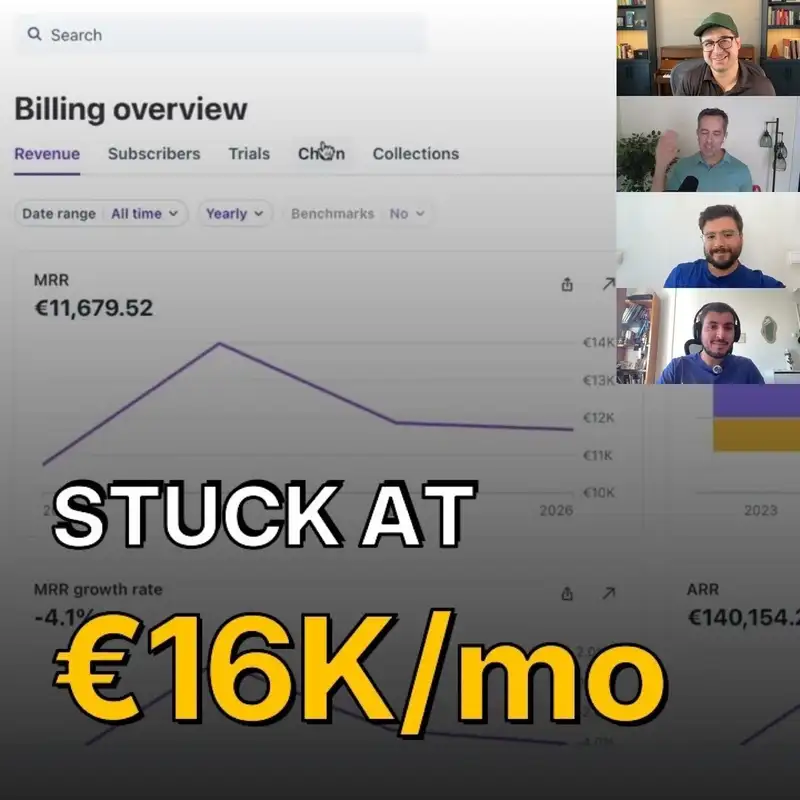
E03 w/ Craig Hewitt: Restarting growth after stuck at €16k/mo
Download MP3Jason Cohen (00:00)
The star of today's episode of Smart Bear Live are two founders of a podcasting content tool who quickly bootstrapped to 16K in MRR in just 18 months with tens of thousands of trial users and turned down an acquisition offer last year. That's a pretty strong move. I like that. But with fifteen to twenty percent churn and only five hundred of those trial users converting to paying customers right now, growth has already plateaued.
Jason Cohen (00:24)
So we're going to use systematic methods to diagnose what's going on and figure out how to restart growth.
Jason Cohen (00:30)
And so who is this we, you might ask?
Jason Cohen (00:33)
Well, me, I'm Jason Cohen. I'm known online as Smart Bear. I've founded and run two unicorns over the past 25 years. That's Smart Bear and WP Engine. I've both bootstrapped and raised hundreds of millions of dollars. I've invested in 60 startups.
Jason Cohen (00:46)
And for 20 years, I've written long-form articles about everything I know.
Jason Cohen (00:49)
And I just finished a book called Hidden Multipliers,
Jason Cohen (00:51)
which is all my best ideas for how to grow with your existing budget and team.
Jason Cohen (00:56)
Now, joining me as the co-host of this episode is someone with deep experience in the podcasting market and has talked to the founders that you'll meet in just a second as well. So he has insider information, and I don't. And I think playing off of that is going to be very interesting. So that's Craig Hewitt
Jason Cohen (01:11)
the founder and CEO
Jason Cohen (01:12)
of Castos, which is software for podcast hosting and analytics.
Jason Cohen (01:16)
And Craig also has his own great podcast called Rogue Startups. So
Jason Cohen (01:20)
Craig knows everything about selling software in the podcast market, having bootstrapped a great company himself. So welcome, Craig.
Craig Hewitt (01:25)
Hey, thanks so much for having me.
Jason Cohen (01:27)
So let's turn to the stars of the show. And this is Tiago Ferreira and Juang Amaru, they'll correct me later, of course, out of Lisbon, Portugal, their bootstrap startup called PodSqueeze.
Jason Cohen (01:39)
So they've tried things like free trials. They've landed Portuguese companies who want to build podcasts, sometimes with AI, sometimes not, sometimes with distribution, sometimes not, sometimes cutting things up into shorts or squeezing all the ums and ahs out of a podcast.
Jason Cohen (01:53)
Which I assume is where the company name comes from. And by the way, maybe that's too many things, and maybe that's part of the problem. But anyways, they've landed some Portuguese companies, haven't really broken out in terms of big customers into other countries. And maybe they've been a little distracted with some side projects, which I also want to talk about. And anyway, the issue is that Podsqueeze has plateaued and they need a way out. And so guys, welcome and thank you for your bravery and generosity, really, coming here today, being willing to expose yourself and your business and your numbers, your challenges.
Jason Cohen (02:20)
So that others can learn how to analyze and solve things like this too. That's very wonderful and we we all thank you for that.
John (02:27)
Of course. Yeah. Happy to do this.
Tiago (02:29)
Thank you very
Tiago (02:29)
much. Yeah, I have to be honest, I'm a bit nervous to expose everything, but you know,
Jason Cohen (02:34)
Yeah.
Tiago (02:34)
it's all in the in the idea of building in public and it's awesome to be here with Craig, which has so much experience and we spoke, as you said, we spoke a lot. so has a lot of experience
Jason Cohen (02:43)
We Yeah.
Tiago (02:44)
in the podcasting world and I love the episode you did with Dmytro so I'm quite excited to dive in.
Jason Cohen (02:49)
Let's dive into things. So maybe you guys can can kick us off by besides correcting the pronunciation of your names, which you should do, filling in a little more detail, what's the situation? We don't need the entire history of the company, just what do we need to know now?
Jason Cohen (03:02)
If you want to throw up some stats and stuff, that's fine. just the things that's gonna help us understand what's going on and what what we should do next.
John (03:09)
Maybe I can do a little introduction. So it all started when GPT came around, in 2023 I I think.
John (03:17)
And we were brainstorming together what would be our next product. and so
John (03:23)
We tried to think about creating something that could benefit from from GPT that just came out. Tiago was podcasting back then and he still does. and so it came the idea of creating something that would transcribe the podcast and write show notes. So we launched that MVP. It was very buggy, but it is the bootstrapped way, so we we launched something very simple.
John (03:47)
And i it got a lot of traction, traction that we have never seen before in other products that we build. and so and and I think word to mouth was a big part of it. but also in those two first weeks we did a lot of different things like cold email. we did a very successful launch in Product Hunt as well. so the product got a lot of traction and that's why it got to
John (04:11)
$14k fairly quickly. then
Craig Hewitt (04:16)
Sorry, can I ask
Craig Hewitt (04:16)
what timeline is that? Like 14K. So from launch to 14K.
John (04:20)
Maybe six months for
Tiago (04:22)
Shall I shall
Tiago (04:23)
I show the graph? Since I have the graph I can show it.
Tiago (04:26)
So here we go, three, two, one, let's make it public.
Craig Hewitt (04:28)
Haha
Tiago (04:29)
Right, so this is in Euros.
Tiago (04:30)
I think this is basically what John is talking about. So this is the growth. that it all happened in the first, you know, few months. And then you can see the rest.
Jason Cohen (04:40)
It's amazing. So it
Jason Cohen (04:40)
was what like six months or even less to get to fourteen K?
Tiago (04:44)
Yeah, yeah, exactly.
Jason Cohen (04:46)
And then how long has it been flat?
John (04:48)
For maybe
John (04:48)
two years almost.
Jason Cohen (04:50)
Yeah.
Tiago (04:52)
So here you can see as well, sorry John So this is in Euros, right? So we were charging in in dollars as well. So this there's like this dip here that came, you know, y you yeah.
Jason Cohen (05:01)
No, th that that stuff's nothing. That that doesn't matter. Here's what's interesting.
Jason Cohen (05:04)
You've done lots of things in this two years to try to change this curve, yes? And yet nothing has changed it at
Tiago (05:08)
Yeah, that's extremely interesting, yes.
Jason Cohen (05:10)
all. I have
John (05:11)
Correct.
Jason Cohen (05:11)
this one little rise. You're talking about noise. So so th
John (05:15)
a little note.
Jason Cohen (05:16)
this is actually already an interesting thing.
Jason Cohen (05:18)
When you tried many different things and it makes no difference at all, that's especially interesting. Like, not even more people coming in,
Tiago (05:24)
Yeah.
Jason Cohen (05:26)
not even fewer people canceling, or something simultaneous, like, a lot of people came in, but they were all bad, So I'm curious.
Jason Cohen (05:34)
Like what are the set of like obviously you added free trials. What are the set of things you did in these two years which we know now made no difference at at a macro level?
John (05:45)
where we start. I just I just wanted to add an another
Tiago (05:46)
Yeah, that's so many things. We really tried, so
Craig Hewitt (05:47)
Hahaha
John (05:51)
note. There w there was a little thing that we did that increased MRR by $2k but it's not showing here in Stripe, which was the B2B. So we we invoice our B2Bs outside of Stripe and we were able
Jason Cohen (06:02)
Okay.
John (06:02)
to around $2k to that MRR. But this
Jason Cohen (06:06)
Okay, good.
Jason Cohen (06:06)
So so let's separate the let's separate that in our minds. You already have it separated in your data, which is probably a good thing. It's bad to combine everything onto one chart because then it's very hard to tell what's going on. It's true that that's the whole company but when you diagnose stuff, it's best to try to segment it out. Because often it's true that like this segment doesn't behave like that one, not just in revenue, but many things, even in the actions you take to
Jason Cohen (06:29)
Talk to them or sell them or r retain them or what features they need. Like often many things are different. So it's useful to segment. So let's keep it segmented, even in the conversation. So I feel like people say B2B when what they mean is sales versus self-serve, which is not what B2B means.
Tiago (06:42)
Yeah, exactly.
John (06:43)
Yeah, yeah, yeah.
Jason Cohen (06:44)
Right. So that's probably what you mean. So okay, this is the self-serve.
Jason Cohen (06:48)
so you say you've done lots of things, so I'm guessing ads and SEO and social stuff and you've had a podcast for years and none of that matters for this, right?
John (06:56)
Yeah, correct.
Tiago (06:56)
Yeah, can
Tiago (06:56)
I can I maybe I'll of course if I'm going to be here and explain everything we've done, we can stay here for hours, but I I can do
Jason Cohen (07:03)
No, no, no.
Tiago (07:03)
a quick recap. so basically when we first started, as John said, it was a very basic product, so show notes and and transcript and so on. And the marketing was I think we took a bit a ride from you know the whole GPT trend.
Tiago (07:20)
So we didn't do any SEO, was we did a lot of cold email, Reddit, you know, product hand launches. And that was, you know, enough to grow to to basically 14k. and then from septem September on, we started seeing less people coming to the website and we started focusing on SEO. And since then, I think we we have made great efforts and we were very successful in bringing a lot of traffic in in in terms of traffic.
Jason Cohen (07:44)
No, you weren't. No.
Tiago (07:48)
Not in terms of MRR. That's that's exactly the the the argument that John and I always have is that we were successful and I can
Craig Hewitt (07:54)
you
Tiago (07:54)
show you the the metrics on the traffic we're having, not you know, converting that into MRR. We launched video clips
Jason Cohen (08:00)
Yeah, that that's the other s that's the other side of writing
Jason Cohen (08:02)
that's the other side of writing a hype wave is you can get a lot of traffic, but since it's hype, it's either ephemeral, they're not serious, or they buy but cancel quickly. You know, one way or another it's not it's not real when it's when it's hype. That's not always true. I mean, I'm sure we all use AI a lot in various ways. So it's not just hype, right? Like clearly it's not just hype, but there is also a lot of hype. There is also a lot of noise when there's hype. That's okay. That just means, all right, well, that's
Jason Cohen (08:28)
That's just what this business will have to process and understand. It's all right. Like it's not a failure or anything. But
Tiago (08:32)
Mm-hmm.
Jason Cohen (08:33)
it just means, like you said, like, we got a lot of traffic from SEO. Mm. That's better than not getting traffic. Right. But clearly, like it's not working. Now, of course, maybe that means
Jason Cohen (08:43)
the website is the problem. Maybe maybe they were they are interested. There is a s a signal there and your your positioning is is not good. It's possible, right?
John (08:51)
Mm.
Tiago (08:52)
Right. to to give you some context, so and I think Craig will definitely have more insights here, it's it's industry with churn which is quite high. You know, there's this innate churn of people that just start after a few episodes and then they quit. and I think the fact that we were able to get this SEO going is the reason why the business didn't die. This is my opinion, because also we saw a lot of our competitors just, you know, eventually dying.
Tiago (09:21)
since then we introduced a few major features, we introduced video clips. Again, you don't see the difference. So I don't know, maybe it's not either we do have people using it. we we introduced a bunch of other things, we improved a lot, that I I I will skip the details here. And then in the
Jason Cohen (09:38)
Right, but but what does that mean? What
Jason Cohen (09:39)
does that mean to you when you th when you realize, okay, we're great at SEO, we've add we've like have all kinds of features, which you do, and it just doesn't seem to matter.
John (09:52)
We actually I mean we we spent so much time looking at analytics and our conversion and our traffic and all that stuff. The reason it's not growing is that SEO also plateaued. So our distribution actually plateaued. We tried
Jason Cohen (10:06)
No, that's
Jason Cohen (10:06)
not why it's not growing. Because if your cancellation were lower, you'd be growing with a plateaued SEO. Because you'd still have X people converting to a paid customer per month. And if cancellation wasn't so bad, you'd be growing.
John (10:20)
No, I mean
Craig Hewitt (10:20)
you
John (10:21)
there are of course in order to grow we need to either increase traffic, conversions, or lower churn. I guess these are the three main factors.
Jason Cohen (10:30)
Right. And you just said you got
Jason Cohen (10:31)
a lot of traffic from SEO. So so so so
John (10:33)
Exactly. So assuming
Jason Cohen (10:34)
the reason you're not growing is not because you need even more traffic than a lot. That that's probably not it. That that's probably something that's going well.
John (10:43)
Yeah, so assuming that conversion and and churn st stays the same, we were not able to increase the the the traffic enough to see any difference in growth.
Jason Cohen (10:52)
No, no,
Jason Cohen (10:53)
no. So the point is if you're already getting a lot of traffic of F off of SEO, then what we would say at a very high level is you're doing well with SEO.
John (11:02)
Yeah.
Jason Cohen (11:02)
So of course, if you're doing well in something, you should lean even further into it and try to do more with it because it's the strength. So that's true. On the other hand, we wouldn't expect like 10x more traffic from SEO, because you're
John (11:15)
Mm-hmm. Yeah.
Jason Cohen (11:16)
already doing well with it and you're already getting a good bulk of traffic.
Jason Cohen (11:20)
So that's probab so while it's
Craig Hewitt (11:20)
So.
Jason Cohen (11:21)
good to to stick with that, that's not what's gonna like dramatically change the company. It's already going well. We have to ask what's not going well. Because let's put it this way, there's more one or more things that are going so badly that despite being good at SEO, it's not working. Despite having enough traffic coming to the website, we're stuck.
John (11:42)
Are you are you talking about conversion and and churn?
Jason Cohen (11:46)
Well, i I mean those sure. Yes. But what I
John (11:49)
Enlighten to into one of those. we
Jason Cohen (11:52)
would say is conversion and churn are both lagging indicators of what I'm actually talking about. Right? So yes, you can measure it
Craig Hewitt (11:58)
So.
Jason Cohen (11:59)
there, but churn means either the pr they weren't that serious, like you say, most podcasters aren't. Most podcasters start and then end. And Craig can probably give us some data about that. And so guys you guys can probably get too. Like everyone here but me can probably do that. So so
Jason Cohen (12:15)
And but some podcasters stay for years. I wonder which one
Craig Hewitt (12:19)
Yeah.
Jason Cohen (12:19)
you want as a customer.
John (12:23)
Well, right now the best
Jason Cohen (12:23)
What do you think? Which which
Jason Cohen (12:25)
kind do you want? Someone who's had a podcast for five years and are and is going to continue having it for five years, or someone who just started a podcast where you guys can tell me what the likelihood is that they'll still be doing that in a year.
Tiago (12:37)
the answer is I think neither. We want agencies that manage multiple podcasts, I believe.
Jason Cohen (12:43)
Okay.
Tiago (12:44)
Those are the clients that have been more sticky, that manage forty, fifty podcasts, because
Jason Cohen (12:49)
Mm-hmm.
Tiago (12:50)
the likelihood of them stop using PodSQIS is quite low.
Jason Cohen (12:53)
Okay, I love that. Just to put a number on it 'cause it's in because we have the experts here, what is the answer to I know there's a lot of new podcasts created per month, but I'm curious, like how many is created per month or a year, how many last a year or six months or however you guys and maybe Craig, maybe you have this, but like what what what
Craig Hewitt (13:09)
Yeah, I don't.
Jason Cohen (13:10)
what are those like what roughly what's that look like?
Craig Hewitt (13:14)
I, I don't know the number. I, know that like, as an industry, the number that, that kind of like net number is pretty flat. I think like number of new podcasts versus people who kind of stopped like the industry as a whole is not growing at like on the, on a net basis. Jason's like, had a tweet about this. I just want to offer to, I think Tiago just said the most interesting thing of the whole conversation, but I just want to like add my take on, on like the growth conundrum for the.
Craig Hewitt (13:43)
kind of PLG motion, in like two, things. One is, I don't think the problem of the PLG motion is like customer acquisition. think it's churn. because like our churn is like 1%. And so I think that, like, I think the, the, the nexus of a lot of growth problems is just the business model.
Craig Hewitt (14:10)
Like your business model is contingent on people continuing to publish content for them to get value from your product. Ours isn't right. Like Jason, if he hosted with Castos, which he doesn't, which is super unfortunate, that's okay. If he stopped this show tomorrow, he would still pay $19 a month to keep his show alive. Otherwise it would go away. That's not true with you guys. Like if someone stops publishing their content, the value of your solution goes to zero.
Craig Hewitt (14:35)
So there's like a fundamental thing that like, you
Jason Cohen (14:37)
Mm.
Craig Hewitt (14:37)
can engineer things to solve. So like, that's part of it. think the other just comments on SEO. It's super hard, but more nuanced is like, you probably are getting a bunch of traffic. That isn't qualified traffic, right? So like top of funnel, the bottom of a high buyer intent or not. I would suppose that like, if you, if you said like SEO is the place you want to go, focusing on the right kind of traffic is like the better question.
Craig Hewitt (15:04)
rather than like, we doing good or not? but I think like focusing on agencies solves the value of the product and churn issue altogether, because as long as they have clients, they're getting value from your product and they're not going to leave. Cause it's also like a core, like a business solution for them.
Jason Cohen (15:25)
Yeah, especially if they incorporate it into the into the pitch that they give to their clients. Like if it's part of what their clients are now paying for, they can't stop without changing the contract with their client.
Jason Cohen (15:40)
this is
John (15:41)
I I
Jason Cohen (15:42)
interesting that that this is so steady. I'm I'm actually shocked at this. Like I'm not shocked that it's high, because I agree with Craig. That's that's the that is the problem. Maybe, maybe you could convert more from the homepage because the homepage is confusing to me because it's like many different products all at once. And so I'm confused by the homepage. But so I I do think probably there's a thing in conversions to be to be to be looked at. We're not gonna do all this on the call, but I I would say that's an area to look at. but
Jason Cohen (16:10)
Especially if you have a lot of traffic, then that means A-B tests actually work. So many people, A B tests don't work because there's not enough N. But if you're getting a lot of traffic, they they do work. So that that is something we could talk about, but it's probably more tactical. Strategically, like I don't I am shocked how steady this is at around at your cancellation rate at around 10% per month. Why is it so steady?
Tiago (16:29)
It just
Tiago (16:30)
it just increased recently because we introduced the the free trials, by the way.
Jason Cohen (16:35)
okay, but why is it
Jason Cohen (16:36)
so steady for two years? That that's amazing. Is it is it because like it's annual plan and they just don't then nobody renews and so it's always one year and so one year was roughly ten percent per month? Like what is this?
Tiago (16:48)
I think is very connected with churn that there is in the industry. So the cult we call this in the industry pot fade. So th this is more or less the the percentage of people that start a show and and it's true Craig, you know, your your churn is much lower because it's it's
Tiago (17:10)
It's a hosting, right? So people even if they stop their show, they still want to show it to their friends. so they they want to keep it. for us, people can even though they can start before, right? So they will start, okay, they start the show, maybe they will go even for a free hosting provider, but then they wanna use us, but as well then they stop, then they stop using us. I think it's it's probably connected to that, I would say.
Jason Cohen (17:39)
So ten percent per month is something like everyone's gone in a year. I say everyone. I'm I'm being, you know, obviously rough about that.
Tiago (17:48)
Exactly.
Jason Cohen (17:49)
So so i is this just another way of seeing the industry d I think you're saying this is another way of seeing the industry data, which is nearly everyone who starts a podcast stops doing it within a year and you're looking at that right here.
Tiago (18:03)
wh what do you think, Greg? I think so, yeah. But
Craig Hewitt (18:08)
yeah, I think, I think probably, I think on the whole, I think maybe the one caveat I might give to that is, these are Tiago and Joanne, I don't know, are these new podcasters or existing podcasters who are already, or already have a show on Lipsyn or Castos or Transistor or whatever coming over to use your solution. I think that might be one thing is like for us, a customer who comes to Castos from another provider worth way more.
Craig Hewitt (18:36)
than someone just starting a new show. So that might be like a cohort analysis you might want to do. But yeah, I don't even think it's a year. I think probably the average life cycle of a customer is like four months probably, of like actually publishing content. I think
Jason Cohen (18:54)
Uh-huh.
Craig Hewitt (18:57)
it's like, whatever, there's a stat. Like most shows don't get to 10 episodes.
Jason Cohen (19:01)
Right, right.
Tiago (19:03)
Yeah. Mm-hmm. We can dive into the reasons why people are churning if you want. I have a board that logs this. If there's something that is relevant, I don't know.
Jason Cohen (19:12)
Well, it's not just that the show ended.
Tiago (19:17)
mostly yeah. But I I
Jason Cohen (19:18)
Right.
Tiago (19:19)
I think it could be interesting to to see that. I don't know if you if you wanna see it or not, but
Jason Cohen (19:22)
Well, let's just go to the
Jason Cohen (19:24)
next most biggest one because because see see again, like staying at the high level, you want to dramatically change the curve, not move from from 14K to sixteen K, sixteen K to seventeen K. That's not the goal, right?
Tiago (19:35)
Right.
Jason Cohen (19:36)
So going to like w well, you know, fifteen percent of the people say this, and maybe we could save a third of them if we did that. See how that's not gonna do anything? Cause now we're down to five percent. Okay, we can move
Tiago (19:46)
Exactly.
Jason Cohen (19:47)
your revenue curve five percent. It's okay. Like it's it's probably a good idea, like all things being equal.
Jason Cohen (19:52)
But that that's not gonna solve the problem. So let okay, so what's the next b we can still look at it, I agree that that still might be interesting. So what's the next one or two biggest things that aren't the show ending, which is clearly the issue that you need to reform your your company around, like Craig was saying.
Tiago (20:10)
So I will share I'll share the the board, let's see, I have a lot of data here, here you can see per week. Recently we started having
Jason Cohen (20:20)
Well just what's the biggest thing that's not
Jason Cohen (20:22)
show ending? What's the next biggest thing? Or two. too expensive. Yay.
Tiago (20:25)
In the in the last weeks it seems to be too expensive.
Jason Cohen (20:28)
No, I love it, it's too expensive because this is my hobby horse. You know already do you know what I'm gonna say already? Cause I say it so often.
Tiago (20:36)
probably that w we are targeting the wrong clients or something. I don't know.
Jason Cohen (20:40)
So
Jason Cohen (20:40)
here's why I think it's so funny. It's so common that the biggest reason, other than okay, project ended, right? The biggest reason often is it's too expensive. We see that to a WP engine, and lots of other people
Tiago (20:51)
Mm-hmm.
Jason Cohen (20:52)
see it. I've seen other people's data, and many, many people, this is either number one or close. But here's why it's never the reason. Because what did the customer do already? They came to your website, they looked around your homepage, they looked at your pricing page, they looked at competitors maybe.
Jason Cohen (21:09)
And they decided, yes, I'll buy this for this price. Which means they decided it was not too expensive. They already decided it was not too expensive because they signed up.
Tiago (21:20)
Yeah.
John (21:20)
Yeah.
Jason Cohen (21:20)
And
Jason Cohen (21:21)
then they were here for four months or six months or a year or a month. And then they quit. Now they didn't quit because it was too expensive. We all we already know that. Now, there's something else which they're saying too expensive, and there's lots of reasons why they would say that. So, for example, they may have thought.
Jason Cohen (21:39)
The product will do X and Y and Z for me. But it turns out it doesn't, or it doesn't with their other systems, or they don't understand it, or you know, right? There's all this like misunderstanding or expectations that were missed. So since the product does less than they thought, it's now too expensive for what it does for them or the value it's generating for them. And so they say too expensive, but it's not too expensive in the sense that you should change your prices or packaging. Because when you hear too expensive, you think, well, we'll make it cheaper.
Jason Cohen (22:08)
But that doesn't solve what I just said, which is they expected the product to do X and it didn't. Now, maybe they were wrong to expect
Tiago (22:14)
Right.
Jason Cohen (22:15)
that and you targeted the wrong segment. Maybe they were correct to expect it because you said so on the homepage and you're the one who didn't fulfill it. Like there's so many things that could go that could be true here, right? So there's still lots of reasons it could be. But what it isn't is too expensive. That's like the one thing it's not true because they already bought it.
Tiago (22:30)
Yeah, I agree.
Tiago (22:31)
But let me let me just say something, Jason, by the way. the the the this reason that too expensive is quite new and it's started since we started the free trials. So I I was actually surprised because it's been a while since I watched this. the free trials, by the way, the way it works is we offer we offer few plans. we give a free trial in the more expensive plan. So we give the starter plan for very cheap.
Tiago (22:59)
and they have to acquire to use it. And then if they wanna start with the pro, they have a free trial. Okay. So and I and I can see started growing, the two experience started growing since we implemented that.
Jason Cohen (23:10)
Well, you obviously
Jason Cohen (23:11)
have to segment this cancellations by that.
Tiago (23:13)
yes. And I do have that as well. If you if you want to see it.
Jason Cohen (23:14)
Yeah. Yeah. So what's just let's
Craig Hewitt (23:17)
I
Craig Hewitt (23:17)
think of this is too expensive question is I'm just going to use Claude, which I think is how some people are, are they're saying it's too expensive because I have
Tiago (23:29)
Mm-hmm.
Craig Hewitt (23:29)
basically a free solution, that I'm already paying for somewhere
Tiago (23:31)
Go to a competitor.
Craig Hewitt (23:32)
else.
Jason Cohen (23:33)
Claude can make shorts.
Craig Hewitt (23:34)
yeah, you could, you could use, like hyper frames with Claude and, and do it, but you sure enough can do show notes and transcripts and
Jason Cohen (23:40)
I mean w what but wouldn't their customers
Craig Hewitt (23:42)
stuff.
Jason Cohen (23:42)
I mean ar aren't they immediately lost from what you just said?
Craig Hewitt (23:47)
Yeah, this is, don't know. mean, I think over
Tiago (23:48)
Yeah, I think so, yeah.
Craig Hewitt (23:50)
time, like this is becoming easier to adopt for people.
Jason Cohen (23:53)
Yeah, yeah, yeah. But but we're talking about what's
Jason Cohen (23:54)
happening now. Like I don't I I don't believe that their customers are using hyperframes and Claude to make shorts instead of using pod squeeze and thing, right? Like you are right.
Craig Hewitt (24:01)
Okay, fair, yeah.
Jason Cohen (24:06)
I I've even tried doing I'm trying to do stuff like that, and it's really hard. I'm not an idiot
Craig Hewitt (24:11)
It is. Yeah.
Jason Cohen (24:12)
about it. I'm not an expert, but I'm not an idiot either. Like it's too hard.
Jason Cohen (24:15)
So what is the reason in your mind?
Jason Cohen (24:18)
That's obviously not it's too expensive. What is the reason for the churn that's not that that's the real reason besides the show ending, since we know that's the main reason.
Tiago (24:28)
What do you John?
John (24:32)
mm the main reason I guess is targeting the wrong people. So we have a lot of people coming to the website that just want to transcribe one file and then disappear.
John (24:45)
So mixed with the pod fade thing, the not using enough, we have actually segmented the kinds of people that are choosing that option when they churn, not using enough. And many of them we we actually went and see the episodes they uploaded and many of them were just like webinars and like voice recordings and stuff like that that and they were not e exactly podcasters. So the the the next reason after is too expensive and the pod fade is
John (25:15)
switch to an alternative product and and quality issues but these are like a small percentage of the churn.
John (25:25)
And in these past two years, we have heard the feedback from the customers. Actually, we have implemented you said that the home page is quite confused because confusing because it has a lot of different features, but all of these features were implemented after hearing the customers. So we had a lot of people asking for clips when we were offering the show notes. So we we implemented the clips. And then all the other little features were things that we that made sense to us to implement in the flow that the users were already using.
John (25:54)
and so we could not exactly pinpoint or could not find a a relevant pattern among the quality issues reason. in this past year we
Jason Cohen (26:03)
Yeah. Okay. So so so this just concludes
Jason Cohen (26:06)
to the same thing as we said earlier. These little details are not the th not the main thing. The main
John (26:12)
Yeah, yeah, yeah. I would say so, yeah.
Tiago (26:12)
Yeah.
Jason Cohen (26:13)
thing is you are mostly getting people that either aren't serious users of this, in other words, they're they're wanting to like use a free trial or or use a a one-month plan, quote unquote, to do something real quick, which is not a real user that that you want.
John (26:29)
Yeah.
Jason Cohen (26:30)
So that's right, or
Jason Cohen (26:32)
they are sincere in making a podcast, but we know that almost all of them will fail at that, despite being sincere. That's all but so so while while the sincerity is appreciated, that's also not something you can build a business off of.
Jason Cohen (26:46)
And those two things account for almost the entire business model.
John (26:50)
I must say one one thing that I think is very important and something we we found out in the next two years, which was the the B to B sales that added two K to our MRR.
John (27:01)
So here in Portugal we actually got the main media companies here in Portugal to be our clients. and we are we are charging them around four or five hundred K. So this is the most we could charge to these kinds of clients. But doing this actually changed our MRR a little bit and actually most of these clients, actually all of them
John (27:23)
are are staying with us for more than one mu one year. so none of them churned. We tried to replicate this in other countries. We actually went to conferences in in other countries. We spoke to the media media agencies and the grip the big media groups in other countries, but we could not reproduce what we were
Jason Cohen (27:41)
No.
Jason Cohen (27:42)
And and do you know why you can't reproduce it?
John (27:44)
Why?
Jason Cohen (27:46)
Because the reason the Portuguese companies picked you is you're Portuguese. It's not because your product
John (27:50)
Yeah, yeah, yeah. Yeah, we could figure that out.
Jason Cohen (27:52)
is head is it's 10 times better than the competition. I'm not saying your product's
John (27:55)
Mm-hmm. Yeah.
Jason Cohen (27:56)
bad, and maybe it is better than the competition. I don't know. But I know it's not like overwhelmingly super better than the competition because there's lots of good products like this, right? I mean, I
John (28:05)
Sure, yeah.
Jason Cohen (28:06)
mean, I think that's probably true of everybody on this call. Castos is a great tool. There's other great tools. WP Engine's great. There's other good ones. Like, you know, like let's be honest.
Jason Cohen (28:16)
Yeah, we have we all have our reasons why, but we're better at this, we're better at that, and and and and for this segment we're better, and we're right about that too. But it's not like it it's a shutout. It's not like linear and Jira, where it's just like, holy moly, shutout time. You know, there's not like 10 tools like linear, right? But there are 10 tools like Jira. So none of us on this call are in that position. That's okay. We all are running successful businesses. We don't have to. But my point is just okay, that's not what you have right now. Maybe you could build that, but at the moment it's not it.
Jason Cohen (28:45)
So there's no reason for anyone else to pick you. The the reason the people in Portugal picked in p i i it picked you is you spoke Portuguese to them and you're native and
John (28:52)
Yeah.
Jason Cohen (28:52)
everything, which is a good reason. In fact, it makes me think there's gotta be more to do in Portugal.
John (28:58)
But I must I must say something. We we actually hired someone from Latin America to speak Spanish with their the media groups there.
Jason Cohen (29:06)
It's not just that you're
Jason Cohen (29:07)
speaking Spanish. It you you're the founders of the company. I if I'm
John (29:10)
Yeah, yeah.
Jason Cohen (29:11)
in Portugal, I want to support a Portuguese company for sure. Right? Not just the language.
John (29:13)
Yeah, yeah, yeah. I can see I can see that, yeah.
Tiago (29:15)
So what what are you telling
Tiago (29:16)
us is that we should have be born American or or or in a bigger
Jason Cohen (29:20)
Well, no, no, no, no.
Tiago (29:22)
market?
Jason Cohen (29:22)
No, no, no, no. I think you have vastly underestimated how much there is to do in Portugal, number one. And
Tiago (29:30)
Okay.
Jason Cohen (29:30)
number two, there's just gonna be a different move you're gonna have to make outside of Portugal. There's just gonna be a different move. It's not gonna just be the same thing because you don't have this natural advantage elsewhere. But I I I don't believe you that that 2K per month is the only MRR possible in Portugal.
Craig Hewitt (29:49)
What are those companies like the, the I'll call them enterprise companies
John (29:52)
These companies are like the main
Craig Hewitt (29:54)
you've sold to.
John (29:56)
these companies are like the major media companies in Portugal that everyone knows about and and hone the main TV channels and all that. The reason we can we cannot charge more to these companies is because they pay per podcast, right? They pay per minutes consumed. And these media companies have like the the cap is like fifty podcasts.
John (30:16)
So the maximum we could charge is is around f maybe five hundred, five hundred, three hundred per month. and there there are not many major media groups here in Portugal. We could maybe count seven, eight, and maybe six of those are already our clients. So yeah.
Jason Cohen (30:41)
Right, but that's not the end of who does podcasts, including agencies in Portugal.
John (30:45)
Yeah, it's it's it's the end.
John (30:47)
In Portugal it's it's pretty much the end.
Jason Cohen (30:50)
No, it's not the end. You y you mean if I go to Google right now and look for people that will help me produce a podcast in Portugal who live in Portugal, I can't find anybody? That's what you're saying?
John (30:58)
Yeah. Well
Tiago (30:59)
I think
John (30:59)
it
Tiago (30:59)
you
Tiago (30:59)
y you can't find anybody that we haven't talked to already. Probably. Because we have
Jason Cohen (31:04)
Really?
Tiago (31:04)
done all of this work.
John (31:05)
Or you couldn't find anyone
John (31:06)
that that that is producing more than five podcasts or something like that.
Tiago (31:09)
We have
Tiago (31:10)
been cold calling people. we closed a few deals with smaller agencies. It's just a very small market, ten million people, you know, it's like it's quite small. Mm-hmm.
Jason Cohen (31:19)
No, that's not the market. That's how many
Jason Cohen (31:20)
people live in Portugal.
Tiago (31:23)
Yeah. I mean those are the the people that consume what these agencies are producing.
Jason Cohen (31:26)
No, no, no. No. People who produ
Jason Cohen (31:28)
who happen to live in Portugal and are agencies can produce podcasts around the world.
Tiago (31:35)
I mean mostly they don't, but they mostly produce for for the market, yeah.
Craig Hewitt (31:39)
What about, what about like,
Craig Hewitt (31:41)
what about like, so, so you've sold to the public media brand in Portugal. What about,
John (31:48)
Yeah yeah.
Tiago (31:49)
Mm-hmm.
Craig Hewitt (31:49)
I think what Jason's saying is like the kind of adjacent thing, like podcasting agencies who happen to be in Portugal or, big news brands who happen to have a production arm in Portugal or, like a big YouTuber who happens to live in Portugal. Like I know like one of our customers,
Craig Hewitt (32:09)
Bob, Bob W Bob W Bob Dunn, right? Like lives in Portugal. He's a pretty big media brand in the WordPress space. Like, but he's American. There's, there's gotta be a lot of those types of folks that are not all these
John (32:24)
The pro yeah.
Craig Hewitt (32:25)
like NPR, you know, version from America, but, like are pretty big creators and maybe it's not 500 bucks a month, but it's a hundred bucks a
John (32:36)
The problem is again, we we don't need someone that has a big profile or has a lot of views. We need people that produce a lot of podcasts. That's where the money comes from.
Tiago (32:44)
Yeah. So so one
Tiago (32:46)
one issue that we had, by the way, was doing this transition from being a B2 Small B self service SAS to a more, you know, sales oriented SAS because we would go to them and this is a learning process and by the way, this is why I love this conversation. We are just learning here, right? we would go to them and of course we cannot
Tiago (33:06)
if they are this big let's say Joe Rogan, right? Like huge, a lot of money, but he only has one podcast. How can I go to him and say, Okay, I will charge you a thousand bucks per month? And then he goes and checks my starter price. He's like, but your starter price is nine bucks. Like why do I need it? So this was one big issue that I maybe you can give me great good insights here because it was very hard for us to figure this out. How to like actually have both, you know, the self service and and the sales oriented.
Tiago (33:35)
Yeah, I'll I guess I'll leave that question in the air, so
Craig Hewitt (33:38)
I'd love to hear, I'd love to hear Jason's approach this, for, my own, for my own like wellbeing. But I'll, I think I'll just say is you are not an enterprise buyer. So you don't know how they think I've been on enough enterprise calls to know that just the way they want to buy software, it would make me vomit. But, but that's how they want to buy enterprise software. And so I think you have to not think like a bootstrap or trying to sell to enterprise, but think like an enterprise customer.
Craig Hewitt (34:08)
who's buying
Tiago (34:09)
Mm-hmm.
Craig Hewitt (34:09)
a solution because I think you have a pretty severe like limiting belief that like, my solution is not worth a thousand dollars to Joe Rogan is a hundred percent it is. But I'd love to hear how Jason thinks about like us as bootstrappers selling to enterprise and like value difference between like self-serve and like sales driven.
Jason Cohen (34:34)
Yeah, there's a couple of things here. One is Joe Rogan's not enterprise. Microsoft is enterprise. And and perhaps the the the major media brands might be enterprise in in in in Portugal. enterprise refers to the company and how they buy and think. I guarantee you Joe Rogan does not think in any way like those media buyers think. So that's the first thing is like you gotta separate the what what is the company.
Jason Cohen (35:01)
What is the way that they think about software, buy software, just like Craig was saying?
Jason Cohen (35:07)
So
Jason Cohen (35:11)
The issue with pricing for everybody is very real, which is why generally you don't do it. It's not true that companies generally sell nine dollars a month thing and also sell million, you know, multi million dollar packages to enterprises. In fact, name me one.
Jason Cohen (35:30)
Maybe a company that does that.
Tiago (35:31)
I mean
Jason Cohen (35:32)
I can. Try it.
Craig Hewitt (35:33)
Slack.
Tiago (35:33)
I can't. Re Riverside.
Jason Cohen (35:36)
Slack, Riverside does not sell
Tiago (35:38)
Reverse.
Jason Cohen (35:38)
multi million dollar packages to enterprises.
Tiago (35:42)
Multi million? Okay, multi million it's a bit too much. But they but they do sell a lot to enterprise, I'd say.
Jason Cohen (35:44)
Yes, multi-million a year. Slack is one. Yeah,
Jason Cohen (35:48)
but not multi don't they don't charge eight, five million dollars a year, right? But Slack does. So Slack works because
Tiago (35:54)
Mm-hmm.
Jason Cohen (35:55)
Slack has both features that they special features that they need and will pay up for, like auditing and all kinds of weird legal stuff and control over things. And bigger, you know, there's a there's an issue of seats. It makes sense for Slack to to charge by the seat. It makes sense for 30,000 seats to charge to cost a lot more than five seats.
Jason Cohen (36:14)
Right. So there's two dimensions by which Slack can charge more to enterprise and make sense. So it for Slack, it makes sense. Another example would be cloud compute, right? A startup might pay zero because of a of a of a special offer. But let's let's even ignore the special offers. They may pay a dollar a month because they use so little, but a big enterprise might spend a hundred million dollars a year on Amazon because they use a lot. Because again, usage in that case, not monthly, but usage now makes a whole lot of sense because it does cost a lot to use it. Like that's just true, right?
Jason Cohen (36:44)
So I can come up with re with companies where it they can charge $5 a month to some people and 100 million to others. There has to be a really good reason like that. usage and maybe also like the features on top of that, like Slack has both. so then you so you roll back to you and you're like, so do you have that? And the answer may be yes or no, or maybe we should construct that. But when you can construct that, and just saying it's custom doesn't construct that.
Jason Cohen (37:14)
There has to be some specific reasons. So for example, with hosting, there's all the security and governance stuff. People often say security when they mean well, they they don't know what they mean. They just say security because they don't know. But it's it's it's it's security, but it's also what's called governance, which is things like being compliant with something like a 409A or or I mean it's not that. Sorry, being compliant with something like like SOC two or an ISO standard or HIPAA in the US for health and so forth.
Jason Cohen (37:43)
Or sometimes just financial compliances. That's not security. That's governance, meaning you've defined certain processes and you've addressed certain risks and that's all documented, which is not the same as security, interestingly. So an enterprise who looks at hosting cares about that because they have internal policies requiring them to care about it, so that their own governance is satisfied because other vendors plug into it.
Jason Cohen (38:11)
And you know, Joe Rogan doesn't care about any of that, which is again why the size of the deal or how much the money they make or whatever it is is not not the same thing as what kind of company it is and how they buy. So all those kind of things probably don't make sense in your case. They're probably just not relevant. Maybe they are, maybe they are, but but probably they're not. And so an interesting question is what does it mean to have usage or what does it mean to have features? Because those are the two dimensions that often make sense in a pricing grid. I think of it, you know, like usage on one axis.
Jason Cohen (38:41)
features on another. In your case, you might say, look, it's not that complicated. We're just gonna have one axis where it comes together. Bigger plants have both more usage allowed and more features. And that's that's fine. You know, Slack kind of can afford, you might say, to have two axes. Zendesk is another example where you buy more seats andor you buy more features separately. So these companies, it it makes sense. it's very natural why there would be both. In your case, it may or may not be natural.
Jason Cohen (39:09)
And you don't have to do any of this, but it's an answer to this question of wait a minute, how do I have radically different prices? It has to be tied to something that the customer values and requires, which can again be features or usage where ideally both, that's that's the best scenario, but not not required.
Tiago (39:26)
So we we thought a lot about that. A lot. and the only thing we came up with was per podcast. So we would go to them and say, okay, for every new podcast, you get seats can also be a possibility, by the way, because normally they have a lot of people working there, but it
Jason Cohen (39:48)
Mm-hmm.
Tiago (39:48)
we would think for podcasts. we end ended up not implementing that. What we implemented was
Tiago (39:56)
basically giving unlimited minutes. But that again, this is goes to to the minutes and we say okay for unli you get unlimited minutes and plus support. We try to come you pri you can see there priority support, feature requests, try to sell this and and package this into an enterprise deal.
Jason Cohen (40:11)
Yeah, that's that's not that's not what they want though.
Jason Cohen (40:13)
You're not listening you you are not really listening to what they need. There's no enterprise that says, I'm gonna buy that one because it has feature requests. That's just not what they say. That's not what they say, say.
Tiago (40:22)
Yeah. I mean but they need they need the pro, the agency, right?
Jason Cohen (40:26)
I'm just saying, I'm looking, you're you have your enterprise pricing up and it's like, you get now priority support, yes, you you need to define that somewhere, but yes, that is the kind of thing that larger companies will pay for. So I like that. But feature requests, I don't know what that means. Does that mean you implement anything I want?
Jason Cohen (40:41)
No. So it just means I can ask. Anyone can ask. Like it just doesn't mean anything. You're just making stuff up that's not what the customer is saying. And so that's why that so
Tiago (40:45)
It it's just something to put there, yeah. That's true, yeah.
Jason Cohen (40:49)
that doesn't make any sense. so
Tiago (40:51)
That's true.
Jason Cohen (40:52)
so so here's here's something interesting. It's very important. So, and I think Craig was getting at this too. It's in you you, of course, were thinking things like, what are my costs? Because obviously pricing has to cover and more and then some the costs. And you're also thinking, how hard is this for me to do or or
Jason Cohen (41:11)
how much work was it to for us to do. now the customer doesn't care how much work it costs you. It they care about how much value it is for them. What's their alternative for do it how would they do this if it wasn't for you? That's what they're thinking. They don't know how much effort it c it took you. They don't care. Cost is kind of in in between because if it costs you more, they kind of understand that. Like another podcast, more AI, more everything, it just sort of stands to reason that would cost more.
Jason Cohen (41:41)
Without spreadsheets and numbers, it just stands to reason. Same with hosting. you know, this site has as ten a hundred times the traffic of this other site. Okay, it should cost more. Maybe not a hundred times more, but maybe a hundred times more. But anyway, it should cost more. Like that's just re is just reasonable. I just expect that somehow. It just makes sense, right? So cost is there. That's okay. It sort of justifies it. But that's but the main thing is what is their alternative and how much value are they really getting out of it? So
Jason Cohen (42:10)
If all they do is transcribe it and it just sort of goes on a page and nothing really happens after that, they've just ticked a box that said has transcription, that's almost no value. So they may be willing to pay a little bit for that, but not much. And if there's another alternative that comes along, whether it's Cloud Code or a competitor, fine, because who cares? I'm just ticking a box that says we have a transcription. I just don't care. Now, on the other hand, if having great transcriptions means their SEO is so dramatically improved.
Jason Cohen (42:38)
that they actually increase traffic to the websites or increase v listens or something like this. And they can see that. Now it has a lot of value.
Jason Cohen (42:50)
Well, it probably doesn't have that much value. I'm just trying to say, like, like if that's true, then it has a lot of value. If not, then it's just a bullet point and it's not a reason to buy, it's not interesting. You're never gonna win against competitors because nobody really cares. They're just ticking a box. Same with shorts. You cut up in shorts. We all know there's a hundred products, maybe a thousand, where you feed in a podcast and it cuts up into shorts. We know that. So is it just to do it? Is it to drive traffic? Does yours do it better?
Jason Cohen (43:16)
And if the answer is like, I don't know, it just cuts it up in shorts, like, okay, well then it doesn't have a lot of value because you're saying it doesn't.
John (43:23)
Can I ask you a question, Jason? how do you how do you figure out what kind of feature ticks that that criteria? because we are
Jason Cohen (43:33)
Yeah. What we did is we called a whole bunch of customers.
Jason Cohen (43:38)
and we did some surveys too. With pricing, we did a variety of things. With pricing, we did some surveys and some calls. Calls are always better, but of course they're so much harder and take more time. So okay. And you can look online, and there's good books actually also about like how do you structure a pricing call in particular, right? There's a whole lot of like best practice around there. So we don't need to get into that here just because like that's findable. But what you're what you're really looking for is
Jason Cohen (44:02)
What is it that they feel is a good unit to buy? So in your case, is the unit a podcast? And they're like, is it easy when you say, like, if you were to add another podcast, if that was an extra five dollars a month, how does that feel? And that may or may not be the right exact question. Again, I don't want to get into the the details of that because that's that there's other experts for that. And if that's easy, they're like, Yeah, of course. If I add podcasts, I expect to pay more. And then now we're only arguing about how much, right? Then there you go.
Jason Cohen (44:31)
But minutes might be something and again, I don't know if this is true. You'd have to find this out. And in fact, maybe, maybe Craig knows. But with minutes, I could imagine something like this where let's say you wanted to charge by how many minutes processed or something like this, right? Where someone could go, my God, like I'm gonna have to start counting the minutes. I don't know how to budget for that. Like I don't know what my bill will be next month because I don't know how many minutes I I'm gonna like, my God, you're just putting all this on me. Like, I don't understand. Just I have a podcast. Now you know minutes is somehow correlated with cost.
Jason Cohen (45:01)
So you'd like to put minutes on there to cover your costs. And you're not totally wrong about that. But the way you should be thinking about that is whatever your costs are, plus of course profit and blah, blah, blah, that's the minimum you can charge. You should just think of it as the minimum. Because if you go below that, you're just not profitable or whatever, right? So it sets a minimum internal bar in your mind, but that's not how the customer thinks about it. So it's just for you. For the customer, it's like, how do they think and how do they want to?
Jason Cohen (45:31)
Be how do they want to be charged? Cause of course they're willing to pay for value. The ones that aren't aren't good customers anyway. So of the ones who are, right? And so if in their mind it's like, yeah, like I have a podcast, I'll pay for a podcast, then in your mind you go, okay, well, I I know what the media end podcast is, or even like the ninetieth percentile podcast is in terms of minutes. Because we all know some have a lot of episodes, some don't, some are long, short. I know they're not all gonna be the same profit. It's okay.
Jason Cohen (46:00)
But like in general, the 90th percentile podcast costs you X, Y, Z, blah, blah, blah. And so if you charged whatever per podcast, you're gonna be fine basically all the time. Right. And then you could say something like unlimited minutes, which is awesome. Or you could put a super high limit. But again, if the limit's gonna be very high and the customer doesn't value it, unlimited is a very strong thing to say. Cause you will have you will have again in my hypothetical, you will have figured out the customer doesn't want to think about minutes.
Jason Cohen (46:28)
Ooh, if they don't want to think about minutes, then give them that by saying unlimited minutes. And then if they're like, even begrudgingly, like, yeah, of course, if I launch another podcast, like, of course I expect the bill to go up. Yeah, okay, well, there you go. That's where you, that's where you do it because they agreed that's a natural thing that they they would expect. And that anyway they think it's fair. So I'm just guessing that that may be kind of what they're thinking. I don't know that. but this is actually one of the things that I think is horrible about.
Jason Cohen (46:56)
Cloud compute is that it's all about usage, right? It's all tied to their costs. And everyone hates it, right? It's the only reason they don't go somewhere else is because everyone else does it the same way. But like that's one of the nice things about DigitalOcean, is they're just like, hey man, here's a VPS, it's 10 bucks a month. The limits are pretty good. Let's move on. And it's like, yeah, that's so nice, right? That's like a big advantage of DigitalOcean. And there's whole companies whose
Jason Cohen (47:20)
Product is to help you understand your costs in the cloud because it's so freaking complicated. So that's like the worst case scenario, right? Now I know you're not doing that. I'm just I'm just bringing that up as an example of the worst way to price that they do, right? So anyway, anyway, so so so yeah, you're gonna you would sense out with your customers what do they feel is kind of fair or expected in terms of what things, whether that's features or usage like podcasts, or and seats is a good example. My intuition is don't charge by seat because.
Jason Cohen (47:50)
The more people that use your software, the more you'll have things like word of mouth and just more usage in general. Including when people leave company A and go to company B, they take with them the knowledge of your product. And that is also word of mouth in a funny way. So the more people that use it, the more you can grow. Anytime I think of a feature where the more people use it, the more you'll grow. I don't want to gate that. I don't want to limit that. I don't want to charge for that because that's helping you.
Tiago (48:19)
Mm-hmm.
Jason Cohen (48:19)
That's like
Jason Cohen (48:19)
market share or mind share, whatever you want call that, right? So anytime it's like, wait a minute, that's helping you. Don't gate it. Don't charge too much that not as many people know about this. That's that's bad. But more podcasts, okay, that's probably just normal course of business, as you say, for an agency or maybe a bigger something or other. So that's where that's where it makes sense. So I'm obviously everything I said, that each of these things in detail might be incorrect in your specific case, but that's the mentality, that's the model I'm going through of like, what do I want
Tiago (48:46)
Right. Mm-hmm.
Jason Cohen (48:47)
to charge for and what do I not?
Jason Cohen (48:48)
Same thing with your, I know I'm just going on and on, but but just so I don't forget. Same thing in trial period. Anything in the trial period that they really value, you should charge for that. But anything in the trial period which helps you sp with the word of mouth and stuff I just said, you should not charge for that. So
Tiago (49:05)
Yeah. Mm-hmm.
Jason Cohen (49:06)
that you have more people what it doing whatever that is, right? In fact, you might even allow people to continue using a trial if they're referring people successfully, because that's another way for you to grow.
Jason Cohen (49:18)
That allows them to offset their, you know, the how much you're charging them because they're giving you value in a different way, which is not just spreading the word, but but doing so in a way that's that's resulting in people buying. Now, that probably wouldn't work. I don't know that that's the first thing I would do. I'm just giving an example of what I mean by even in the trial period, give away the stuff that adds value or to grow to you or growth in the company. yeah.
Tiago (49:40)
Mm-hmm. And and and
Tiago (49:43)
yeah, one one thing that is interesting here from our experience with B2B. When we first started, again, port port for the Portuguese people listening, I don't know if there are any, people here in Portugal mostly they don't want to pay, right? it's you know kind of more poor p country mentality. They always say it's too expensive. So when we first started, we started very cheap in in certain in big companies. and then we we said
Tiago (50:08)
Together and say, like this was a mistake, this is super cheap. the next year, when they renewed, we said no, now let's charge them properly. And funny enough, they didn't even question. So that that was incredible because I I told them, okay, here's the the the new price, it's five times more expensive. you get basically a little bit more minutes, something like that. And they said, sure, just bill me or send me the invoice. So this was incredible for me to realize that they
Tiago (50:35)
At some point they don't really care about the price, especially because the person signing off on paying is not the person using it.
Jason Cohen (50:43)
Well that's what Craig and I have been saying. Now here's the thing. So you you you quintupled the price and they said, Okay. And so what are you gonna do this year?
Tiago (50:56)
I mean I guess there's a limit, right? I cannot keep the
Jason Cohen (50:59)
Are you anywhere close
Craig Hewitt (50:59)
No, I
Craig Hewitt (51:00)
think...
Jason Cohen (51:00)
to the limit right
Jason Cohen (51:00)
now?
Tiago (51:03)
Again, sorry, I didn't I didn't hear.
Jason Cohen (51:04)
Are you anywhere close to the limit right now?
Tiago (51:08)
I don't know. How?
Jason Cohen (51:09)
Yes, you do. You just said
Jason Cohen (51:11)
you raised the price 5x. They didn't even blink. If you were at the limit, they would have blinked. They'd have said, my gosh, I don't know about that. look, I get it, you gotta charge more, but I don't know if I have budget for that. Let me get back to you, blah, blah, blah. And maybe they still
Tiago (51:27)
Right.
Jason Cohen (51:28)
would have paid, but blah, blah, blah, blah, blah. If they don't even if they're just like, okay, anyway, is that it? 'Cause I got other things to do, then you see how you're nowhere in close to the limit.
Jason Cohen (51:41)
Now that doesn't mean
Tiago (51:41)
Right.
Jason Cohen (51:42)
you quintuple again necessarily. Maybe you double. You know, you could we could, you know, you could suss out what this means. But what it means is you're nowhere close to the limit.
John (51:50)
Mm-hmm.
Tiago (51:51)
Right. Agree.
Jason Cohen (51:52)
Craig,
Jason Cohen (51:52)
I I think I've cut you off a few times, so go for it.
Craig Hewitt (51:54)
No, no, it's
Craig Hewitt (51:57)
okay. What's, what's, what's a little painful, but, so interesting is like the reason, I like this kind of format so much as I see my business in this discussion a lot. And it is,
Craig Hewitt (52:13)
And I think this applies to many people who will listen to this show is selling a $9 a month thing is very hard to grow a substantial business. You know, we have thousands of customers, and very low churn and it, like, we're not growing either. Like it's really, it's really hard. I think the answer to all this and, and, know, Jason, I think it's interesting that like in this discussion, we're talking about like, should we price this and what's the value metric and all this kind of stuff? I think that none of that is.
Craig Hewitt (52:41)
Is the issue, the issue is who is your customer and your customer or agencies or media brands. They're, they're the same. Let's say it's not the individual who has a podcast. And so if I'm looking at this, I'm like, I'd love, and I'd love to hear how WP engine did this because you sell to both. Like we were a customer of WP engine before we left WordPress.
Jason Cohen (53:01)
Yes.
Craig Hewitt (53:01)
It's great. Also a shit ton, excuse me, a ton of,
Craig Hewitt (53:08)
hosting providers would essentially white label WP or, you know, agencies, marketing agencies would essentially white label, WP engine for their, for their customers and, pass the, pass the cost through and stuff like that. But, because to me, like, I think back to the very first graph of like flat revenue and high churn that's very consistent, let's just say, and this is no, no shade at you guys, you can't make this business work selling to individuals. Let's just say that, right. Unless you add.
Craig Hewitt (53:36)
5 million
Tiago (53:36)
Mm-hmm.
Craig Hewitt (53:37)
followers in a podcast or a massive YouTube channel or some kind of unfair marketing advantage that makes top of funnel so enormous that that 10 % churn just doesn't matter. That that's like a huge outlier in the marketing world, but I don't think like I don't and I don't think you guys do. And so you have to just sell a more expensive things to stick your customers
Tiago (53:55)
And and yeah, I agree. Mm-hmm.
Craig Hewitt (53:57)
who stay longer and they're less of a pain. That's the whole, that's the whole thing. And then like,
Craig Hewitt (54:03)
There's a lot, I think the macro thing in SAS is.
Craig Hewitt (54:10)
That unfair advantage used to be easier to achieve through content marketing and SEO. Now it's really super hard. And so that that alpha has like eroded for a lot of, a lot, a lot, a lot of us. When I talked to all the tiny seed companies, a lot of us are struggling because that was our go-to-market motion. Maybe it's not really marketing. It was like, we were lazy and bad markers and that was kind of cheating, but, but, but that opportunity is kind of largely gone. And so a lot of us should be looking at like, okay,
Craig Hewitt (54:40)
I need to change who my customer is, sell stuff to them, charge more money and not rely on me typing words and Google sending me free leads who are kind of like not amazing customers by retention and metrics perspectives.
Tiago (54:56)
But th Craig, by the way, this is great because also one of the reasons why we wanted to do this is to get, you know, the confirmation for a lot of things that Joe and I already kind of think we know. and this is the first one. And I I would love to hear Jason's opinion as well. So do you agree, based on this information, of course, which is not a lot, that there is nothing major we can do that will double our MRR for the let's call it B2 Small B self service?
Jason Cohen (55:27)
I mean it's hard to say never, but I think it might be easier
Tiago (55:27)
So that's settled. Right.
Jason Cohen (55:31)
to say you will be fishing in a difficult pond, so you had better be amazing fishermen. It might be smarter, more strategic to be in a pond that's just a better pond in the first place. You still want to be the best fisherman you can be, but why are you making it harder for yourself by s by being in a in an almost impossible starting position?
Jason Cohen (55:53)
Because I think Craig is right. And again, it's no fault of yours.
Tiago (55:53)
But what would be even the possibility?
Jason Cohen (55:55)
And it's not a it's not saying, in fact,
Tiago (55:57)
Right.
Jason Cohen (55:57)
I think your data shows that your product is good and works. That's what I think your data shows. I think what that what your data shows is there's a whole bunch of noise in the market, either because of people kind of abusing what you have for their own stuff, which is fine. Again, that that in itself is actually not a problem. You would just ignore that met those metrics and you say, All right, some people join for a month, they do some transcription and leave, and you know what?
Jason Cohen (56:20)
Who cares? Like as long as we're not talking doing tech support, like it it doesn't matter. it just of course that's not how we're gonna build our business, but we're also gonna ignore it because it doesn't matter. So there's all that, it just doesn't matter. And then there's this huge chunk of people, which is most of them, that genuinely wanna start a pot generally want to do a podcast, but it doesn't work out. Once again, you're fine with that, right? You just don't want to focus on them. That's not how you're gonna build your business. You're not gonna make features for them.
Jason Cohen (56:46)
You're not gonna you can't stay stay on tech support a long time with them. They're gonna have to just figure it out on their own. You can get great knowledge base. You can set up an AI for them to answer questions. You can answer maybe some questions a little bit here and there, but like in the main, they need to like just be on their own, because it's just not gonna work out. Yeah, yeah. So so so that's fine. Like
Tiago (57:01)
And that's what we did, by the way. Exactly what you said.
Jason Cohen (57:05)
there's nothing wrong with that, but just that's not where the healthy business is, right? And and and so
Jason Cohen (57:12)
It's in people where you you you
Tiago (57:13)
Because the market is small.
Jason Cohen (57:14)
you you you multiply the price by five for essentially the same product and they go, I I I who cares? That's your that's your your the best market for you, right? Obviously. Now now there is there is an exception. So like it's fun, it's fun to talk about well, what would it look like if this self-serve high churn market worked? And a good example is Shopify. But you have to ask what else is true about the product or market that makes it work anyway, because
Jason Cohen (57:41)
Shopify's cancellation rate is 7% per month. Now, yours is much higher, so okay, but still, 7% per month is ludicrously high for a company of their scale. Like, if you just heard that, you would think, well, there's no way they could be big, even though, of course, yes, they are. They're enormous and very healthy, very great company, right? But 7% per month cancellation rate means that at the end of one year, one half of their customers have left. That's
Jason Cohen (58:08)
See what I mean? Like that's terrible. How could they become a big company if half their customers leave every year? What the heck, right? So that that's what I mean. Like, that should be too much. However, what else is true about their business and business model? Some because of the market they're in, and some because of because they're excellent at their business, that offsets that. Well, one is there's an enormous constant inbound. There's always tons of people starting a new store. So it's just a tsunami
Tiago (58:33)
Yeah, yeah, yeah.
Jason Cohen (58:35)
of inbound.
Jason Cohen (58:36)
And they're known as the best place to do it. So they get a lot of the inbound. Okay. So they have this huge inbound. So even if a lot of them die off, boy, it's just the N is so big that even if a trickle stay, that's an that's that's still good, right? You can almost think of this first year as a trial period that's paid for, right? And when you think of it that way, you're like, well, if it's a trial period that's paid for and the N is enormous, I've okay. Now I'm starting to see why it works. And here's the other piece.
Jason Cohen (59:04)
Of the people that do stick around, they generally grow every year. And so whatever that amount is, you know, the f the
Tiago (59:12)
And they take a share.
Jason Cohen (59:13)
it's not even 50, let's say it's 25% that were sort of stick and really grow. Yeah, but when n is big and then those people just grow, grow, grow, grow, then you're just stacking growing customers, growing, growing, growing, and stacking them. And that is an insane growth engine. So why does it work even though they have let's just call it high churn, quote unquote, like you have.
Jason Cohen (59:33)
In a market where a lot of most people who start a store fail, just like most people start a podcast fail. And let's ignore the detailed numbers. Those are still true. But it the reason it still works is one, and is huge and inbound is huge and consistent. And two, those who stay then grow in their revenue. And therefore, really it's like a big paid trial period and then this big growth engine underneath. Okay. So is there a way for you to be like that? I don't know.
Jason Cohen (01:00:00)
Again, if I had to bet and I were you, I would rather f fish in a better shit or shaped market. That's what I would do.
Tiago (01:00:04)
Mm-hmm.
Jason Cohen (01:00:06)
But could you say, well, you know, we have we okay, we're not Shopify, of course. We don't need to be Shopify either. Like that's not the point. It's just a great example of the mechanics, right? but you know, maybe we do have enough of those pieces like Shopify, because we do have a lot of inbound things to our SEO and the fact that people start podcasts.
Jason Cohen (01:00:27)
And yeah, we have high trim, but the people that stay make a podcast, and it's important to them once that's once they stay, it's it's an important marketing thing. That's what it means to continue, is that it's important to them. Hmm. Okay. But what we're missing is the piece where they grow. So we don't have that piece
Tiago (01:00:42)
Yes.
Jason Cohen (01:00:42)
of the Shopify business model that I said in my little reductive analysis here. We don't have that part. If that if we did.
Jason Cohen (01:00:52)
If of the, you know, let's call it 25% that really do make a podcast and stick, it's probably not even that high, but okay, I'm just making up numbers. If they grew how much they're paying you by between 25 and 100% per year every year on average, you'd have a decent business all of a sudden. Right? And these bigger customers, if they were doing that too, okay, so once they're at a bigger number, they're not doubling every year, but whatever. They're like growing a little and they're at a bigger number. Now we've
Jason Cohen (01:01:20)
Now it's interesting. So you could go now and and maybe we should I think talk about the better market as a good use of our time here, probably. But I think as an exercise to come away with for you guys is
Tiago (01:01:31)
No, but it's it's a great idea, yeah.
Jason Cohen (01:01:33)
to explore this option of, well, wait a minute, could we I mean, and again, I don't mean to say copy Shopify, but just just I'm just using that a a as a as just a name for that. Could we have, could we, is there enough other things that could be true about this low end that would make it good?
Jason Cohen (01:01:50)
That we could actually do. And again, my guess is probably actually if you explore that option, it won't be as good as other options. But I think you should explore because maybe it is. And also, maybe if you chose a second option, you could say, you know, if we implemented some things for this low end, maybe we could get it from 15K to 20K, 25K, and that would matter. And so we can't
Tiago (01:02:10)
That would matter, for sure.
Jason Cohen (01:02:12)
afford to spend a lot of our time on that because we need to go to the better market. But if we could spend 10 to 20% of our time on that and
Jason Cohen (01:02:20)
And maybe in fact double that business or add another ten K of MRR on that business with ten to twenty percent of our time by adjusting some things with that new mindset. Hmm. I don't know. Maybe that's not a bad use of ten per 20% of our time. Now I I generally like to say you guys are too small to f sh to split your focus on different things and y and i I would say it's better to just pick one option and and put all in. But I know
Tiago (01:02:44)
Yeah, I agree. I agree.
Jason Cohen (01:02:45)
you guys, especially you Tiago, are
Jason Cohen (01:02:48)
Guys that like to do many things at once. And so I would say rather than more different projects that have nothing to do with this, which I think is a bad idea. Sorry. I think if you want to do spread your attention on different things, maybe this is a better way to spread your attention. Spread it on different segments and ask what's best for that segment. I still think it's not a good use of your time, but if you've got to sp if you insist on having different projects, I would suggest that's a better use of your time.
Tiago (01:03:12)
It's a great idea and it and in
Craig Hewitt (01:03:12)
One, one thing that's sorry,
Craig Hewitt (01:03:13)
just like, just, just like our own data that that might be helpful
Tiago (01:03:16)
No
Craig Hewitt (01:03:17)
here. we have almost no expansion revenue, which is kind of like what Jason's talking about. We have almost none. our pricing is on, downloads in, in one and features. so we kind of double, value metric, which is not how I think it should be, but just what we do. You guys kind of do too. The only expansion revenue we see is people upgrading plans based on features.
Craig Hewitt (01:03:40)
and so, I think what's interesting with your pricing model. And again, I think this is not the lever to pull, right? But, but I think what's a lesson that we could like abstract away to other people, listening or watching is like your value metric. Is minutes largely from a usage perspective or podcasts, which, very few people.
Craig Hewitt (01:04:02)
In podcasting would increase the amount of minutes they publish. Like Jason, you're going to publish
Jason Cohen (01:04:06)
Right.
Craig Hewitt (01:04:07)
this podcast every week or every other week. You're not going to suddenly do one a day.
Tiago (01:04:11)
Yeah.
Craig Hewitt (01:04:12)
that would be, that'd be amazing, but like you're probably not like, a show might be more successful. Like usage would go up, which is like cloud compute or traffic on a website. If you're a WP engine or something like that, but rarely. And so I guess like the takeaway for other folks is like, don't bet on your expansion revenue value metric being a thing that a customer is unlikely to do.
Craig Hewitt (01:04:33)
which like Shopify
Jason Cohen (01:04:33)
Right.
Craig Hewitt (01:04:33)
is very aligned, like a show or a store sells more stuff, they pay Shopify more, but not opening more stores or something.
Tiago (01:04:42)
yeah, and one this is really interesting. One thing that came to my mind is and what a lot of you in our industry d do is to so yeah, minutes won't won't grow, but listens might grow, right? And how do we make money from, you know, our customers having more listeners and normally that's with ads, right? And that's actually Craig, you are in a better position than we are.
Tiago (01:05:06)
To explore that, right? So, and you have AKS and these kind of players that they say, Okay, we will give you the ads, we get a percentage, and you know, if your show explodes, we get a percentage. So maybe or or something kind of Patreon like, but again, it's a very divergent type of feature. We would go to a different place, but it makes sense in a way.
Jason Cohen (01:05:31)
here
Jason Cohen (01:05:31)
here's here's I think still there's a confusion that's happening here, which that makes it sound like you're confused and and that you're not good at this, but everyone does it. Also, me, also, we did this so many times at WP Engine. So I just mean it happen. It's a confusion that happens, okay? It's not a not an acqua accusation, it's a fact, okay, of all of us. All right. Which is we're still confusing what is the customer value that you do for them with
Jason Cohen (01:06:00)
You want to make more money off of certain kinds of customers. So, in other words, even these minutes, I don't understand that. I would understand something like the more minutes there is, the more transcription costs are that I get. Listeners, though, what does it have to do with you? Now, maybe in your hosting side, and again, this is why I'm a little confused bec myself, because you have you have a lot of different products, and yet I don't see different products on this pricing page. So that is a little confusing. Because if you're charging me,
Jason Cohen (01:06:30)
for l the listens because you have a hosting page, but I'm not using you for that. I'm using castos for that. I'm using you for this other for shorts, but then you're charging me for listens. That doesn't make any sense. You see what I mean? Like at this this confusion.
Tiago (01:06:41)
No no but
Tiago (01:06:43)
that that's not what I meant, Jason though. What I meant is we could use this
Jason Cohen (01:06:45)
Okay, good. But but but but like but like
Jason Cohen (01:06:47)
I don't want to if your shorts generated more traffic for me, I'm gonna I wanna pay for that because that's the value I expect from shorts. Right now
Tiago (01:07:00)
Yeah, yeah. Mm-hmm.
Jason Cohen (01:07:01)
you may not be able to track that. That may be a bad that something you can't actually measure and do, so that fine, but like I would. Certainly more podcasts. I mean, you'd have to find out, but I've gotta think that someone would agree that.
Jason Cohen (01:07:14)
Every time there's a podcast, there's a whole bunch of stuff you do for it. It should should should cost more somehow, you know. the minutes though, I'm you know, it's just like, what the hell what the difference does it make to minutes? And and if you say, but but I just want like if they're a big podcast, I just want them to pay me more, I would say, okay, I I hear that, but that's not the metric that they value it. So somehow you what else would a big podcast need where they would pay you a lot.
Jason Cohen (01:07:41)
And it's probably more like features, like a big podcast needs certain features that a little podcaster doesn't even know they need, or something like that, or doesn't it occur to them or whatever. And it's probably something more like that, where net where your desire to charge the big guys more money, which I agree with, and you're right, needs to be aligned with what they want to pay for.
Tiago (01:07:57)
Yeah.
Jason Cohen (01:07:58)
And and so if those are misaligned, you're right, you're charging big guys more, but not in a way they like and that doesn't work. Yeah.
Tiago (01:08:04)
But yeah, I got it. No, what
Tiago (01:08:06)
I was trying to say is that was brainstorming some ideas in
Jason Cohen (01:08:09)
Mm-hmm.
Tiago (01:08:10)
to find a more kind of stripe model where Stripe the more you money make, they take a percentage and they get more money. So I was thinking, let's say we would sell ads, so the more ads so most of the money would go to our customer.
Tiago (01:08:26)
We are connecting them. So it's a di that's what I said it's a different type of model, but it could make sense in this industry, because even though it's not a big industry, some people get really big. So if you could get a percentage of that, not by selling a different feature, but by selling ads, by s that's what I meant. But that it's it's a divergent feature.
Jason Cohen (01:08:40)
yeah, but ads it once you get big, you you don't you don't outsource
Jason Cohen (01:08:45)
ads once you're big, isn't that right? Maybe Craig knows.
Craig Hewitt (01:08:48)
Hmm. Yeah. I think that's pro- I don't know. I don't know.
Jason Cohen (01:08:55)
Yeah, I don't I don't know that market, but but my my underst I think my understanding is you it's small people that want to do that because they they they don't have buying power. And it's when you get big and have buying power, like what what you don't need is an agency taking or or just some some random podcast software company taking 20%. So either you're gonna take it in-house and keep all that money, because that's your revenue. Like that's it's it's a huge amount of of money. or you're gonna use some agency that's actually good at it, but you guys are not.
Tiago (01:09:23)
Mm-hmm.
Tiago (01:09:24)
Yeah, but you have for instance Patreon or Buy Me a Coffee type of model, which you could in theory create.
Jason Cohen (01:09:29)
Yeah, they don't need you for that. They
Jason Cohen (01:09:30)
just have a Patreon. What do they need you for?
Tiago (01:09:33)
I mean you can't compete with them, right? You can compete with us. We we
Jason Cohen (01:09:35)
No, you can't compete with Patreon.
Craig Hewitt (01:09:35)
I out.
Jason Cohen (01:09:37)
No, that's the come on.
Craig Hewitt (01:09:38)
I would say that's a worse, like if we're, if we're stacking
Tiago (01:09:40)
You can always can.
Craig Hewitt (01:09:41)
up like business models, that's worse than your current one, which is like beta prosumer that that's like, Kind of want one entrepreneur type, but which is, which is like, well, cause we do a bit of that. And I'll just tell you like, on our entire platform, we have one customer who makes a hundred dollars a month from ads or more.
Jason Cohen (01:10:00)
my god.
Tiago (01:10:02)
Yeah, it's it's very little. Yeah. All right.
John (01:10:03)
There's actually another
John (01:10:05)
another trick we could do with that I've seen other platforms that create content doing is charge for usage rights. So for example, we could charge if you have a podcast and you have an audience for ten for ten ten thousand people, for example, we charge a fee to use our content. And for this enterprise
John (01:10:32)
enterprise media organiza organizations that use our content for their websites that have a lot of traffic, we could charge a a a usage rights fee. I don't know if that makes sense to you.
Jason Cohen (01:10:45)
I understand what you're saying. I just personally have no experience with that to know if that's very exciting or not and what their alternatives are or not and so forth. So I just don't know how how special
John (01:10:56)
Okay, okay.
Jason Cohen (01:10:56)
that idea is. but I anyway, what you guys are doing, I think, is still right way of thinking about it, which is okay, is there something that could grow as the customer grows or grow as the customer has more value in their podcast? The the customer the what what I what I mean to say is.
Jason Cohen (01:11:15)
That would grow as the customer values their podcast more. One way in which they might value their podcast more is that it grows and downloads. But since we all know that's that usually doesn't happen very much, I would actually encourage you to think about when people care about it more instead. For example, I don't make any money off of this podcast and I don't care. I don't run ads, I don't want to run ads. I want to I want this to be the best and most.
Jason Cohen (01:11:42)
Really, just a genuine authentic conversation and not have things like ads and not have it be produced and I don't have any freaking, you know, special effects during the day. Like I don't want any of that. I just want it to be this. now, will I ever get big? I doubt it. But as I get more episodes, I care more about it and I might want more stuff. Like I I actually should do shorts. I just I don't know how to do it. And my gosh. But I probably should do that. But my first episode I didn't, but then eventually I will,
Tiago (01:12:09)
Maybe you can use pot squeezed?
Jason Cohen (01:12:10)
right?
Jason Cohen (01:12:11)
or once there's a corpus of let's say fifty episodes or a hundred, I bet there's stuff I should be thinking about or doing at that point that don't make sense now when I don't have that many out yet. and I don't know what I don't even know what that is, but maybe I should do that. And I would pay more to have that thing done, whatever that is, right? And so it's not necessarily downloads. And maybe it's number of episodes that that might be yeah actually better. Maybe that's shows the maturity, longevity, and that means I want or maybe not. I'm I'm not entirely sure myself because I d I haven't done it and then
Jason Cohen (01:12:41)
you know, Craig and and actually you guys probably know, but i it's this general s concept that I'm trying to get across of like as the c when the customer cares about their podcast more, what will they want so that you can give that to them for more money and that's why they upgrade. It could be things like listens or downloads, but it could be other things and other things that they want. And when you charge by the listens
Jason Cohen (01:13:08)
Of or downloads, of course, as a hosting company it makes sense to charge for the downloads because now it makes sense why that's why that's proportional to costs for that my vendor has. So now it makes sense to me. When it's shorts, making shorts, it doesn't make sense to me. Who cares how many listeners I have if I'm making shorts? but but whether I can make shorts or not.
Jason Cohen (01:13:30)
Well, yeah, that makes sense. Like here's a plan where I can't make shorts. Here's a put now, I'm not saying you should do that because that's probably the wrong division, but but if that were the case, that would make sense. Like this feature of making shorts with AI and it's like, yeah, I mean you know, yeah, yeah, I understand I understand why that would cost more. Maybe in the free trial, you find the the areas where shorts would be smart, and then when I pay, you actually can make the shorts and put the text and say four hours later and all that shit. Like, you know.
Jason Cohen (01:13:58)
And that's what I pay for is that you actually make it. You know, maybe that makes sense. I I don't know, right? but I'm just trying to emphasize this thing of like where the customer values it more, which might be a usage metric, but might not. And how do you align the features and things to that? And then we should continue talking about these particular plans actually, and also this thing about agencies, because that's still I think the answer, and that at least that's what Craig is saying too, right? And so
Tiago (01:14:25)
Yeah, yeah, okay, okay.
Tiago (01:14:27)
Mm-hmm.
Jason Cohen (01:14:27)
And that's
Jason Cohen (01:14:27)
where you haven't even found the limit of what a big one will pay. And and like, duh, like isn't
Tiago (01:14:32)
Okay.
Jason Cohen (01:14:33)
that a huge signal? Like you haven't even found the ceiling yet. well maybe you should
Tiago (01:14:36)
Okay, so so
Craig Hewitt (01:14:36)
What are you guys?
Jason Cohen (01:14:37)
find it, you know.
Craig Hewitt (01:14:40)
What are you guys doing to sell to agencies right now besides this custom plan on the site?
Tiago (01:14:49)
So what what we've done, we've tried a lot of things. We tried cold calling, we tried cold emailing, we tried it was none of this really worked. What really what worked, but again, maybe that's because we are Portuguese, that's we're trying to figure out, is we go to conferences and we just demo the product.
Tiago (01:15:13)
to the people and and norm obviously we go to conference where people relevant people are, people that are working in these media agencies or or you know, newspapers and and companies, and we we show this to them. And and then we go through the full, you know, enterprise cycle of okay, do you like it? I will get you a trial so that you can try it out. we will accompany like the the full process and then eventually if they like it, we we convert the sale. But it's you know it takes months.
Tiago (01:15:42)
so it's it's a big investment from our side, first of all. And second, we haven't been able to replicate that outside of Portugal. So those are the challenges I would say.
John (01:15:57)
Any ideas?
Craig Hewitt (01:15:58)
I mean, I hate to, I hate to like ask an obvious question. Why do you think you haven't been able to replicate it outside Portugal, but besides the fact that you're Portuguese, is there something else?
John (01:16:11)
We actually as I was mentioning we we hired a a girl in in Latin America and we connected I guess we almost d the same as we did in Portugal, we connected with the major companies in in countries like Brazil, and other Latin American countries and we actually went through all the phase of you know connecting with them, demoing,
John (01:16:37)
chasing them, trying to collect the feedback and all that stuff, but we never reached the point where they converted. And this was actually
Jason Cohen (01:16:44)
That's because what?
John (01:16:46)
sorry, what?
Jason Cohen (01:16:48)
Because why?
John (01:16:50)
many of them just I don't know, maybe Tiao can can can s say say a little bit more about
Tiago (01:16:56)
I think I think
Tiago (01:16:58)
I think they never really tried. So I
Jason Cohen (01:17:01)
Okay. And why did
Jason Cohen (01:17:02)
they never try?
Tiago (01:17:05)
They're busy, I don't know.
Jason Cohen (01:17:08)
But they took the sales call.
Tiago (01:17:10)
They did. But after taking the sales card
Jason Cohen (01:17:11)
Well, they don't take the you
Jason Cohen (01:17:12)
don't take a sales meeting. I get emails every day, cold emails every day for crap. I don't take the meeting. Only take sales calls if I'm in the market to buy it. Now it's true they may just be exploring and they didn't have a serious project. That is possible. But when it's 100% failure rate, that doesn't explain it. Just that every single person didn't really have a project and was just curious. That's not the case. So why did they take the meeting and then decide not to proceed?
John (01:17:43)
Well part of the reason yeah. No but
Tiago (01:17:43)
That's why I'm here to figure it out. I don't know.
Jason Cohen (01:17:45)
Well, you can't ask me because I wasn't in the meeting. So, first of all,
Craig Hewitt (01:17:47)
You
Jason Cohen (01:17:47)
you can't just like if you yourself don't know how to sell the product, then you can't just hire someone in some other country and hope that she just figures it out. Now you could
Tiago (01:17:56)
That's true.
Jason Cohen (01:17:56)
do that if you hire a really great person who knows how to be the first one into the sale. In other words, sorry, you can do that if you that there's certain people you can hire who can build a sales organization from zero and figure out how to sell it and then sell it.
Jason Cohen (01:18:14)
That's a very special kind of a hire. Most people can't do that. Shoot, most founders can't do it and their companies don't work, right? Like you guys haven't been successful yet in doing that. There you go. It's very hard. It's a special skill.
Tiago (01:18:26)
It is.
Jason Cohen (01:18:27)
So, yeah. So that's it's kind of not surprising unless you had a very special hire.
John (01:18:35)
I I I think part of the reason was well first of all, sending emails didn't
John (01:18:40)
didn't work. So we had to be a little bit more aggressive. So what we did was having this person that we hired messaging people in certain departments in these companies directly through WhatsApp. and so connecting really personally through to their phones. after we connected, we did a demo with that person. So maybe that person wasn't really the decision maker, but it was the relevant person, at least from our understanding, that could be
John (01:19:10)
I guess the first person using
Jason Cohen (01:19:10)
Okay, but you're still not answering wh
Jason Cohen (01:19:11)
so why did they take the meeting and do all that stuff and then never talk to you again?
John (01:19:15)
Yeah, so then they did the meeting, we set up there now. I don't know, they but
Jason Cohen (01:19:17)
I know, but why did they never talk to you again? Just what is the answer?
John (01:19:20)
it did, but it did. They they they talked to with us again. actually Tiago was chasing them for for weeks.
Jason Cohen (01:19:25)
Okay, and then why didn't
Jason Cohen (01:19:26)
they buy? Just what's the answer to to why, despite this interest, they didn't do it?
John (01:19:30)
I guess
John (01:19:30)
I guess they probably the the real answer is probably they did not see immediate value right away and they were just too busy doing other things and it it it it wasn't just worth for them to spend more time experimenting the product. I guess that would be the the real answer.
Jason Cohen (01:19:46)
So you're saying they
Jason Cohen (01:19:47)
did experiment with the product or they never did that either? What do you mean you think they did? What
John (01:19:50)
No no no, I think they did. Mm many many of them did. Sorry, what
Jason Cohen (01:19:54)
do you mean you think they did? Did they did they did
Tiago (01:19:55)
Yeah, they they they did, they did.
Jason Cohen (01:19:56)
they b g pay to get an account and use it or did they not do that?
John (01:20:00)
Yeah, yeah, yeah. Yeah,
John (01:20:02)
yeah, yeah. we did the demos, they had an account, they converted a few episodes, but it never went beyond converting maybe two or three episodes. Say so they
Jason Cohen (01:20:11)
okay.
Jason Cohen (01:20:11)
So so so so the product didn't do what they anything valuable for them, so they didn't want to continue. I mean possibly. If it was valuable, why would they stop?
John (01:20:17)
Possibly, yeah, yeah. Yeah, yeah, I guess I guess
John (01:20:21)
I I guess that's the reason, but but again, like we did not have that.
Tiago (01:20:22)
I I I I will I'll tell you I'll
Tiago (01:20:25)
tell you why there's this confusion. Because we had the same with with the Portuguese you know, folks
John (01:20:29)
Exactly, yeah.
Tiago (01:20:30)
where they would start and then they would like I I guess I don't know, you probably know this better than I do, right? Like in in these enterprise things they have so many things going on. And then they would start and then they wouldn't put the focus on it. and then only when we actually went to this enterprise and we met them and we created like a connection, then they say, Okay, let me really put, you know
Tiago (01:20:51)
Focus on like figuring this out.
Jason Cohen (01:20:52)
Yes, of course. That's that's that's
Jason Cohen (01:20:53)
just what sales looks like. So so there's there's there's there's generally speaking,
Tiago (01:20:56)
But how can you do this as a bootstrapper? Like I there's it's
Jason Cohen (01:20:59)
a person at a larger company has a couple of priorities on their desk. It may be like their quarterly priorities or something like that. sometimes it's an emergency, right? So sometimes they're like, for this quarter, I've got two things I gotta do that I'm my job is depending on, I'm being measured by, we're talking about every week in our stand-ups or whatever, right? There's usually just a couple of things at a time that a person at an enterprise
Jason Cohen (01:21:22)
has. Now, they may be attacked with a dozen things at all times, but that's not affecting their job. If they dropped one of those and said, I'm too busy, they don't lose their job. But there's usually like one or two critical priority things where like if they drop that, that's their job. Right. Now, when you're one of those, you get the attention. And if they need to get shorts up, they are going to buy something to do shorts if
Jason Cohen (01:21:47)
It's one of those things that's like, this is my job. Like I have to get shorts up this quarter. That's the deal. If it's one of those. So when you're selling to someone who's in that position, this, this, this thing of like, well, I don't know, I moved on. That doesn't happen. What the reason that happens is what you're describing, which is very common, which is sure they'd like to do shorts. Sure, they'd like to have the transcript, you know, whatever. Like it's all night. Like, sure, all else being equal, they'll they would take that. That'd be good. But it's not one of those top one, two, maybe three things that's on their plate right now.
Jason Cohen (01:22:16)
The other thing that happens is emergencies. So you often start the quarter with one, two, maybe three of these things, but then something happens in the middle and you're like, I have to do it, right? And that becomes one of them, too, right? And they have even less time for other stuff, or maybe one of their other priorities gets gets pushed, often happens, right? So it's their priorities, and I'm including emergency priorities in that in that bucket of stuff. So if you're in there, this doesn't happen and the sale works.
Jason Cohen (01:22:44)
And if you're not in there, then people will say you'll you'll experience exactly what you experience. This is the this is the symptom, what you're seeing is the symptoms of this disease. Where the the way I put it is, if you could just have this for free, and by free, I don't just mean money, I mean your time. I mean if just magically this just happened to all your podcasts and you never thought of it again, it just happened. Do you want that to happen? And
Jason Cohen (01:23:12)
It's amazing how often the answer is still no, I don't. In which case, that's a product. See, and if that's the case, we got a more fundamental problem with the product, right? I can name products like that. for example, if I said, here's a new email product from a vendor you've never heard of before. I'm gonna move all your email over there and you have to use them for email from now on. You want that? It's free. You would say, wait, no, no, no. Email is very important. I don't want you just giving it to some random person. No, no, no, no, no, no, no. Hold on. No, no, no. Email, no.
Jason Cohen (01:23:41)
Not even for free. See what I mean? So, like it's not necessarily okay. So, in your case, probably the answer is yes, I'll take it for free. When and I mean free in this broad sense. Yeah. So that's why they take a meeting in this case. If when it when they would take it, if it were free, but it's not one of these priorities, then what happens is they take the sales meeting, they take the demo, they might even try it, and then they don't buy because it's not one of their top priorities.
Tiago (01:24:07)
Mm-hmm.
Jason Cohen (01:24:08)
So my guess is that's what's going on because this is the symptoms of that disease.
Tiago (01:24:14)
Right. How do we fix it?
Jason Cohen (01:24:17)
Now, this could be
Jason Cohen (01:24:18)
now the here's another question though. They didn't buy from you. Now my question is, did they buy from someone else? So do if I went to those people right now, do they have shorts on their podcasts? And if the answer is yes, then the problem is, no, they did buy. And what I just said is not true. They did buy, but not from you. And that and that's that's the thing to figure out. On the other hand, if they didn't buy anything, if they just had a no-buy, then it's not a question of how you're different from the competition. It's a it's an issue of
Jason Cohen (01:24:46)
You didn't find people where this is in their priority and you need to find in your marketing and sales people where this is in their priority list now. Not just people who could want it, but this is right now what they're activated on.
John (01:25:03)
I I guess.
Jason Cohen (01:25:03)
If that's
Jason Cohen (01:25:04)
the case. So so did they did they go with a competitor? If I if you check them, will you see shorts and s and transcripts and stuff? Or not?
John (01:25:10)
problem
John (01:25:11)
is not is not the competitor, the problem is offering a solution to something that they are al already doing in their in the company. So they already have a person editing the videos manually, they already have someone writing the articles manually. So what we are offering is something that is going to save time, not something that they suddenly are able to do.
Jason Cohen (01:25:31)
Yeah, see, that's even harder because it
John (01:25:33)
Yeah.
Jason Cohen (01:25:33)
is true that people are a especially in marketing, are asked to do more with less, or at least do with less. Right. Cutting costs in marketing is a common theme, especially now, but also always. So I get it. Also, though, you'll have a bunch of people who don't want you to do that because it's their job. So you'll have internal back pressure.
Jason Cohen (01:25:53)
That's really hard. So here on the one hand, you have something that saves money, which is not that interesting of a not that interesting of a proposal. And there's you can even you just named people who will push back on this and say it's not very good, whether it is or not. That's not that so that that's that's headwinds going against you. And I can't imagine again that this is a top priority of of the of whoever is the decision maker and all the things that their purview is.
Jason Cohen (01:26:22)
I just it's hard to believe that this is a very important thing for them. So you're probably falling
John (01:26:25)
Yeah, yeah, yeah, yeah.
Craig Hewitt (01:26:26)
I would.
Jason Cohen (01:26:27)
through all that just it's just not that valuable, just not that important, just not that urgent.
John (01:26:31)
Mm-hmm.
Craig Hewitt (01:26:32)
I actually, I am not the person to say this, but actually think this is a product and a capabilities problem. To your point, Jason, about like Hyperframes and Claude kind of doing this. I think that if this was, if you could have this for free and you wouldn't have to do anything, this would magically be taken care of for the agency customers. I think all of them would say yes, because they're...
Craig Hewitt (01:26:58)
They should be doing this for their clients, right? They're going to edit the podcast and that's probably still manual, but then all the other stuff kind of downstream, the transcripts and the show notes and the titles and the publishing and the shorts and all that kind of stuff. They should be doing that. I think they are not doing that with a solution like pod squeeze because it's not that good.
Craig Hewitt (01:27:21)
And that's not a, it's not a slam on you guys, but like, I don't think it solves the entire problem because they're still going to have to go through it. They're still going to have to edit it. They're still going to have
Jason Cohen (01:27:28)
Mm.
Craig Hewitt (01:27:29)
to upload it to Instagram. They're still going to have to do all this kind of stuff. So I think it like, it doesn't solve a painful enough problem in a complete enough way to justify the pain of switching from a not doing this at all, or a human kind of driven solution. I mean, that that's like, we have a agency kind of arm at Castos. We don't use a solution like this because it's, it's not good enough to
Craig Hewitt (01:27:51)
to take a significant amount of work off of our team. And for me, like as a user, I don't use this or Opus or anything like that because like, it's just not, it's just not amazing. And that's not a, that's not a knock on you guys. Like, I just think that like, we're trying to like, do this thing with AI that is not
Tiago (01:28:10)
Mm-hmm.
Craig Hewitt (01:28:11)
always amazing. We've all seen like the results of this stuff. I think that like,
Jason Cohen (01:28:14)
Right. So you're
Jason Cohen (01:28:15)
saying, if the humans were completely out of the loop, you would save time. But instead, it's like it makes a a reasonable draft that a human still spends a non-trivial amount of time on. And so while it saves a little time, it's just now we're just it's such a sliver at this point. It's just not it's not worth the the the effort of implementing a whole new tool and dealing with stuff and blah, blah, blah. It's just like the overhead isn't worth it.
Craig Hewitt (01:28:40)
Yep, that's my experience.
Tiago (01:28:41)
Wouldn't
Tiago (01:28:41)
wouldn't that mean though that the ones that are actually paying us would also not use the product? Or not so much. Because
Craig Hewitt (01:28:48)
I think their bar
Craig Hewitt (01:28:49)
for what good enough is is different than other people.
Jason Cohen (01:28:53)
Yeah, in fact, looking at your home page, I I got the feeling that some of your customers have like AI voice podcasts, they don't even record it themselves. Is that true?
Tiago (01:29:04)
no, they most of them they have their own their own podcast that they record. Yeah.
Jason Cohen (01:29:11)
Okay. I think I saw that in in a trans
Tiago (01:29:12)
You you you
Jason Cohen (01:29:14)
in in a testimonial or something. Anyway, but a s a person who does that doesn't care about the show notes. Like as long as the show notes are okay, like it's fine. They already don't care.
Tiago (01:29:26)
I didn't get the question. So the the person that record that makes an episode with AI doesn't care?
Jason Cohen (01:29:31)
Yeah, like if I if I'm already using an AI voice to do my podcast, I probably don't care what that the show notes are AI generated. That they're good enough. I don't I already am
Tiago (01:29:40)
Why?
Jason Cohen (01:29:41)
just I'm making a podcast that's just like kind of okay at that point.
Tiago (01:29:45)
I I wouldn't I wouldn't agree with that. I think there's a lot of big channels that are fully AI and they they make it a business out of it. So I think they would care about it, I would say.
Jason Cohen (01:29:57)
But not enough to actually like make a podcast themselves.
John (01:30:02)
I mean I guess we could exp speculate about that, but at the end we what what we want to figure out is how can we reproduce what we did in Portugal with in in in other countries. If we
Jason Cohen (01:30:13)
Yeah, I think that's a good question.
Jason Cohen (01:30:15)
I I I so
Tiago (01:30:15)
Yeah.
Jason Cohen (01:30:18)
I think what what we haven't put our finger
John (01:30:18)
And what do the Portuguese companies get a value?
Jason Cohen (01:30:21)
on, so maybe you guys can tell us what the answer is. Craig has said for a lot of people at least, it saves some time, but not enough time, or it does some it does some good, but not enough. So I guess some people will think that Craig does, right? And and some won't. we've also talked about how it might help, but it's just not critical for them. And we've also wondered.
Jason Cohen (01:30:45)
How it's different from other there's there's a lot of other tools that do this. So we've also wondered how it's different from other tools. I didn't even say better, just different. what will what will happen with Podsquee? It don't doesn't happen with something else that some people might prefer. what we know is that people in Portugal will like that you're Portugu that you're it's a Portuguese company. So let's take so so to answer the question, how do we replicate this outside? We obviously have to take that.
Jason Cohen (01:31:14)
advantage off the table for other countries. So okay. So we take that away. And now we're left with okay, so for a large media company that wants to spend thousands of dollars a month on various AI related things to support their work, whether or not they take it as is or whether they edit it afterwards, either way, I don't care. Anyway that they're they they have dozens of podcasts, let's just say, and they agree
Jason Cohen (01:31:42)
This has this saves us time. We like it and it's worth thousands of dollars. Let's say they agree. Done. Craig's Craig's what Craig said, they're like, no, no, no, it's great. It saves us time. Okay. Now, what is special about pod squeeze or different to where if I were gonna spend one, two, three thousand dollars a month, whatever, for these things, I would, I would need to pick pod squeeze over a competitor because why?
Jason Cohen (01:32:09)
And the answer can't be we're Portuguese because we know that's one of the reasons in Portugal. And maybe it's not. I don't know. But let's take it off table anyway. Let's just pretend it is and ask, why would they buy pod squeeze over you name it?
Tiago (01:32:22)
So you're asking us, right? Or
Jason Cohen (01:32:25)
Yes,
Jason Cohen (01:32:25)
because I've just constructed the perfect customer for you. They have the problem. They know they have the problem. They have a budget of three grand a month to solve the problem. They understand it's going to be AI generated and they may need to edit it afterwards. They understand that already. They go to your homepage. They're like, yep, these are the features. These are basically the features I need more or less. I've I've I'm stipulating all that is true. Now, why would they buy PodSquee? Now given that they're going to buy something. I'm stipulating it.
Jason Cohen (01:32:54)
They're gonna buy something, why would they buy pod squeeze over s some competitor?
John (01:33:02)
I I I don't I don't see if if that's the right question. If you
Jason Cohen (01:33:06)
Well, what's the answer
Jason Cohen (01:33:07)
to the question, why would they buy 'cause that's what's gonna happen.
John (01:33:10)
Well, in these enterprise plans I guess timing and the way you follow up, the the way you present the solution, making sure that the the
Jason Cohen (01:33:19)
No, no, no.
Jason Cohen (01:33:20)
I'm not asking how do you sell it? I'm asking if the customer's already going to buy something like this pod squeeze. They're either going to buy pod squeeze or a competitor to pod squeeze. Let's let's just we're just saying that.
Tiago (01:33:31)
I mean I can yeah, got it. Mm-hmm.
Jason Cohen (01:33:34)
I'm not asking how you will sell it. I'm let's just assume you are perfect salespeople. Whatever the answer
Tiago (01:33:39)
Mm-hmm.
Jason Cohen (01:33:39)
is, you will sell it perfectly, perfect process. Take that off the table. Why should they, in fact, genuinely choose pod squeeze over a competitor?
Tiago (01:33:48)
I can I can tell you. So for instance, if we see Cast Magic as a competitor, they don't do shorts. as at least as far as I know, they don't do any video shorts, for instance. If we take Riverside, Riverside they do remote recording, but they don't are not as flexible as our product is to generate the show notes. It's more made for recording. So each competitor will have a different
Tiago (01:34:15)
we have a different edge on on each one of them. But what Joan is trying to say, and this is something we have been realizing a bit in our bootstrapping journey, is that distribution sometimes is more important than the product.
Jason Cohen (01:34:24)
No wait. Riverside is not a competitor. Riverside is not a competitor.
Jason Cohen (01:34:29)
You're just making you're making up competitors so that there's a good answer. Riverside's not a competitor.
Tiago (01:34:33)
Why why why do you think it's not a competitor?
Jason Cohen (01:34:35)
They record stuff, they give you a transcript, which is good because you can also edit the stuff in place, which I imagine
Tiago (01:34:40)
Mm-hmm.
Jason Cohen (01:34:40)
some people do and some don't, right? Some people use Riverside to do it and some don't. But
Tiago (01:34:43)
Right. Mm-hmm.
Jason Cohen (01:34:44)
they give you a transcript to begin with. they give you shorts, but obviously it's nonsense, right?
Tiago (01:34:51)
but it's a competitor. I mean, they do also show notes though.
Jason Cohen (01:34:52)
No, it's not. No.
Jason Cohen (01:34:55)
Anyone who's serious about shorts is not going to use Riverside for that. No, there are hundreds of competitors for making shorts and you didn't name them. What's a good competitor who makes shorts pretty well? Okay, Opus
Tiago (01:35:04)
Opus Opus Clip Opus Clip is one that comes a lot.
Jason Cohen (01:35:08)
Clip is a competitor. Why should they pick Podsqueze over Opus Clip?
Tiago (01:35:13)
In that case I think it's because we have a a more complete solution that does both. So we also do the show notes, we do the text part, which is quite important, for them and yeah.
Jason Cohen (01:35:22)
Okay. We we're we are getting here somewhere.
Jason Cohen (01:35:25)
Are you as good or better or are you as good at at Opus clip as as they are at making clips?
John (01:35:33)
Ragged, why why let me just ask why is that question relevant? Because we
Jason Cohen (01:35:38)
Well, are you or not?
John (01:35:40)
in some in some use cases I would say yes, in other words.
Jason Cohen (01:35:43)
Okay, which use cases?
John (01:35:45)
Well if you if you need control over each word we allow people to edit the clips in a very many way if they need more control
Jason Cohen (01:35:52)
okay. And and they don't?
John (01:35:53)
yes. I'm not right
Tiago (01:35:57)
But to be honest,
Tiago (01:35:58)
I think I think the the the fair answer to this is that we are if we are only focusing on shorts, we are probably not better. so it's
John (01:36:06)
Yeah, yeah, yeah. I would say so, yeah.
Tiago (01:36:08)
it's so the feedback I get, and I I think it's easier to tell about the feedback than rather what I think, right? Because I'm biased. But the feedback I get is that sometimes opus doesn't identify the right clips, but again, s they also say the same for for us.
Jason Cohen (01:36:21)
Yeah, yeah, yeah.
Tiago (01:36:22)
it does give you some more control, opus in certain things. So
Tiago (01:36:27)
Yeah, it's not that everyone says like sh opus is much better than pod squeeze, but also not they also don't say the opposite for short specifically. So that's that's a the true answer, yeah. Yeah,
Jason Cohen (01:36:35)
Okay, so it it's maybe kind of a tie.
Tiago (01:36:39)
I would say so, yeah.
Jason Cohen (01:36:40)
But does the market would w if I if I pulled ten people in the market, would they say it's a tie?
Tiago (01:36:48)
For for podcasters, I think so, yeah.
Jason Cohen (01:36:50)
For for short clips, they would say it's a tie.
Tiago (01:36:53)
For short clips that includes other types of clips like YouTube and stuff like that, maybe they would go more for opus.
Jason Cohen (01:36:59)
Okay. So you can see what I'm prodding at here. I'm trying to figure out why would someone buy pod squeeze over competitors? And you have an interesting thing that could be an advantage or a disadvantage, or I guess I would say and a disadvantage, which is that you do many things.
Jason Cohen (01:37:19)
So the problem is if
Tiago (01:37:20)
True, yeah.
Jason Cohen (01:37:21)
I zoom into one thing, I probably can find a better vendor. Because that vendor think does nothing but think about that. So they will probably do a better job. The the
Tiago (01:37:31)
Yeah, true.
Jason Cohen (01:37:31)
underlying thing might be better, the UI for you know whatever it is after it might be better, right? but to your point,
Tiago (01:37:38)
Yeah.
Jason Cohen (01:37:39)
it's hard to find a vendor that does all of it. Like here's Castos, that you know, you
Tiago (01:37:42)
Yeah. That's definitely where we focused then.
Jason Cohen (01:37:44)
guys both do hosting, but Castos doesn't do some of it. I don't I don't know, whatever it is, right? So so
Jason Cohen (01:37:49)
The all in one is something that you have that many others don't.
Tiago (01:37:54)
Yes.
Jason Cohen (01:37:54)
Okay. So also I don't know that you have to beat everyone else. Again, when there's hundreds of products that do stuff like transcription, I'm not sure you have to beat everybody. I'm not sure that's what's going on with transcriptions or even shorts. I think you have to be not worse. Like I it it i i if I use pod squeeze and the transcriptions are just garbage, which I know they're not, but let's suppose they were just garbage. Then if you're trying to sell it by saying it's all in one, but the transcripts are garbage.
Jason Cohen (01:38:24)
That's just if I care about my podcast, that's just not acceptable. On the other hand, if your pr transcripts are fine and it's like, this other tool, it's almost the same, but they get they do this one other thing. I you can com you can compete with that, right? Like you the fact that you do many things, that's fine. I just you just can't lose outright to some of these other ones because then then I'm really giving up something by going with PodSquee, right? So that's why I was that's why I was I was harping on this with Opus. So
Jason Cohen (01:38:53)
so like there's no
John (01:38:55)
That's good.
Jason Cohen (01:38:56)
way you're as as good at newsletters and blogs as some kind of very specific blogging AI thing. But does it have to be the perfect amazing thing? No, probably not for a lot of your customers. Can you be good enough? I would guess yes, probably. and the fact that it's all integrated and I don't have to so you know the good news of of so the good thing about an all-in-one product is one vendor, one throat to choke.
Jason Cohen (01:39:22)
One tech support line, one budget line, and once I pay the thousands of dollars a month, I'm in and I can stop thinking about this stuff. And I'm I'm not I'm
Tiago (01:39:28)
Mm-hmm.
Jason Cohen (01:39:30)
not having to see demos of millions of things, and it all works together. Like you've ingested my podcast, and bam, all this stuff comes out in a beautiful UI where the whole pipeline of my episode going to publish is all together. And the the transcription and the show notes and and the and the and the and the socials, they're all connected.
Jason Cohen (01:39:50)
So I this beautiful connected UI. this is so good. So that feels awesome. And now you can sell against things like Opus Clips and other things by saying, sure, if you wanted to, you could literally, you could literally buy nine different tools from nine different vendors, all of whom are charging you in weird ways and upping their price every year. And then you could figure out how to be the project manager to glue all this crap together and copy and paste stuff all over the place. Yeah, you could do all that.
Jason Cohen (01:40:19)
But God dang it, why would you want to do that? With pod squeeze, what's beautiful is it's all in one place. And so so see, see what I mean? So I'm now because if I can build if if the answer to the qu my question, which is why should they pick pod squeeze, if the answer is because it's all in one, which means, like all in one is actually not the answer, all in one is a is a is a feature, is a fact, right? But if the answer
Tiago (01:40:42)
Mm-hmm.
Jason Cohen (01:40:43)
is what I just said, it's so easy. The UI, there's a pipeline, like.
Jason Cohen (01:40:48)
It's my whole thing. And you say automate your podcast, but automate isn't what I'm saying. And so maybe I'm wrong, but you're with my pitch, but you see what I'm getting at. If it because you said automate, and and Craig says it doesn't automate everything, actually. So this might be the wrong positioning. But okay. if this is how I do everything in my podcasting in one shot without having to wire up nine vendors that are all and and still have all kinds of problems with that integration and project management, that's pretty sweet. I get that. Now again.
Jason Cohen (01:41:16)
You can't be terrible at transcriptions or terrible at clips or terrible at making blog posts. Fine, fine. Cause because then it's like, yeah, I like that you I, but god dang, guys, like like I'm not actually getting all these things really, because it's so bad. Or you know, right. You see what I mean? Like you're gonna you still would need to say, there's this minimum bar. What you can't do and you shouldn't do, and I don't think you are doing, is say, like, we've got to beat every competitor at every piece. You can't. You can't, and that can't be the strategy, and that can't be the promise to the customer.
Jason Cohen (01:41:46)
What you could do is say it has to be good enough that they're like, you know, that's good enough that the fact that it's all in one is just winning the day for me. Now, not every customer will agree that doing all it in one wins the day. Not all will agree, but some will. And that's where you're gonna win. But if someone said, look, the only thing, listen, I already get transcripts out of Riverside and then I edit it. I already do the editing myself, so I don't need you for that.
Jason Cohen (01:42:10)
And the show notes, I just make a Google Doc and other people type in what they want, which is PS what we're gonna do. And so I don't need AI for that. but the c shorts, that's the only thing I need. Okay, well then you know what? Maybe occasionally they'll still get pod squeezed, maybe. But it's okay if they don't, because that's not how you win. If they only wanted the one thing, like, sure, there's probably some competitor out there on the one thing. If they already wired everything together, okay, I I guess, sure.
Jason Cohen (01:42:39)
But to but to me again, like, okay, fine. Now that that's all assuming the strategy of all in of the all in one pitch is the right one, which it may not be. I'm just giving you example. But this is why I was asking these questions, why it matters, because what I'm trying to get at is what is it that you have that you can win on? And it's probably not head to head on one of these bullet points with a vendor that's super good at it. That's it's possible. If you if you tell me I'm wrong, we're actually best in the world at newsletters and blogs. I'm like, great. I would say great, then then say that.
Jason Cohen (01:43:08)
Like you right now I see on your website, you know, 10 bullet points of all of equal weight. But if you're telling me one of them is the best in the world, well, freaking say it then. Then sell it. So that could be, that could be. No, no issue. No problem. I'm just this is these are all examples of like how could this work? And notice we're not saying Portugal. This is why I'm getting at this. Why will people buy this that aren't in Portugal? That's what we're getting at.
Tiago (01:43:32)
Yeah, makes a lot of sense.
John (01:43:35)
Yeah, but again there's there's a lot to unpack there. I think in these past two years we have worked on improving the product and so we haven't yet seen a relationship between improving the product and converting better more clients. So what
Jason Cohen (01:43:53)
Well, that that
Jason Cohen (01:43:54)
is because you're adding features and you're not doing anything I just said.
John (01:43:56)
No no no no no no.
John (01:43:57)
We were not I'm not talking about adding features. I'm talking about improving what we already add according to the feedback from the clients. So we
Jason Cohen (01:44:05)
Yeah, yeah, yeah. But but
Jason Cohen (01:44:05)
it but again, like like that's not what we're talking about. Like you're right. You've you've you've proven that just improving the product the way that paying customers have asked for isn't working for growth. It's good
John (01:44:15)
Yeah.
Jason Cohen (01:44:17)
work. I'm sure it's good work. Like that's not the question. But what you've proven is that incrementally improving the product in whatever direction, quality or or features, whatever, for people that already value the product, we've already proven that does not create new growth. So what we're trying to do here is say, wait a minute.
Jason Cohen (01:44:34)
What is what should the product be and positioned and sold how that would be substantial new growth? Because just adding a feature or making the quality a little higher is not the answer to that question. So we're focused on this new question now, and we're isolating our brains to just this question of like, because this all came because Tiago said, well, how do we how do we get more sales like these media sales or big agency sales outside of Portugal?
Jason Cohen (01:45:01)
That was the trigger for this latest part of the conversation. So for just that part of the conversation alone, right, the the answer is like, okay, it's it's about positioning in sales for this product that you have now.
John (01:45:11)
Mm-hmm.
Jason Cohen (01:45:13)
It's not adding another feature because you already have big media companies happy with these features. So adding a feature, so should you incrementally improve it? Yes, of course, of course. But like that's not the answer to how
John (01:45:23)
Yeah.
Jason Cohen (01:45:23)
to get someone from Germany to buy it or Central America, as you've already proven.
John (01:45:29)
Yeah.
John (01:45:32)
Yeah.
Tiago (01:45:32)
Yeah,
Tiago (01:45:32)
I I think it makes a lot of sense.
Jason Cohen (01:45:33)
So e
Jason Cohen (01:45:34)
ev even just this phrase, automate your podcast production and promotion. Is that what the big agencies are doing? Are they automating their podcast and promotion? Is that what they would say they're doing? If I asked them, what are you doing with the software, would they say, it automates our production and it automates our promotion?
John (01:45:52)
Yeah, there's there's also we also have that have that difficulty trying to figure out exactly what PodSque did for these enterprise companies.
Jason Cohen (01:46:04)
W well, I'm not asking what it did for them. I'm asking how they would describe why they love it and what they do with what they do with it.
John (01:46:12)
Yeah yeah. They mostly mention I mean we have different c enterprise clients that use mostly the clips and we have but mostly of them I think the the biggest edge for them is is the the transcripts and the the way they can interact with the transcript and create content out of it.
Jason Cohen (01:46:30)
Okay. So
Jason Cohen (01:46:30)
if they're interacting with the transcript, then that's not automation.
John (01:46:36)
Mm-hmm. Yeah.
Jason Cohen (01:46:36)
So I'm not saying
Jason Cohen (01:46:37)
you have to go change everything now. I'm just what I'm getting again, what I'm getting at is this is why what we're talking about now is different from like incrementally improving the product. We're talking about positioning and selling the product now, the product that you
John (01:46:48)
Yeah yeah.
Jason Cohen (01:46:48)
already have, the people already love, people who will pay you five times more and then maybe another two times more. Let's let's let's imagine. Those people already love this, and there's a reason for that. And if we can get our put our finger on it, and we won't do it all here, you'll you might need to talk to more or review the text.
Jason Cohen (01:47:06)
And hear what are the words, the actual words they use, right? Which
John (01:47:10)
Mm-hmm. Yeah.
Tiago (01:47:10)
Mm-hmm.
Jason Cohen (01:47:11)
won't be the same words that you use always. Sometimes it will, right? And when what do they say? Cause that thing, what they say about it, that's what it is that you want to position for. And so another another interesting question will be do they love that it's all in one, or do they not care about that? I don't know the answer.
Tiago (01:47:31)
Mm-hmm.
Jason Cohen (01:47:31)
But if that
Jason Cohen (01:47:31)
is something they value, then that might be a way again, it is something you have. So is that something to put forward? But if if they say, I never really thought of it that way, I just like the transcripts. I never really thought of it as all in one. In fact, I don't use most of the stuff. So no, I don't, I don't use it as a quote-unquote all-in-one. I use transcripts. See if they say stuff like that, then leading with all in one won't be a very good idea because that's not what the successful customers who do love you, that's not what they that isn't what they value, even though it's true. So
Jason Cohen (01:48:01)
now of course it's gonna be hard because not every like you said, not everyone's the same. So you're not gonna get the identical answer from everyone. But you see, this is what I would try to go do to get the positioning of and and and the qu answering what are those customers saying? Because that is what the message to take to Central America, to Brazil, to Mexico, or to anywhere else, right? Is you know, is it like, you know, there's tools that do transcripts and there's tools that do editing, and there's tools that do shorts.
Jason Cohen (01:48:32)
But the problem is the transcripts don't understand that what you need to do next is editing. And the editors don't start with a good transcript. The only way to get a fantastic edited good transcript is if you do both. Now it's
Craig Hewitt (01:48:48)
you
Jason Cohen (01:48:49)
possible that what I just said is a pitch that your customers would say, yes, exactly, exactly. That's yeah, that you that's it.
Jason Cohen (01:48:56)
It's possible. Maybe it probably not, because I don't know what I'm talking about. But like they they could say that, in which case it's kind of an all in one argument, right? Because it's about multiple pieces that are integrated. And and then then maybe it is that argument, but in that particular way, if if if you know, just under that hypothesis. Craig, what do you have any thoughts on on
Craig Hewitt (01:49:14)
Yeah. Yeah. So
Craig Hewitt (01:49:15)
you, you, you, you, said something that I think is like for this, answer to the question Tiago had of, how do we sell more of this to agencies? You, kind of said the answer, which is like, do, customer interviews and, that's like jobs to be done and all this kind of stuff. Like there's a bunch of frameworks and books on it. April Dunford has written like, you probably have, you probably do, but,
Jason Cohen (01:49:35)
I I might even have a framework and a book on it. I mean, who knows? I actually have AI
Jason Cohen (01:49:40)
skill at skills.asmartbear.com. But I do. I have AI skills specifically
Craig Hewitt (01:49:45)
Yeah.
Jason Cohen (01:49:46)
for finding good questions to ask your customers. So you can check that out.
Craig Hewitt (01:49:50)
and I think the most important thing here, and this is why I think early on it's so hard for like new companies to get traction is because you don't have what you said, Jason, which is the same people saying the same stuff over and over about what they want. And that,
John (01:50:06)
Yeah, yeah.
Craig Hewitt (01:50:06)
that, that, like, there's, there's three things that you need the same people. So you need agencies saying the same thing. it's this transcript or it's the clips or it's the whatever, and you need it happening a lot.
Craig Hewitt (01:50:17)
You need all of those things to be true a lot to be able to have the conviction for yourself of saying all the other five bullet points on this page and the words are not important, but this is the only thing that's important. And actually I think like,
Craig Hewitt (01:50:33)
That is hard when you have two different types of customers you're selling to, which is the case for you guys, or it should be, or it is currently,
Tiago (01:50:41)
Mm-hmm.
Craig Hewitt (01:50:42)
maybe it shouldn't be, but like if you only sold to agencies,
Tiago (01:50:44)
Yeah.
Craig Hewitt (01:50:45)
that answer would be this. And if you only sold to individual podcasters, the answer would be this. And then you try to smush those two together and this page looks like a mess. I'm not saying this page looks like a mess right now, but I'm saying like, if you did that, then the messaging and the positioning would be inconsistent for each of
John (01:51:01)
Yeah.
Craig Hewitt (01:51:01)
them.
Craig Hewitt (01:51:02)
which is like the risk. And so if you guys do that and you have the conviction to only sell to agencies, then only put the agency stuff on this page.
John (01:51:13)
Yeah, yeah, yeah.
Craig Hewitt (01:51:13)
which is
Jason Cohen (01:51:13)
Yeah,
Craig Hewitt (01:51:13)
probably the answer to how to grow this company.
Jason Cohen (01:51:14)
in fact, the page is I wouldn't say
Jason Cohen (01:51:15)
the page is a mess, but I when I looked at the page in my notes ahead of this, I was specifically saying, I I this is for so many different people. I don't I don't understand what's going on here. If you told me it's all in one, I would understand better, but you didn't even say that. And so you're the host of the podcast, but you also distribute and help get people to view the podcast, but you also edit the podcast and make content.
Jason Cohen (01:51:41)
adjunct content for the c podcast. It's like now if you painted this I'm so confused. And also it says like manage multiple podcasts. Like, my God, what another thing in multiple podcasts. And it's because you're speaking to your different customers
Tiago (01:51:55)
Yeah.
Jason Cohen (01:51:55)
all at once. And it's just a it is a mess. I don't know what to do. And then I go look at your pricing page, I still don't really know what to do. Like there's pro, but then there's agency, which is about the same price as pro. I don't even know why it's different. Is it different? so
Jason Cohen (01:52:09)
It is confusing because you are mixing your personas on the homepage. Now,
Tiago (01:52:15)
Mm-hmm.
Jason Cohen (01:52:16)
either you pick one and focus, like Craig is saying, which I think is a good idea, or you acknowledge you have that and you paint that story off the homepage. Pod squeeze is used from everyone from individual creators just getting started all the way to some of the biggest podcasts on earth, blah, blah, blah, or agencies that run hundreds of podcasts. Because everyone needs
Jason Cohen (01:52:38)
The same great stuff, blah, blah, blah. Now, you said that, now when it's like, now you could even say a whole page just for individuals and getting started people, a whole page just for agencies, a whole page, and you could send me there. And now I'm now it's making sense to me. And now I can see that on your pricing page. Now it could that could make sense to me now. but you didn't say that, right? It's just automate everything, which is not even really right.
Tiago (01:53:00)
But but but we're what
Tiago (01:53:02)
are you saying, Jason, is that we shouldn't do that. Like what we should do, it seems, is okay, you've tried we we've tried the B2 Small B, the individual creators. We have done everything we could. We realize that our you know customers that will stay with us for a long time are big agencies. Let's do the same we did for the small customers.
Tiago (01:53:24)
to the big agencies. Let's figure out why they are using it. Let's figure out how we sell to them. And let's put that in the main page. Let's put that in the pricing and somehow ignore in a way that that l that other tier, right?
Jason Cohen (01:53:38)
Well, it that could be. That would be pivoting the company. You could choose to do that. Another choice you could have is to say,
Tiago (01:53:46)
Is that what you o you would do?
Jason Cohen (01:53:48)
listen, we're a bootstrap company. We can't afford to just not run the business we have and have the profit we have. That's not an option. and so what we want to do is yes, we would like to change our mix of revenue so that it sort of more and more comes from agencies.
Jason Cohen (01:54:06)
And maybe eventually we full pivot away from the previous company, but we can't afford to just turn off the spigot now. And so what we're gonna do is we are gonna have dedicated pages for the individual or whatever you want to call that and for the agency so that when we are in control of where we send the traffic, we'll send them to the right place. So when we run ads and SEO for individuals that are getting started, we will send them to the getting started page. And when we talk to agencies and run those ads.
Jason Cohen (01:54:35)
Have that SEO or make those sales calls, we're going to send them to the agency page. And our homepage is going to indeed say, we cover everything from here to there because our stuff is so universally useful. and here's links to this and that, you know, right? And and so if someone goes to our homepage anyway, they'll get directed. And that's what we're gonna do so that we don't just tank the business we have. I think that's a very reasonable thing to do. and then
Jason Cohen (01:55:05)
Then again, of course, over time, you can always elect how much are you emphasizing one or another. Maybe the homepage
Tiago (01:55:11)
Mm-hmm.
Jason Cohen (01:55:12)
does switch to agencies, but you still have the other web pages for the other stuff. So you can still funnel people over there. And maybe eventually you decide you never want the other business anymore and you really do want to shut it off. All under your control. But so I yes, the more focus is better, complete focus is best, but there's also the pr from a strategic perspective, but there's the practical consideration of.
Jason Cohen (01:55:34)
You're here now, you use this for income and you need to fund all this other stuff. So like
Tiago (01:55:40)
Yeah, of course. Mm-hmm.
Jason Cohen (01:55:41)
we have to consider that. So I think that's very reasonable to do.
Craig Hewitt (01:55:45)
Hey, Jason, I
Tiago (01:55:45)
Mm-hmm.
Craig Hewitt (01:55:45)
have a question for you. Like on behalf of these guys, I'm sure it's something they're wondering is you mentioned in the intro, they turned out an offer for 500 grand last year. I know that podcasting is a challenging industry. think AI is challenging for SAS in general. I think these guys are in kind of ultra hard spot because of like the value, ongoing value kind of that people get from the business.
Jason Cohen (01:56:07)
That's fair.
Craig Hewitt (01:56:09)
we've talked about like.
Craig Hewitt (01:56:10)
pivoting the business to agencies would probably be easier for them to sell to. But like, think you had an even higher level is like, if you look at the opportunity cost that they have, is this the best place for them to spend their time?
Jason Cohen (01:56:28)
I mean nobody knows.
Tiago (01:56:32)
Yeah, it's the exactly a question we have, yeah.
Jason Cohen (01:56:32)
because it
Jason Cohen (01:56:34)
with because you could say, you know, AI will eat all SAS. And in particular, you're using AI for this, which means other people will, whether it's competitors or the agencies themselves. So your days are numbered and you should stop and you should try to get out of it and sell before that's too obvious. You could say that. I think that's a very reasonable thing to say. Very reasonable case to be made for that. I the reason I'm hesitating is
Jason Cohen (01:57:00)
Is there a SaaS business out there where you couldn't make that case? No, you could always make the pessimistic case that AI is gonna eat your ass. Okay, so everyone should sell? No. In fact, lots of SaaS companies are quite profitable and doing fine, including the big public SaaS companies whose valuations are tanking like crazy. I understand that, but whose revenue and profit are often up. So
Jason Cohen (01:57:25)
Valuations, okay, yeah, I get the valuations, but but actually the businesses are healthy a lot of them are super healthy, actually. So if we if we back apply that here to a bootstrapped situation where you may not care about your valuation, quote unquote, that much, and you do care about whether you can grow it and make profit, you know, it could be that getting this to double the profit, notice I didn't say revenue, double the profit.
Jason Cohen (01:57:49)
With this idea might be a whole lot easier than selling it and then trying to find another business that's profitable. That also sounds really risky. So again, I feel like both of those are very excellent paths forward. They're very logical. They obviously come with different draw risks and trade-offs. And they're both smart. It's smart to take to take money off the table and go do the next thing. And it's smart to say, this is working.
Jason Cohen (01:58:17)
you have an avenue for much higher profit that you could potentially unlock that's right there, right there
Tiago (01:58:24)
Mm-hmm.
Jason Cohen (01:58:24)
at your fingertips. and you know why the rest the other rest of the business is not good. And it's actually not because of AI, it's because the customers themselves go out of business, which actually would be true if you were doing this business 10 years ago. So you know that though. So it'd be logical to say I don't feel like going after these agencies and making a different kind of business model. I don't want to do that.
Jason Cohen (01:58:46)
So I want out,
Tiago (01:58:46)
Mm-hmm.
Jason Cohen (01:58:47)
that's logical. But so is to say, yeah, of course I understand why that part of the business isn't good. Let's go do this other thing, the agency thing.
Tiago (01:58:55)
Because if you also think about it, like since we started everyone said like, but why don't we use GPT? And as you can see, we are neither growing, but we also not I mean we are not falling, you know. So yeah, I I always thought that maybe and eventually it could be that AI will just, you know, replace us fully. But I guess another question would be like who would buy such business? Like who would buy a business that is, you know, not growing?
Jason Cohen (01:59:25)
Yeah, I mean, this a different question. it's a it's an interesting one. There's lots of answers because you're small enough. What's really hard is these companies at 20 million, 100 million, 200 million revenue. Cause then the answer of who buys it is a small list. And why they buy it is a small list,
Craig Hewitt (01:59:41)
Especially if they raise a whole ton.
Jason Cohen (01:59:43)
and like, good luck. But lots of people want to buy a small company who they believe they could get they could take you from 16K to let's say 80 or 100K in in MRR over a couple of years.
Jason Cohen (01:59:55)
because they look at the business and say, my God, this is a sales, this is a marketing and sales play. You guys don't know what you're doing. I'm I'm exaggerating now because I'm telling you what the other person would think. You guys don't
Tiago (02:00:04)
sure.
Jason Cohen (02:00:05)
know what you're doing with marketing and sales. I could easily I mean, you these things first of all, you should be charging three times as much to those media companies. And I know how to go get a hundred more of those in the US. So I'm just gonna go do that. The end. Get out of my way. Like I'll buy your business and I'm just gonna go do it. And there's of course there's people that think that. And may they may be right or wrong, but it's a very logical thing.
John (02:00:30)
Any other insights?
Tiago (02:00:30)
Awesome.
Jason Cohen (02:00:30)
So
Jason Cohen (02:00:31)
an investor won't buy it because that because there's nothing to invest in. It's a sideways business. There's no big payoff. Now there could be with agencies. That's what we were just saying. But you haven't proved it yet. So an investor needs that proof. So as an investor, I don't want that because you haven't proved that it can be different. But if I'm buying the whole company as an entrepreneur and I'm the one who's going to do it, awesome. Right? Investors don't buy and then run it. They want to buy and then see that it grows.
Tiago (02:00:59)
Yeah,
Tiago (02:01:00)
of course. Yeah, yeah, yeah. Mm-hmm.
Jason Cohen (02:01:00)
And and de-risk that
Jason Cohen (02:01:01)
idea. Okay, this this is not a de-risked growth story. Again, that's that's not I'm not putting it down. I'm just saying it's not an investable thing. So what? It's just not one of the choices. But there's all kinds of entrepreneurs out there who don't want to build a business from scratch, can't build a business from scratch, and see a lot of opportunity in podcast world. I mean, I don't think podcasts are going away.
Jason Cohen (02:01:27)
So I believe in the podcast market as like a whole market. I do believe it's changed a lot. And of course, Craig can talk, and so can you guys about what does that mean? I don't imagine we're gonna stop seeing new podcasts appear, but I also don't imagine we're gonna start seeing them convert to real podcasts any higher either. I imagine it's gonna be like that. and some older ones will stop as they do. maybe they run their course or whatever.
Jason Cohen (02:01:56)
nothing's forever. I mean, Seinfeld stopped making Seinfeld episodes. I mean, if it kind of okay, sure, right? So and AI will have lots of roles to play. And I think that a I so let me give you an opinion that's not that informed because because I'm not the podcast expert here. I do not believe that people want to listen to AI generated content.
Jason Cohen (02:02:22)
Period. So I think people that do real content, I hate even the word content. I don't make content. I try to make good shows and good articles. Because I think content sounds throwaway. That's what most people do, but anyway, I think people want to see good stuff by humans. And I think we want to automate all of the busy work bullshit that doesn't add any val any human value to it.
Jason Cohen (02:02:51)
Like this, like all the stuff you have. The shorts, I don't y sure, shorts can be whatever because they don't have any value other than like an ad. So I agree. I want to use AI for shorts too. show notes. Yes, of course. I w it's just busy work to pick out all this stuff and find the links. Please do that for me. That adds no value for a human being doing that. So of course I want to automate that. Transcription. Of course I don't want to type all the words while I'm listening. Are you crazy? So the the more accurate the better.
Jason Cohen (02:03:20)
And and and just as you say, I want to also use that as part of the editing for all the reasons you you say already. And actually I love the fact that for with you, I can start with a short clip that AI made to pick out a good area, but then I can edit it so that it's as good as I I think it can be. I love that. You're getting rid of busy work and allowing me to still make the thing. I like that. audio enhancement. Sure. That great. You know, again,
Jason Cohen (02:03:49)
Making a blog, okay, I understand why that's useful sometimes. For me personally, that's not useful because my blog is so sacred to me and what that is. So I wouldn't do that. So what? I just said I would I I just said I wanted seven out of eight things. That's great. What the hell? Like that's really good. I don't have to do eight out of eight.
Tiago (02:04:06)
We can
Tiago (02:04:06)
get we can get you a free trial so that you can experience now with this
Jason Cohen (02:04:09)
Right. So
Tiago (02:04:10)
episode.
Jason Cohen (02:04:10)
so so I think you could be very well positioned to not be disrupted by AI if the attitude is we don't want AI doing the episodes. We want AI to s to to remove busy work that no one cares whether a human did it or not. I do care if a if a human being wrote or did the podcast. If this podcast we're doing right now are AIs, of course no one
Jason Cohen (02:04:37)
Would or should look at it. The only reason they're doing it is because we're real humans. But I'm sure no one listening would would want us to e even want us to try to transcribe it or maybe translate this the closed captions to another language. It's like, of course, of course, please do that. Right. And so
Jason Cohen (02:04:56)
So I think that's the perfect place for entertainment or infotainment, or in this case, it's kind of maybe it's infotainment. I don't even know what you call it. I don't care. It's it's what it is. It's you get to listen in on real founders. All four of us are real founders trying to solve this stuff, bringing everything we know to bear. Do you want to listen to that or not? Like that's what it is. And the instant it's AI or content or we read something, like it's like, what? That's not why I'm here. no one's, you I'm not trying to sell
Jason Cohen (02:05:24)
a consulting c contract on the other side of this or some nonsense. You know, like it's just we're just t we're just trying to do it. I think that's compelling and AI can't take that away.
Jason Cohen (02:05:37)
I mean, right now, like ever everybody I know, if they s if they notice that the y AI made the YouTube video, then they hide the channel. Nobody wants that shit. So I think if you're at this intersection of of course AI to automate the busy work and make some of the stuff like marketing better, hell yeah. Okay, well, why is AI making that go away? I don't I don't understand. You are using AI to make the busy work away. You're doing it.
Jason Cohen (02:06:05)
So why would ChatGPT make it go away? You have all this stuff around it. The stuff I said about, no, you're gonna own the whole like pipeline of getting it out there and the project management. ChatGPT doesn't do that. Now you could say, but you can make skills and project management and use obsidian or or or freaking Notion or whatever to Yeah, I know, but like almost no one builds all that. Only people like us do. But we're that's almost that's 0.001% of the population is doing that crap.
Jason Cohen (02:06:34)
Did people stop using Basecamp because because now you can do that in Obsidian and AI? No. Like UI matters.
Craig Hewitt (02:06:45)
I'll just kind of like give my perspective on, like the podcasting industry. like I agree, think in a lot of ways it's stronger than ever because of AI, but because people need, and want this, this like human connection. I think that like, that's both for like the consumers of it and for, for, you know, brands wanting to create content, that is really genuine, pretty, pretty tough to fake this kind of conversation. So I think like, as a medium, it has a lot of,
Craig Hewitt (02:07:13)
Tailwinds like it has a lot of support. I think the question for you guys to me of like, just back to like, you had this offer for the businesses, like you, turn it down because you believe there's a path to grow. And like, maybe that's the prosumer route. Maybe that's agency route. I don't really know. Like to me, think like selling agencies seems like an easier thing. Agencies get sold to a lot because all everybody says the same thing. Wow. I can go sell to agencies. Like they have a bunch of people, that are their clients that they can pass through is true too. And like they're easy to identify and stuff.
Craig Hewitt (02:07:42)
So, like selling to agencies maybe isn't as easy as Jason and I make it out to seem, but, like selling eight, eight bucks a month is, is also hard. so, so like, I think that's kind of it. Like, I don't know the answer, but, I would guess since you turned out an offer, the answer is like, you, you believe there's a path to grow. I think like podcasting is about as AI resistant of a market as there is, in certain, applications of the market.
Craig Hewitt (02:08:10)
So I think you're relatively safe there, especially the more you get to critical tooling and infrastructure for serious creators or agencies.
Tiago (02:08:20)
Mm-hmm. Yeah, I mean for for us I think that
Jason Cohen (02:08:22)
You know, another potential go ahead.
Tiago (02:08:25)
you know we are making around two hundred close to two hundred K R, right? So you know off of of course that half a million is a lot, but it's something that we could also since this the business seems to be so stable and it can change, but it's something that we can okay, we wait two years and a half or something and we get that. So maybe we value that more.
Tiago (02:08:48)
and of course we always think that we we can improve and you did give us some great ways on how to look at or what what to look at in the the next months.
Tiago (02:09:01)
yeah, so it's it's been really I really appreciate your time and your your insights because I think that this is also how we grow, you know? Bootstrappers together, exchanging ideas and this has been really, really helpful and I really you know appreciate both of you being here and and you know accepting well I kind of invited myself to to the podcast, but I I do appreciate the fact that you accepted that, Jason.
Jason Cohen (02:09:24)
Heck yeah. That was awesome.
Jason Cohen (02:09:26)
And and I would say there's w there's one other way you could think about or one other way an acqu at least one other way an acquisition can happen, which is that an agency buys you for themselves. So let's suppose I'm an agency and I need to do everything you're doing, but I want to own all that code and do all that stuff so I can just do whatever I want with it forever. Now, this is a bigger agency, to be clear, not like a two three person agency, but a bigger agency. How would they build this in-house?
Jason Cohen (02:09:53)
Like if they've already decided strategically we need to bring this in house, let's say they've made that decision. How will they bring it in-house? Well, one is they could build it themselves. One is they could buy something that already exists and go from there. Building it themselves takes longer
Tiago (02:10:05)
They vibe coded, no?
Jason Cohen (02:10:07)
and it still takes millions of dollars.
Tiago (02:10:10)
Mm-hmm.
Jason Cohen (02:10:10)
Because one team at a big at a big company costs multiple millions of dollars because it's not just their salaries and taxes, and if they have equipment, maybe they have office space.
Jason Cohen (02:10:22)
won't get it all right the first time that there's opportunity costs lost in in the amount of time it'll take before they have something that works and they don't have experience they have to develop the experience in-house to to build it at all etc you just said like we added all kinds of features customers needed and it took us two years right that's what it's gonna take them you know it's like wait
Tiago (02:10:41)
Yeah.
Jason Cohen (02:10:41)
a minute that that's not good so so that's gonna cost them a lot of time and millions of dollars so shouldn't they just give you a million dollars
Jason Cohen (02:10:51)
stop doing to just bring pod squeeze over there and forget your customers or wind them down or whatever, or maybe they want to keep them because now I mean I don't know. Who knows? But like even if all your customers had to just go away, it's so much cheaper to just just give you guys a a a a million dollars, half a million dollars each or even a million dollars each, to say, hey, stop that, bring all your stop that with your customers, bring all your crap over here. And from now on, let's make what we want, starting from here and starting right away.
Jason Cohen (02:11:21)
So we're gonna roll this out on our 200 blogs that we manage now, and we're gonna do whatever we want in the future, because now we own it. And you'd say, okay, so so I'm just painting a picture, whether you want to call that an aqua hire or a real acquisition. I don't care. I don't I don't really know how people set that bar, and I don't care. But that is another way to get to a valuation which in terms of a financial multiple is unreasonable. Like paying a million dollars or two million dollars to this business.
Jason Cohen (02:11:50)
Is not reasonable. It's too high. If you only looked at it financially. But I just gave you a scenario that's quite possible where they're
Tiago (02:11:58)
Yeah.
Jason Cohen (02:11:58)
not looking at it like that. They're not computing it like that. So they're asking, how do we get this in terms of time and money? And my gosh, a million bucks is actually the bet and we get it today, is a really good deal. Right? And so they don't care what your finances are in that case, right? So
Jason Cohen (02:12:16)
So that's why I I bring it up. It's a way to get an an amount of money that's more than what it is sort of let's just for the sake of argument say objectively worth financially. I know that's not really a concept, but okay. In the ballpark of what it should be worth financially. What how would you get more money than that? Why would that happen? Actually, right in your backyard agencies.
Tiago (02:12:37)
Mm-hmm. Right. What what do you think would be like
Jason Cohen (02:12:39)
And it's
Tiago (02:12:39)
a a price we could actually sell it to? Like Well if it's not if it's not that
Jason Cohen (02:12:42)
I just said, like it dep it depends on why they're buying it. If it's if it's financials, it's low.
Tiago (02:12:46)
what what what what is low? What would it's like two X, three X?
Jason Cohen (02:12:49)
I don't know, like like it it likely
Jason Cohen (02:12:51)
the answer is you can't. The answer is there's no lowest price. Because sort of like my my thing from before, if you could if you gave me this business for free, but I had to run it, I'm not sure I want it. Like if you guys leave, you gave it to me for free and you guys leave, I I don't think I want that. It's too hard.
Tiago (02:13:08)
Why?
Jason Cohen (02:13:09)
Cause I have to hire people as good as you and pay them what you're g making. And I've got to solve the problem we just talked about on this call. That's a lot.
Jason Cohen (02:13:18)
A lot of risk, a lot of people. Man, I I don't I can't take on all that risk and and that's too difficult. I've got to enter a new market with a new team. I mean, that's that sounds really, really hard. Now again, if I was an entrepreneur buying it, okay, then that's different. But you have a sideways company. So even one X revenue is pretty good.
Jason Cohen (02:13:40)
You know, the half a million is a is a is even that would be maybe possible, but a pretty hard.
Jason Cohen (02:13:48)
'Cause again, I'm gonna need hire somebody else. Like you guys take off. Well, okay, the new entrepreneur replaces one of you, but I gotta hire somebody else. Like again, there's stuff to be done that costs money and and risk, right? But on the other hand, the the other scenario I gave, I think a million dollars is easy. I say easy. A million dollars is possible, maybe even two, a million each
Tiago (02:13:57)
Yeah. Even th even though to be fair, it doesn't require Yeah, yeah. Obviously obviously that would be yeah.
Jason Cohen (02:14:06)
is maybe possible in a strategic buy like I was talking about, where we're not talking about finances.
Tiago (02:14:13)
Mm-hmm, got it. Even if so at the moment we are not like putting our as you know, and you mentioned that, we are not putting our full time like Pot Squeez almost runs itself. would that be
Jason Cohen (02:14:25)
So that that that's even worse.
Tiago (02:14:28)
why?
Jason Cohen (02:14:29)
It's even worse.
Tiago (02:14:32)
Why is it even worse? If I just t told you that you don't need to hire two people?
Jason Cohen (02:14:36)
Because you
Jason Cohen (02:14:36)
you so don't believe in this company and what it can do that even you're not paying spending time on it. Even the founder doesn't believe in the in the future of this company.
Tiago (02:14:47)
Sure.
Tiago (02:14:50)
Okay, got that point, even though so as like a a a passive asset that is there generating
Jason Cohen (02:14:56)
It is not a passive asset.
Jason Cohen (02:14:58)
A passive asset is I bought stock on the public market and I'm holding it. That's a passive asset.
Tiago (02:15:04)
Hmm. Okay.
Jason Cohen (02:15:06)
A passive asset
Jason Cohen (02:15:07)
is I wrote a book and I get tiny I get tiny royalty checks from the publisher every quarter. That's a passive asset. It wasn't passive to begin with, okay. Now it is, right? Then it then it is. That's a passive asset. This is not a passive asset at all. You
Tiago (02:15:24)
Okay. Okay.
Jason Cohen (02:15:25)
have to you you have to do a whole bunch of work just to just to keep the business where it is.
Tiago (02:15:28)
So w what
Tiago (02:15:28)
what are you telling me is that n no business like ours has or mo like has hasn't been selled sold for two extra so like you cannot sell a business like this unless it's for the the other scenario where you told me, where people just get the software.
Jason Cohen (02:15:43)
What I'm saying is financially
Jason Cohen (02:15:45)
it's all bad news because it's not growing. Cancellation is super high. you've been unable to grow marketing or sales despite trying, which suggests that it's impossible. I don't think it's impossible, but if I'm if I'm if I'm just taking the outsider view, right? Right. It's
Tiago (02:16:04)
Yeah, yeah, of course, yeah.
Jason Cohen (02:16:05)
like it's been flat for two years, despite you trying every kind of thing you could think of. It's not nothing works.
Jason Cohen (02:16:13)
And then even you don't believe in it. So you went part-time. And if you're going to argue
Tiago (02:16:16)
Mm-hmm.
Jason Cohen (02:16:17)
with me that that means it's a passive asset, then I would turn it back on you and say, so are is what you're telling me that if you went full time right now, you could double this business in a year? Is that what you're telling me?
Jason Cohen (02:16:28)
Okay, well then then it's then it's bad news that you're part-time. It's because you know there's because you think there's nothing that could possibly be done. It's not even worth your time to work on this business. See what I'm saying? So I I'm not saying all this is I'm not saying all this is
Tiago (02:16:34)
Well dep yeah, I understand. Yeah. all of these were yeah, yeah. And we we discussed all of this. Yeah, yeah, it makes sense. Yeah.
Jason Cohen (02:16:41)
is true. I'm just saying as as a buyer, this is why financially I can't value this very
Tiago (02:16:44)
It's a prospection, yeah. Yeah, yeah.
Jason Cohen (02:16:47)
much, right? Financially. That's why. Because that's the story I see. Right? And as an investor, especially, I'd be like, what? Now, as an entrepreneur.
Jason Cohen (02:16:58)
I can see it differently. you guys don't even understand the opportunity. You don't know how. That's why you're not working on it. I'm gonna go do it now. I'm not gonna overpay, but I could do this. That's a possibility. But
Tiago (02:17:09)
But he just told
Tiago (02:17:10)
me you wouldn't even get it for free.
Jason Cohen (02:17:12)
That's me. But there's a different person out there like Craig.
Tiago (02:17:14)
As an investor.
Jason Cohen (02:17:15)
Now, Cra maybe Craig doesn't care. But if Craig's like, dude, I already have the hosting locked. I don't have other things to upsell. He just said, I don't really, I don't have a lot of things. I have features to upsell, but I could use more. So maybe Craig's like, okay, if I could up upgrade all these, if I could upsell these features, first of all, he could take your customers and try to sell them the hosting. And he could take his customers and try to upsell them your features.
Jason Cohen (02:17:38)
Maybe he could get another million dollars of ARR out in total out of all this. Okay, what can he afford to pay for that? Certainly half a million, not probably a whole million. I know it's ARR, but there's a lot of risk and timing in this. That's why I'm saying that, right? And it's not profit, it's revenue. So, like, so that might be a quick thought, you know, powers of 10 thought process of of how that could work, right? But
Jason Cohen (02:18:04)
Then the big the the the best way is if it's not valued financially at all, because I'm an agency, I'm thinking completely differently. And as an agency, I'm thinking,
Tiago (02:18:10)
Yeah, got it.
Jason Cohen (02:18:12)
I already charge many millions a year for this kind of stuff. I want to have a special and highly optimized thing. So that's a hyper profitable
Tiago (02:18:20)
Yeah.
Jason Cohen (02:18:21)
thing that I can continue to get clients all day long with this awesome story of AI that I have that my that
Craig Hewitt (02:18:27)
you
Jason Cohen (02:18:27)
my consulting rivals do not have. And
Jason Cohen (02:18:30)
If I'm gonna build this in-house, it's gonna cost me several million dollars and a year. Instead, it could cost me one or two million dollars and I get it tomorrow, done. See how that they don't care what your finances are.
Tiago (02:18:38)
Got it. But no makes
Tiago (02:18:41)
it. Wa one last question, this I that you probably also need to go, but one what about like the brand? Like for Craig actually, this is a good question for you. Like we don't offer only the business, right? Like we have we have a good ranking on Google, we have tons of people. So inside the podcasting world, you could easily
Tiago (02:19:00)
like take this and and pivot towards your business or to start another business. So isn't this value as well if you're trying to sell special to s another company in our industry?
Craig Hewitt (02:19:12)
I don't know, categorically, think you could, you could say it's, either neutral, a benefit or a risk. I don't know. I think for you guys, as it relates to,
Tiago (02:19:23)
That's all the options.
Craig Hewitt (02:19:24)
I think as, as it relates to us, it would be neutral. Like if we bought pod squeeze, we would just fold the product into our solution and sell it to our customers. Pod squeeze.com would just go away. I think the agency model,
Craig Hewitt (02:19:41)
You know, Jason mentioned it would be nothing, right? Cause they would just use it internally. I think that like, the only place it would be added to is, is if you, we're going to operate next to on, on an ongoing basis, another brand to where they could, they could share, you know, SEO and content and cross-selling and all this, like, but, but if it was like, Hey, we're going to buy you and just fold you into our product. It's it's, it's almost nothing.
Tiago (02:20:07)
So you just take
Tiago (02:20:08)
all the thirty, forty thousand views we get every month, you just like ignore it?
Craig Hewitt (02:20:14)
I mean, we would, we would redirect all that into our site and bring your content over and stuff like that. But yeah, I don't.
Tiago (02:20:20)
Okay,
Tiago (02:20:20)
but then there's value, right?
Craig Hewitt (02:20:23)
I don't know. Yeah. I mean, yes, there's some value, that like to quantify that into a dollar amount, I think would be, would be tough. Like that's, that's definitely not the thing you're selling.
Tiago (02:20:33)
Interesting. Okay.
Craig Hewitt (02:20:35)
Everybody has a degree of that.
Jason Cohen (02:20:35)
Yeah, I mean you you've you've again you've
Jason Cohen (02:20:37)
kind of proven that traffic's not that valuable.
Tiago (02:20:43)
Well, I guess people bail. Yeah. Okay, I understand. For our for our business, in a way, right? Yeah.
Jason Cohen (02:20:43)
Now now now you could say that but that's what I mean. And so you could say, but for another
Jason Cohen (02:20:49)
business that would be valuable. And I would say, Great, name that business where this particular traffic is really valuable, and then maybe they would value it a lot. But if we can't name it, and if it's like, no, it's it's you know, just kind of the same, then I think what Craig said is right. Is it worth a dollar? Would would Craig pay one dollar in order to get all your content
Tiago (02:21:05)
Yeah, yeah, definitely, yeah.
Jason Cohen (02:21:06)
folded in? Of course. Is he gonna pay a million dollars just for the content to fold in? Just the just the SEO? No.
Jason Cohen (02:21:13)
Okay, so we've established it's valuable but not that valuable for Craig. And again again, like if you could name someone else where they would call call it very valuable, th then you've answered your question. But if not, then it's it's okay. It's you know, a kicker.
Tiago (02:21:24)
Yeah yeah. No no that's why I asked Craig as well.
Tiago (02:21:27)
Because if it was the opposite, I would like I would say like Craig, I want those users, you know, like I want those podcasters because you know I'll put them in my funnel and there's a conversion and I'll I'll definitely get something, some value out of it. So that's why I I I posed this question, but it's definitely an interesting answer.
Jason Cohen (02:21:42)
And and and it would, it would be some
Jason Cohen (02:21:44)
value. The problem is when you when you go down that whole thing of of like and the conversion rate and which of them stay after a year because their podcast didn't fail, and you end up in what is the actual value of it, you you probably end up with a pretty small number. And so then the question is: like if you tried to LTV it, which I don't even like LTV, but suppose you just did a basic LTV on it, right? The LTV is probably not that good. And then the question is, what will you pay? Let's say let's say the total LTV for
Jason Cohen (02:22:12)
A year of this traffic is shall we say a hundred K of revenue?
Tiago (02:22:19)
how much we would make in LTV? Or?
Jason Cohen (02:22:19)
What do think? Yeah.
Tiago (02:22:22)
Yeah. We have a competitor that they did a lot of this and they made like
Jason Cohen (02:22:25)
No, what would you make
Jason Cohen (02:22:26)
an L T V on o off of all what what do you make an L T V off of all this SEO? Remember most of them cancel,
Tiago (02:22:32)
So
Jason Cohen (02:22:33)
so what do you actually make?
Craig Hewitt (02:22:33)
How much revenue do you drive from inbound?
Jason Cohen (02:22:35)
Yeah.
John (02:22:36)
Yeah yeah. I I think that the lifetime value of each client is around two hundred dollars. So that would mean
Jason Cohen (02:22:48)
No, not not not not when you count everyone that comes to the site.
John (02:22:52)
No, no, no. the ones that convert, right?
Jason Cohen (02:22:56)
Yeah, not with the twenty percent cancellation rate, no. Mm mm.
Tiago (02:22:56)
And I guess I don't understand the question, so li
John (02:22:59)
The lifetime
John (02:23:00)
you you are
Tiago (02:23:00)
life
John (02:23:00)
you are talking about the lifetime value, right?
Jason Cohen (02:23:03)
Yeah, no. 'Cause 'cause they're they're on the nine dollar plan and the twenty percent cancellation.
Jason Cohen (02:23:10)
That that's a fifty dollar L T V for those people. And that's that's that's surely the majority of the people.
Tiago (02:23:17)
I mean we do have that that those metrics here on Stripe, right?
Jason Cohen (02:23:20)
Well, that's the metrics. At ten dollar I know it's euro. At ten euro a month a a month and a twenty percent cancellation, it's fifty dollar LTV. If it's ten percent cancellation, then it's a hundred dollar LTV. So it's something like a hundred dollars.
John (02:23:32)
Yeah, but our starter, I I think most of our clients subscribe to the pro most of our revenue comes from the pro plan, not the starter plan.
Jason Cohen (02:23:44)
is that right? Okay. That's
Jason Cohen (02:23:46)
un that's unusual. That's really cool.
Tiago (02:23:49)
So here it here it is.
Jason Cohen (02:23:50)
So it's a hundred and fifty?
Tiago (02:23:52)
Euros yeah. So it's gets close to two hundred dollars.
Jason Cohen (02:23:54)
Hundred and fifty euro?
Tiago (02:23:56)
Yeah.
Jason Cohen (02:23:56)
Okay. Uhhuh. Just what's the answer? What's the L T V total for a year of of your inbound, of your S SEO inbound, not your sales, but your SEO inbound?
John (02:24:08)
I don't have that number from the top of my head. We
Tiago (02:24:09)
I I
John (02:24:10)
have to see we have to see the I think from Google we we have a conversion of around one percent. So if we are bringing four thousand forty thousand people a month, that would be
Jason Cohen (02:24:22)
That that's that's not the question. So
Jason Cohen (02:24:24)
so the the po the point is like like i the company is flat at f two hundred K a year, right?
John (02:24:32)
Yeah.
Jason Cohen (02:24:33)
I mean in this segment, in the in the SEO segment. It's flat at two hundred K a year ish or less. Less, right?
Tiago (02:24:38)
Yeah. Right. A bit less, yeah, I'd say.
Jason Cohen (02:24:41)
It's flat at a hundred fifty K a year in this segment?
Tiago (02:24:46)
Yeah, under yeah, under fifty, under sixty K dollars, yeah. Yeah.
Jason Cohen (02:24:49)
Okay, so so it's about a hundred and fifty because
Jason Cohen (02:24:52)
that arrives and leaves every year, right?
Jason Cohen (02:24:56)
So the LTV is about 150K. Okay. So that's the answer.
Craig Hewitt (02:24:57)
You're s-
Tiago (02:24:57)
Yeah, guess so. Mm-hmm.
Jason Cohen (02:24:59)
It's worth, it's worth about 150K in revenue not profit. In revenue not profit. That's what your SEO is worth to you in this business currently, 150K. Right? In revenue,
Tiago (02:25:11)
Mm-hmm.
Jason Cohen (02:25:11)
not profit. So what would I pay for that? Well, not 150K. Because the profit, how long would it take the profit to pay that back? A long, long time. Less.
Jason Cohen (02:25:22)
Now you could say, yeah, but you could do something better with that traffic. And I would say, I know, but that's the acquirer's gonna do that. And they and they may not. That's a risk. So yeah,
Tiago (02:25:30)
Yeah.
Jason Cohen (02:25:31)
you see what I mean? So maybe they pay only a hundred or fifty, or maybe they pay half a million. Maybe. Like we don't know. But like we're we've set sort of the ballpark of like what what is that traffic worth even to you in this business in revenue, which isn't profit, right?
Jason Cohen (02:25:48)
Just a so we can't put a number on it, but we we can put a power of ten on it. It's something like that.
Tiago (02:25:53)
Got it.
Jason Cohen (02:25:55)
But really it's in the eye of the buyer because the agency example, they value that zero, but they they might give you a million dollars anyway, right? And so and someone else might be the other way around. So like, you know, who knows? Right?
Tiago (02:26:05)
Yeah, yeah, yeah, yeah, of course. Yeah.
Jason Cohen (02:26:09)
Yeah. But I think what Craig is saying is Craig wouldn't this is Craig's target audience and he's not valuing it very much.
Tiago (02:26:16)
Yeah, exactly.
Jason Cohen (02:26:17)
More than one dollar, but not a lot, is the answer.
Tiago (02:26:20)
Yeah. Guys, I unfortunately need to also get going.
Jason Cohen (02:26:23)
Well good. Yeah, we definitely need to wrap
Jason Cohen (02:26:26)
up. It's gone long at these i I always I always wonder if we can do this in an hour and then it goes two hours. But I think I think we
Tiago (02:26:30)
Ha ha
Craig Hewitt (02:26:30)
Hahaha
Jason Cohen (02:26:31)
have a lot of meat. So it's okay. God guys, thanks again so much. This is y you are so generous to do this and and to ex expose all this. And you know this because you saw it yourself on other on on other episodes, but but it's so valuable for everyone else too, to to
Jason Cohen (02:26:52)
For you to be vulnerable and see that. my gosh, it helps other people see and ask for themselves how how would I think about this for my business? And very often people are like, well, that part's like me, that part's like me, you know. And so I think it's great. And and if you whatever you decide to do, maybe, maybe in the future, once you're further along whatever that path is, if there's new new question, new challenge to solve, and we can come back again, whether it's like, all right, we
Jason Cohen (02:27:18)
We've talked to twenty agencies, we've got a couple more on board and like how do we scale that? Or maybe it's we decided to sell, how do we how do we structure that? You know, like who knows what you decide to do. But maybe we can maybe we can do it again.
Tiago (02:27:31)
Definitely. I appreciate your time again and it was really there's a lot of things now to discuss, a lot of things to think about. And you know, I love this. So and keep doing this with other founders because it's very helpful. I'll definitely listen.
Craig Hewitt (02:27:46)
I would just say,
Jason Cohen (02:27:46)
Excellent.
Craig Hewitt (02:27:47)
would just say like, you guys got a lot of, constructive, hopefully critical like feedback and stuff, but you should be very proud of building the business that you have. It's not something to take lightly to be making 150 grand a year and owning your time and building a real business that has enterprise value.
Tiago (02:28:04)
Yeah.
Craig Hewitt (02:28:05)
so you should be really proud. it's, but business is tough, especially these days. like, don't,
Tiago (02:28:09)
Yeah.
Craig Hewitt (02:28:10)
don't, undersell what you've done so far.
Tiago (02:28:13)
Yeah yeah definitely. I mean we are very proud. It's
Craig Hewitt (02:28:15)
Yeah, it's awesome.
Tiago (02:28:16)
we we know that we c we could be making more and we want that, but you know, coming from working a nine to five to having this freedom it's incredible. So we were definitely we're definitely very happy with this.
Craig Hewitt (02:28:27)
Great
Craig Hewitt (02:28:27)
stuff.
Jason Cohen (02:28:27)
Yeah, I
Jason Cohen (02:28:28)
would echo I would echo that. And I would say my bet is pod squeeze has a lot more life in it. Whether that you want to call that value or what you want to but I mean revenue and profit is what I mean. Yeah, whatever that ends up resulting in. I think
Tiago (02:28:45)
Yeah, I think so too.
Jason Cohen (02:28:46)
you got stuck on a shitty market. You tried everything
Tiago (02:28:49)
Uh-huh.
Jason Cohen (02:28:50)
you could inside of a shitty market, and guess what? It didn't work. Proving it's a shitty market. Okay.
Jason Cohen (02:28:56)
Then you found the hint that there's a not shitty market. And legitimately you're like, geez, I don't know how to attack that not shitty market. And hopefully
Tiago (02:29:04)
Mm-hmm.
Jason Cohen (02:29:04)
we've gotten some progress here and anyways, a mindset for how to continue. And you might want to talk to more people
Tiago (02:29:09)
Yeah, definitely.
Jason Cohen (02:29:10)
who are great at building a new sales motion and there's positioning on the website. There's like all kinds of things to do right? And having seen like,
Jason Cohen (02:29:18)
Geez, there's a better market out there, but our initial attempts didn't work. It's a new motion we don't understand. So rather than doubling down and figuring that out and getting other people to help or whatever, I'm just gonna go part-time and do other crap. And so the business suffered because rather than saying, this is a new thing we have to figure out and do, let's go figure out and do it and spend all of our time figuring out and doing it until it's done. Instead, you took your eye off the ball.
Jason Cohen (02:29:46)
Let me go do something else because I don't, I don't know. You could do that, but then you shouldn't expect it to change, right? I think this has a lot more legs. Now who knows how much? I'm not saying it's gonna be a hundred million dollar a year business, but who who cares? Right? That wasn't the goal. Who cares? So, but I'm saying, my gosh, of course there's more legs in this. Of course there's a lot more to go do, but it's different from the market you've stayed in that's crappy.
Jason Cohen (02:30:10)
It's a different market with different motions that you're gonna need to
Tiago (02:30:12)
Yeah. Mm-hmm.
Jason Cohen (02:30:13)
do. And you could decide I don't want to. so instead I'm gonna sell or instead I'm just gonna continue doing it part-time and make it as part-time as possible so you can go do other things. Those are all of totally legitimate things. I'm not judging. I'm just saying if you want to, I think this has a lot of legs, but you have to decide to go do the thing where the market is good
Tiago (02:30:31)
Yeah. Yeah,