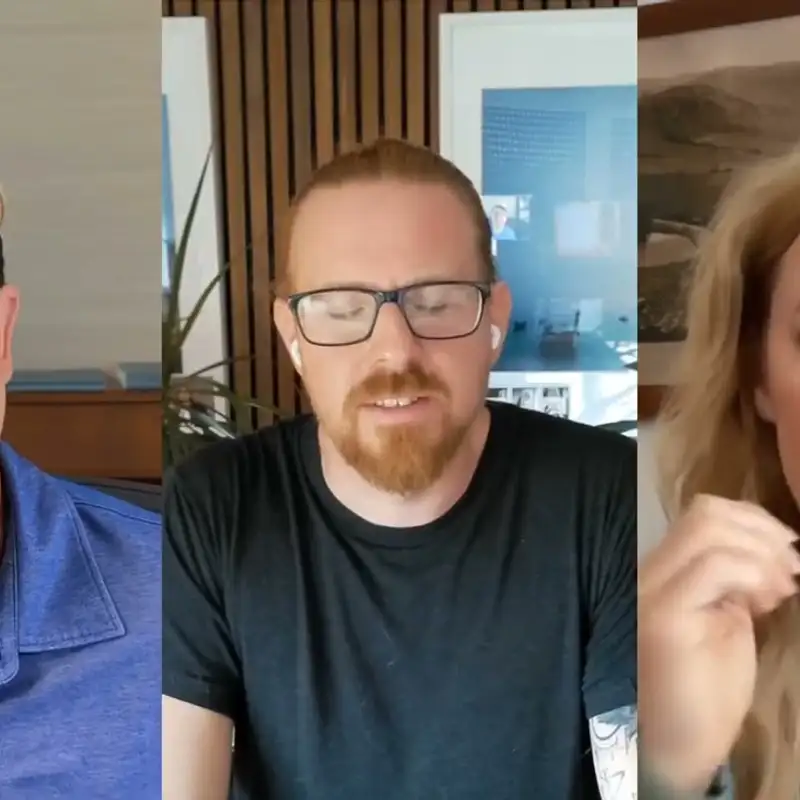
E04 w/ Dr. Sherry Walling: He built a great business, but it doesn't feel like it
Download MP3Dr. Sherry (00:01.003)
Hey Jason. How you doing?
Jason Cohen (00:02.444)
Hey.
Doing good.
Dr. Sherry (00:07.287)
Do you have an injured wrist?
Jason Cohen (00:10.162)
yeah. How could you tell? My I feel like Vader, 'cause he kinda like waves his hand without changing moving his his wrist. So
Dr. Sherry (00:11.607)
Bar fight?
Dr. Sherry (00:22.56)
Right.
Jason Cohen (00:25.848)
Like when he says you don't know the power of the dark side, you know, and he's kinda like just kind of moving his whole arm around. That's how I feel all the time. And then I always think like, No, I I I know the power of the dark side. I can I can see. This is it's okay. No, you don't know the power. No, you don't know what I know. Maybe I do know the power of the dark side. Who are you to you can't know what I what I do or don't know.
Dr. Sherry (00:43.671)
I can't believe you're gonna backsaft Darth Vader like that, dude.
Jason Cohen (00:48.862)
Ha ha.
Dark side's fine, you know, it's good. Good for some.
Dr. Sherry (00:56.023)
How's my mic sound? I'm remote, so everything sound all right.
Jason Cohen (01:01.256)
might be quiet. Let me see. maybe I'm just quiet. Let's see. Try again.
Dr. Sherry (01:06.101)
Hmm. Just testing the sound of this microphone. Better? Okay. Good deal.
Jason Cohen (01:09.787)
yeah, that's perfect. Yeah.
Okay. Yeah. No, we're both a little early, so that's okay. But yeah, this should be this should be interesting. I'm looking forward to all the other episodes have been much more about, you know, I wanna grow my business, which of course it is and that's fine. But I'm really looking forward to this being, you know, how do I wanna be now?
Jason Cohen (01:51.246)
Did I lose you?
Dr. Sherry (01:52.501)
Yeah.
Jason Cohen (01:54.177)
Mm-hmm.
Dr. Sherry (01:55.031)
Let me make sure I've got everything.
Dr. Sherry (02:10.347)
Is Patrick German or he's just living in Germany?
Jason Cohen (02:13.207)
Think he's Austrian. Yeah.
Jason Cohen (02:33.099)
Yeah. The product is definitely for the German speaking world.
Jason Cohen (03:22.209)
Here we go. Hello.
Dr. Sherry (03:23.809)
Okay.
Dr. Sherry (03:27.445)
Hi Patrick.
Jason Cohen (03:28.077)
I was gonna say there's no way an Austrian's gonna be late. That's just not gonna happen. No, you'd have to be Yeah, you'd have to they have to move. You wouldn't be allowed anymore. Awesome.
Patrik Inzinger (03:30.826)
No, we're very punctual. Not as bad as the Germans, but yes, we are very punctual.
Patrik Inzinger (03:40.447)
Ha ha ha.
Good to be here.
Jason Cohen (03:44.939)
Yeah. let's see.
Patrik Inzinger (03:46.646)
I'm a little nervous. English is not my first language, so we'll see how this goes. But yeah, I'm a bit rusty, but yeah. It's gonna work out.
Dr. Sherry (03:50.378)
I can't hear you.
Jason Cohen (03:50.549)
Yeah, that's okay.
Let's see. Sherry, are you did your your video's kind of frozen here? Are you still there?
Dr. Sherry (04:00.471)
All right. I'm still here. Let me switch Wi Fi is here.
Jason Cohen (04:03.347)
Maybe we're resetting a network. She was she was there.
Patrik Inzinger (04:06.615)
Okay.
Patrik Inzinger (04:10.488)
What's the time? at your place? plus two right now, yeah.
Jason Cohen (04:10.689)
Are you plus two are you GMT plus two or plus one? Or are you Yeah, okay.
Patrik Inzinger (04:18.806)
And it's ten AM where you are right now? Or okay. So you got your day ahead of you. I'm already tired.
Jason Cohen (04:20.994)
Yeah, yeah.
Jason Cohen (04:24.961)
Yeah. I got my coffee, see, I'm ready to go.
Patrik Inzinger (04:29.005)
Mm-hmm.
Patrik Inzinger (04:32.301)
Perfect.
Jason Cohen (04:32.673)
Yeah. It's good to be a little nervous because that means we're gonna get into something good.
Patrik Inzinger (04:38.658)
yeah, obviously. I mean I saw the first two episodes, so I watched the other one like two days ago. so yeah, that was my prep basically. But I'm a big fan of your your articles that you write and you've written over the years. I shared some of them with the with the team as well, so I'm I'm really looking forward to getting an outside perspective to our business basically.
Jason Cohen (04:43.721)
Okay. Uh-huh.
Jason Cohen (05:03.115)
Yeah, and of course the the big thing is is you right like the business is fine the
Patrik Inzinger (05:09.294)
Sure. I mean the business is not bad and and that is something that I just realized a couple of months ago because I was in in Tokyo at Tokyo Design Forum and there were like the
head of design from Adobe and Cursor and and people like that and I told them our story and everybody was like that's awesome you have a really really good business and I didn't really realize that until until then because all you read is like those huge headlines with like 30 million here and 50 million funding there and we're here like with like 1.5 million euros so close to two million US I guess with eight people and it it it doesn't sound like much right compared to those people.
Jason Cohen (05:39.191)
Yeah, yeah.
Patrik Inzinger (05:50.981)
people but I think it's actually very healthy.
Jason Cohen (05:52.737)
I I don't think I don't think you can use that as a metric for how it's going.
Patrik Inzinger (05:57.239)
yeah, definitely. there Sherry. Hello.
Jason Cohen (05:58.829)
All right.
Dr. Sherry (06:00.036)
Hello.
Jason Cohen (06:03.745)
All right, are we are we back? Do we think we're ri ready to go or okay? so after we're finished recording, I know it's already recording, obviously I'm gonna edit it out. it'll it'll ask you to wait until it finishes uploading. So you probably know that already, but anyway, it's useful to rem to say it again.
Dr. Sherry (06:06.905)
I think so.
Patrik Inzinger (06:19.811)
Yeah.
Patrik Inzinger (06:24.343)
Yeah, I think they changed this because it's it's running in a separate tab now. and it just got a Chrome warning that the tab is stuck, but yeah. Okay.
Jason Cohen (06:29.131)
Yeah, it should it should be uploading all along. And so it's just of course catching up at the very end with whatever it isn't highly variable depending on the network and so forth. So you know. Okay. anything else before I get started? I can edit anything later, by the way. So if you've even in the moment, if you want to say some restart or or say like, wait, don't don't put that, then that's fine. Or if you think of it later, that's fine too.
Patrik Inzinger (06:36.971)
Okay. Awesome. Perfect.
Patrik Inzinger (06:50.847)
Okay, sure. As I said, it's it's not my first language so we might have to like do do a couple of takes of some questions.
Jason Cohen (06:57.749)
At the at the same time, like I sometimes edit the beginnings a little bit just because you want it so tight, you know, to to get people's attention. But I almost never edit anything unless people are like fumfering with a screen share or something like that, which of course you just wanna c cut cut that. It's not interesting. But everything else I t I tend to leave because the the p the point is to be unproduced and uncut more or less, you know, unless someone's like I I I regret saying that. Okay, well I'm not trying to catch anybody. That's not the point, you know. so
Patrik Inzinger (07:02.947)
Mm.
Patrik Inzinger (07:11.083)
Yeah, sure. You don't want to watch that. No.
Patrik Inzinger (07:23.764)
No, I think it's gonna be fine.
Jason Cohen (07:28.759)
Yeah, yeah. Okay. In that case I will do the intro here and we'll and we'll get started.
Patrik Inzinger (07:38.007)
Okay.
Jason Cohen (07:40.248)
The star of today's episode of Smart Bear Live is a founder who did what every bootstrapper dreams of. He built a calm, profitable software company with low churn and it's healthy and he likes running it. He even turned down acquisition offers because he likes it and it's going well. But now he faces an unexpected problem. The mission is complete. I mean, the company works, it grows, it doesn't need him. And so now he's looking around, wondering, so what is it all for?
What am I doing? What should I be doing? And so today we are going to help him navigate the closing of one chapter and the opening of another. That doesn't mean selling the business, means a mindset, means maybe even a philosophy. And so who is this we, you might ask? I'm Jason Cohen. I'm known online as Smart Bear. I founded and run two unicorns over the past 25 years. That's Smart Bear and WP Engine. I've bootstrapped, I've also raised hundreds of millions of dollars. I've invested in 60 startups. For 20 years, I've written about all that.
And I just now published a book called Hidden Multipliers. You can look that up later. So, joining me to help our star founder is the great Sherry Walling. She is a mixture of being a clinical psychologist from a degree with a degree from Yale and 20 years of experience working deeply with founders, including her husband, the equally great Rob Walling. Sherry is the host of the Zen Founder podcast and the author of books like Exit Strategy and the Entrepreneur's Guide to Keeping Your Shit Together.
Which I think probably we all need, whether we want to exit or not. Her whole body of work answers these kinds of questions of founder identity, who you are when the company no longer needs you, and so on. So she helps founders through this kind of transition all the time. So welcome, Sherry.
Dr. Sherry (09:23.877)
So glad to be with you both.
Jason Cohen (09:27.307)
Okay, so together Sherry and I are gonna help the star of the show, who is Patrick Inziker, with his company Appointmed Appointmed is software that ironically runs a therapy practice. All right. You should be ready for this. So stuff like booking, scheduling, patient records, probably not turning the gun on yourself, but anyways, for independent therapists and health practitioners across the German-speaking world. And so, Patrick, vielen Dank, for being so open with us today. It's brave.
Patrik Inzinger (09:38.723)
That's actually true, yeah.
Jason Cohen (09:56.384)
And it's generous to everyone else who's listening.
Patrik Inzinger (09:59.683)
I'm really looking forward to that. So as I said before, I'm I'm a bit nervous. English is not my first language, I think we're gonna get through it. and and I look forward to hear your outside opinions to our business and to where we are right now or why where I am right now.
Jason Cohen (10:15.445)
Yeah. Yeah, I it's gonna be it's I think it's gonna be amazing. So everybody knows Danke Schön, aber ich habe "vielen dank" gesagt just to prove that ich sprechen ein bißchen Deutsch. So that does not mean I'll be able to help you, because you clearly know English better than than ich ich habe Deutsch kann gelernt, but anyways. All right, so Patrick, perhaps you can s start by just filling us in in English on some of the details of of where you are right now, where your mind's at, and therefore how we'll be able to help today. And
Patrik Inzinger (10:28.643)
That's not too bad. That's not too bad.
Jason Cohen (10:43.957)
Just before we started recording you said something interesting, which was it was only four months ago that you realized you had a good business. And so that's funny. So that me that certainly should be part of of getting us up to speed on on how you're feeling and and and and what's going on.
Patrik Inzinger (10:50.285)
Right.
Dr. Sherry (10:50.757)
Hmm.
Patrik Inzinger (10:59.192)
That's true. I'm I'm gonna start way back when when everything started basically. So I I got started in the web industry at the age of thirteen. that's where I first started like downloading Photoshop. I had no money to purchase it, so
You had your sources basically at the time. And my co-founder today actually was the coding part of this project. So we've been working together for almost 30 years, 25 years. So this is already a very interesting like constellation in our company. and I worked as a product designer the past 17 years. most of the time as a freelance designer for startups, and
big businesses, large corporations. and then I founded appointment in 2016 with three other co-founders. The first couple of years obviously as as every bootstrap company were tough. So we made 40,000 euros a year until like 2018, 2019. So every one of us had to do side projects to keep the thing alive and it was very like survival mode basically, right? So we had to
Decide are we gonna pay rent this month or are we gonna put it into the business and try to grow this thing? and ultimately it started working in around 2020-2021 when we really started to see like the compounding effects of what we have done, like SAO and word of mouth and refers from existing customers and stuff like that. Umada we are sitting at around 1.5 million.
Million euros ARR, which about 2 million US dollars, if the math is correct in my head. We're still eight people, we are a fully remote company. And I always tell people we are a calm company, so there are no like 80 hour work weeks or stuff like that. So we try to keep our sanity while running this business, basically. And what we do is we build practice management software for healthcare professionals, mostly therapists. We started with doctors, but
Patrik Inzinger (13:13.366)
But realize that sales cycles are too long to actually survive on that.
segment, customer segment basically. then we switched to therapists where the sales cycles were a third or even a fifth sometimes of of what it took for us to get a doctor on board. and that's what we switched to in around twenty seventeen, twenty eighteen. and yeah, that's our our main target group right now. We have three thousand five hundred practices running on on our software right now in various sizes. and yeah, I think that's that's the gist of it.
Jason Cohen (13:45.42)
And then you didn't mention anything about yourself and how you're feeling, which is how this whole thing came about. So that's good that we have a good that's great that we have a good overview of the company. It's amazing you've worked with somebody for 30 years. I've also done something like that. It's special. And and also for a person that doesn't know English, you use the word constellation, which I thought was funny. I think you're doing okay. so so we started talking because
Patrik Inzinger (13:52.215)
Yes.
Patrik Inzinger (14:07.683)
Okay, that's fine. That's good.
Dr. Sherry (14:08.505)
you
Jason Cohen (14:15.233)
You said, Wow, like everything's going so well. And also I'm still interested in this story from a couple of months ago. Maybe you can fill us in on on that and how that's changed how you're thinking about yourself.
Patrik Inzinger (14:23.883)
I mean the th Yeah, the thing that the
We often see in the startup community are those big headlines like Company X raised like 40 million or 60 million or they increased revenue by 800% or something like that. and then here we are with like a tiny team of eight people. We're making 1.5 around 2 million a year. And that in comparison to those headlines, it doesn't feel like and I wrote about this in in my newsletter. I I asked the questions, are we even a real company? Are we ambitious enough
basically compared to to those others that are out there. And
That's a that's a question that sat for a while with me. And I traveled to Tokyo in February for Tokyo Design Forum, which is a tiny event with some high caliber designers. It's there's there's a pendant in in San Diego that Drew Wilson does, ValueCon. it's also a very a very tight knit community, the dribble community basically from way back in the day, if if you ever heard of that. And I talked to people that are way more experienced.
than me that make a hundred times more money than me, and they work for like Adobe Head of Design and stuff like that. And I told them about our business, and the resonance was basically, hey, you you you got a great business. Do you know that you have a great business? And I was like, no. And that kind of like opened up this whole like maybe it's not as bad as I thought it is.
Patrik Inzinger (16:06.497)
And I was like the the the kicker for for the newsletter essay that I wrote and what I sent you in an email, Jason. And yeah, that's how this this whole thing got started. It was like this from self doubt to hey, we actually have a good business and other people see that we have a good business, but we are unable to see that. At least we were unable to see that.
Jason Cohen (16:28.685)
Why does that happen? I mean, maybe maybe Sherry can help us out here because I know you know that news is just news and it has nothing to do with you whether you have a good business. And you were just told by others that you do have a good business. But even in telling that story, you said, and also they make more money than me. In the same breath you said, and they work for Adobe, which you wouldn't be caught dead doing. So I think in in funny ways like that, you've answered your own questions and you already know that news doesn't mean anything.
Patrik Inzinger (16:37.783)
Yeah.
Patrik Inzinger (16:53.761)
Right. It still triggers a reflex, I think, right? At least
Jason Cohen (16:57.751)
Well well that's that's what I'm wondering. I I don't know if Sherry, like, is there what is why do we all like this? 'Cause I'm the same. And it's not like, Patrick's so weird that he's like, I mean, of course I'm the same. Why? What's going on? Yes, why are we like this?
Patrik Inzinger (17:04.835)
Ha ha ha.
Dr. Sherry (17:09.429)
Why are we like this? Well, I think there's a, the human process is to define ourselves in, in reference to each other. And it's like we exist as our interactions are in reciprocation with each other. So we're always looking to sort of use the people around us as a reference point. How am I doing? Where am I in the story?
Jason Cohen (17:21.666)
Mm.
Dr. Sherry (17:36.892)
But the challenge is that, especially for founders, there's not a big reference point. And so the reference point becomes these headlines or the flashy pieces of news. And we take that as kind of reality. It's a little bit like kids looking at social media. Like they assume that it's real because they see it, but it's not necessarily an accurate reference point.
And so that's where the importance is sort of defining for ourselves what success looks like. And that often is not just money, it's also freedom, it's connection, it's healthy relationships. In your words, you talk about a calm company, which you've made, which many people do not have. And so...
Patrik Inzinger (18:02.403)
Make sense.
Dr. Sherry (18:21.101)
your ability to define for yourself what it is that you want and not get distracted by the sort of shiny reference points external to you is the challenge. It's a very hard thing for humans, but.
Patrik Inzinger (18:33.685)
Right, and so always the the question is is building a calm company the right thing? Because not a lot of people are building a calm company, right? The the business industry or the the the default way is to aim for hypergrowth and build something big and have thousands of employees and stuff like that. So yeah. Okay.
Jason Cohen (18:47.265)
No it's not. No it's not. Wait, wait, wait, wait. No it's not.
In the news, you see that because news is wants to grab onto something sensational. And things like a big funding round or something grew a lot is sensational. And it's probably fair to say that someone with a big vision about changing the world, even though to me, like I kind of throw up my mouth a little when I hear that, because I don't care. Right. Right. So so I don't care about that stuff. But but I will admit that is more interesting as a story if I'm a journalist.
Patrik Inzinger (19:11.959)
Yeah, we're not gonna change the world with like practice management software. It's not sexy like that.
Jason Cohen (19:22.423)
Than someone who says, I'm building a calm company. That's just not as interesting as a journalist to write about. Okay. I I I can I can see that. That's okay. so from a I mean, the news, of course, is written by journalists who want to get eyeballs and do things that are like that. whatever that means. it's disconnected from reality. It certainly is not a random sample slice of what r real life is, even in America.
Patrik Inzinger (19:30.337)
I get them. Yeah.
Jason Cohen (19:51.298)
Because also it's a very American thing to want that more. And so I don't wanna just harp on the on the Austrian or German things, but like Middlestand isn't about growing and hyper growth. Right? It's about who what is this company's role in the local community, the you know, the local community as well as for the for the country. What does it mean about treating employees well, making a product that we're proud of doing 'cause it's so good? also charging more 'cause we 'cause
Patrik Inzinger (19:53.24)
Mm-hmm.
Patrik Inzinger (20:03.457)
No, that's true.
Patrik Inzinger (20:18.296)
Mm-hmm.
Jason Cohen (20:20.865)
it costs more to to treat employees well and to make have higher quality. So okay. and what is and and what is the role that we that that that we have in the you know where we physically are. And and none of that has to do with hypergrowth. Of course if we if we grow, maybe that's good. Money's fine. Creating more jobs is good. Like it's not that growth is bad or undesirable or not a goal that we set every day. Like that's fine. But that's ultimately not the point of something like that.
Patrik Inzinger (20:21.227)
yeah.
Jason Cohen (20:48.119)
And that's just in the in the in the German world. Now I know that's that's that's it's harder right now with how manufacturing is going. We don't have to get into all that. But the point being, like, there's clear attitudes that are not like that. But even in America, what percentage of software companies are funded? And the answer is single digit, because only a few companies, I mean, relatively speaking, only a few companies are funded every year. So just mathematically, almost no one's doing that. Period. So like the news doesn't talk to them, but mathematically, that's what's mostly going on.
Patrik Inzinger (21:11.243)
Right. But it's the one thing you read in the news, right? Yeah. Yeah.
Jason Cohen (21:17.545)
Even in America, which you think of as the most hypergrowth everything country, and of course the rest of the world is often less so like that.
Dr. Sherry (21:25.307)
It's interesting to hear you say is growing a calm company the right thing? And that's the sort of right or wrong, black or white, it's one way or another way is something that I get curious about. Like it's this assumption that there is a right kind of company and there's a wrong kind of company. And that if you are one kind, then you're right and one kind, then you're wrong.
Jason Cohen (21:46.974)
Mm.
Dr. Sherry (21:51.566)
And I think that language makes it cloudy and hard for you to assess yourself, whether you have a good company or a bad company. Like we like these very simple labels. It's good. It's right. It's bad. It's wrong. But you have the company that you have. Yeah.
Patrik Inzinger (22:05.335)
Yeah. But it's everything all the time, right? There are good sides, there are bad sides, and we're we are I I saw like the hypergrowth side of things when I worked with startups in the crypto space and
And it didn't really look like fun to those people, right? So they're really like grinding and working a hundred hours a week, hoping that they get the big paycheck at the end of the day. but I realized that this is not the thing that I I wanted to do with with our company.
That being said, it's it's very enticing when you read those headlines, right? So it's it's it's always like a trigger for me where I can where I start to think about are we doing the right thing? Is there is there another way that we could grow our business faster or do we even need to grow faster?
Dr. Sherry (23:02.159)
What is enticing? Is it the dollar amount? Is it being on, is it being in the headline? Like, what do you think it is inside of you that's like, I'm curious about that. I want to touch that. I want to be closer to that.
Jason Cohen (23:02.327)
Well, y you already know you don't need to.
Patrik Inzinger (23:15.734)
Yeah, I think it as an entrepreneur you're just drawn to those kind of things, right? And I also see like people like Jason Fried from Basecamp or Jason on on X or Twitter or whatever you wanna call it. or John Owen from Ghost and those people they have built like incredible companies and you wanna kinda go there as well, right?
Jason Cohen (23:39.031)
You have grown a company like that. Those are not guys looking for hypergrowth.
Dr. Sherry (23:39.099)
But I guess, yeah.
Patrik Inzinger (23:43.895)
Yeah, that's something that I I just realized like a couple of months ago, that this is actually not not that bad what we have here.
Jason Cohen (23:49.963)
No, no, that's not what I said. I didn't say whether it was bad or good.
What I said is you said, I would like to make a c I'm I'm impressed with companies like Ghost and 37 Signals. I want a company like that. And you also said earlier you want a hyper you you might want or you might be jealous of a hyper growth company, but neither of those two companies are hyper growth companies. They're both calm companies that grow slowly. So you are building a company like those two. That is what you're doing.
Patrik Inzinger (24:17.123)
Yeah.
Patrik Inzinger (24:20.813)
They're just a magnitude bigger than we are, right? So maybe we just need more time. That could be it.
Jason Cohen (24:25.085)
in the case of ghost, no, it's not.
Patrik Inzinger (24:30.529)
I think they're like at ten million or something like that. I'm not sure, but
Jason Cohen (24:35.083)
So y yeah, and and and like so so you keep bringing up the how much revenue it is. It's so that's the thing. It has to be because hypergrowth and having a lot of rev and having ten million instead of two million is not the same thing. Cause once again, neither of those companies ever had hypergrowth. So is it the growth, in other words, is it the slope of the line or is it the absolute number of the line that you're keyed on? Like if your AR doesn't have two digits of millions of any currency of your choice, then you're not happy or what?
Patrik Inzinger (25:04.094)
No, I think it's it's not the the number of euros or dollars or whatever that we bring in. I just feel like growth is gonna slow down sooner or later for a company like us. which is natural, I guess, with churn and you wrote about the max MRR thing, I think. Was it called? and I think we're just trying to navigate this as well. What where is our ceiling and how can we break through this ceiling? And
Jason Cohen (25:22.613)
Mm-hmm. Yeah.
Jason Cohen (25:33.766)
Okay, well, let me get back to that. because before you said I looked at some of our clients or so someone else anyway, who not clients, but somebody else who's in hypergrowth, and you say, Well, that doesn't look like fun. Well, that's something I can speak to, having you know, of course, made a hypergrowth company for real hypergrowth, like, you know, going from one to five million dollars in one year and then from five to fifteen in the next year and stuff like that, which is proper hypergrowth. no, it's not fun at all.
Patrik Inzinger (25:46.691)
Mm-hmm.
Patrik Inzinger (25:52.355)
Mm.
Jason Cohen (26:01.749)
In fact, people would say stuff like even like a decade in, people would say stuff like, Are you still having fun? And I would say, What do you mean, still? I haven't had fun in a decade. It's not fun. It's fulfilling, it's interesting, it's challenging, it eats your whole life. And either, well, I should say, either all of that activity and all that stuff that you're accomplishing, all those challenges you're facing and overcoming, either that is in fact fulfilling.
Patrik Inzinger (26:11.829)
Okay.
Jason Cohen (26:29.245)
Or it's something that at that moment in your life you want that, then that's good. It doesn't make it fun. That's the wrong word. It's not spas. It's it's but it is, it could be fulfilling. but or but but maybe it's not fulfilling, right? That's that's clearly in the eye of the beholder, and there's no correct answer, and it can change over time. It can be and then some and then not be at some point, you know. and so
Patrik Inzinger (26:38.819)
Ha ha.
Jason Cohen (26:53.995)
Yeah, it's it's fun, it's n it's not it's definitely not fun. I get I mean for some people it could be fun, of course, everyone's different, but for me it's not fun. And when I've spoken to other people, even in close behind closed doors, about that kind of thing, I essentially never hear fun. Occasionally I do. I have to I take that back slightly. I do occasionally hear that. And then I'm jealous of them that they find that fun instead of a instead of hard. So, well, you know, we all want, you know, straight hair wants curly hair and curly hair wants straight hair. What can I tell you? You know. but
Dr. Sherry (27:12.367)
you
Dr. Sherry (27:19.675)
you
Patrik Inzinger (27:19.757)
Sure.
Jason Cohen (27:22.091)
That and I and I wonder even if that's part of what it is, here of like you've built here here's one way I'm thinking of it, and then I'll stop talking.
W y y when you started this, you said I built a calm company and I felt in you pride in that. You're proud that you created a company that people aren't k having to destroy themselves in order to have a great life and make enough money, maybe even good money and all that. And they work remotely and all kinds of good stuff. Like z you're you've created eight incredibly good jobs and of course a life for yourself.
In a company that does something actually valuable. Like I I felt from you pride in a calm company. I also started by introducing it that way. And then later, like almost in the same session, same same same turn, you said it was calm in a way that you felt embarrassed. Like what these other companies are growing faster and you know, so now am I embarrassed that it's calm? So I'm I'm just interested. I'm I'm curious about like, is it pride? Is it embarrassed? Is it both? And that's why it's part of why it's confusing or like what's going on?
Patrik Inzinger (28:08.163)
yeah, definitely. Yeah.
Patrik Inzinger (28:31.531)
I think that's the part that's confusing, right? Because of the one one side it's it's a great company and we have like a work-life balance or I call it work-life integration basically that's that works out for everyone. If if someone wants to take a walk with their dog at like Wednesday at two pm, yeah, go for it. See you in like four hours or whatever. we don't we don't really track time and everyone has the freedom to work from everywhere and this is fantastic. But on the other hand, you basically see the
Jason Cohen (28:33.088)
Yeah, yeah.
Patrik Inzinger (28:59.265)
What could have been, basically, right? So I'm wondering, did we take the did we take the right path? I think we did, but as always when when when you read those headlines there is this nagging feeling of like, you sure? You know what I mean? Yeah.
Jason Cohen (29:12.813)
Well, you say what could have been, first of all, you don't know that that is what could have been, but but okay, let's even pretend like it could have been something else. Besides having more revenue and maybe more profit, besides that, which is not nothing, I'm not trying to say that's nothing. It's okay if that's the only thing. But I'm just curious, besides that, what else are you envisioning that that could have that counterfactual would be? That alternative would be. What are you envisioning that is that you wish you had besides the money?
Patrik Inzinger (29:41.549)
Mm-hmm.
Jason Cohen (29:41.933)
It's again, it's okay if the answer is just the money, but like what else besides the money are you saying, man, it would would have been great if we had that?
Patrik Inzinger (29:44.813)
Ha ha ha.
Patrik Inzinger (29:49.837)
That's a good question. Maybe part of it is also the recognition. because I
I had to drop out of school at 17. And I I don't want to go in into this whole how school system in Austria works, but if you fail a class basically you have to repeat the entire school year, and I had to do that three times. and in in those years, that's where I basically taught myself how to read and speak English, because most of the content that I was learning from was in English, right?
I installed Photoshop, I learned how to design stuff. and that was basically what I did instead of school. Then I had to drop out and then I felt like a failure. And I don't think that my parents were super happy at the time with how all of this shaked out. but yeah.
Jason Cohen (30:38.413)
Is that an understatement?
Patrik Inzinger (30:40.179)
yeah, maybe. I mean it were it all worked out fine. So I I got self employed when I was twenty-one, twenty-two or something like that. And I had a great business from from then on. But the the time between the school dropout and having your own business, that was a really tough time. And I think that's also select select subconsciously something that always comes up in those discussions, right? And I also had like I had a company name in front of my name for
Jason Cohen (30:41.503)
Okay.
Dr. Sherry (30:41.829)
Thank
Patrik Inzinger (31:10.512)
eleven years, I think. And I just recently bought patrickensing.com. Ma domain with my name on it and not like a fixtures company name that I was running my my freelance business under, right? So I'm I'm trying to work through that, I guess. And this is also part of it, right?
Dr. Sherry (31:28.612)
I think this is really important, Patrick. The things that you referenced earlier about watching Jason Fried or seeing people on X, and then your pull toward those big headlines where people are getting recognition. And the story is being told, and they've sort of been turned into startup lore. And I think there may be a part of you that...
that has this compelling story and wants to be seen for the human that has done this, that has survived all of these challenges and has come through this time of upheaval and uncertainty to have created a calm and stable company. And maybe there's a part of you that wants your story to be known that.
Dr. Sherry (32:17.167)
That's a different question than the value of your company. That's about the value of you and your identity and your identity being recognized. So I get curious about that as an underpinning motivation that's kind of guiding some of this sense of discontent or upheaval. This question of is it good enough? Am I seen enough? Did I do enough? Do people know what I did and what I've come from and how hard I've worked to get to this place?
Patrik Inzinger (32:35.8)
Yeah.
Patrik Inzinger (32:45.847)
Yeah. That I I I kind of agree with that assessment, basically. and yeah, definitely. The the recognition is something that we in in the bootstrap space we we don't really get, right? We don't get the big headlines basically. And maybe that also is is part of the of the trigger whenever you read something like that, right?
Jason Cohen (33:09.495)
Yeah, I I agree. Recognition for what? Recognition for how large the company is? Recognition for how calm the company is? Recognition for how you overcame something in your youth and had to prove to your parents and yourself that you're capable. Recognition for what?
Dr. Sherry (33:09.561)
What's the?
Patrik Inzinger (33:24.748)
I don't think it's about the the the growth. It's just like the recognition for building a company to begin with, right? Because that is not an easy task. It's it's
Jason Cohen (33:34.475)
Yeah, but building a company with what attributes? In other words, are would you if you're recognized for building a calm company with two mil in euro or dollar, is that sufficient recognition or you it's only okay if the recognition is for having built a company at ten million?
Patrik Inzinger (33:53.513)
Mm. No, I mean if you put it like that, two million is is way more than we ever expected to grow into, right? So
Jason Cohen (34:00.525)
So recognition that you, I mean, shoot, most of the people I've interviewed so far, not all of them are published, obviously, almost none of them have a stable, profitable, calm company. And or and all smaller than you. Now, of course, there's lots of companies bigger than you. Of course, of course, of course, everything exists, right? But just saying, like, even among the people I've interviewed on just this show, I don't not interviewed, that's not what we're doing.
Patrik Inzinger (34:18.979)
Sure.
Jason Cohen (34:29.013)
The people that have come on this show, like almost none of them have achieved what you've achieved. Eve at it if you think two million's not a lot, and I you just backed that down a little bit, but but you were starting starting this out by saying maybe two million is not a lot, right? like all of them would think that's great. All for all of them, that would be something they wish they could have. You have what they wish they could have. So maybe so you're I'm hearing you want recognition of that. You don't need recognition that you got to ten. You just you would like recognition of where you are.
an another thing is yeah. So I have I have not yet yet I've done like six of these and I've never said, yeah, you should go down and comment in the YouTube and you should go tweet. I should be saying that. I should be saying you should like and subscribe. I don't know, I should say all that crap, but like that's not what we're doing here. I don't really I'm not really paying attention to the listeners, right? But in this case, because you want recognition, I wonder could I ask the people who are watching on YouTube to comment or on Twitter to we
Patrik Inzinger (35:10.765)
Ha ha ha.
Jason Cohen (35:27.327)
And what I wonder what people legitimately think about you and your company. Now they may not have known you before, so they couldn't have recognized your achievements, but I wonder whether they think what you've done is impressive, deserves recognition. you know, is it too small to be interesting? Or are are they are they already are they already impressed and by what you've accomplished, but also just just grateful that you're sitting here talking about all these feelings? I so
Stupid to ask for that, I think, but but but but but I think it would be great because like what if you saw 20 comments that said, no, dude, you're wrong. Like I think this is amazing. I w I wonder if if you want recognition, is there something like, there's nothing wrong with the company? Maybe you just want a little more visibility personally. Like maybe Patrick Inseker.com should get more traffic. Maybe you want to speak on some more stages. Maybe, you know, like is there something where you could get some of this personal recognition, which I think is fine. You could say that's egotistical or shallow. I don't think so.
Patrik Inzinger (36:00.161)
No, honestly, but I'm curious as well.
Jason Cohen (36:27.211)
I think it could be that there's a version of that that's egotistical and shallow, but there's a version that's like, I'm really proud of what I've done and I would feel more fulfilled if not a million people, but even just thousands of people who are my kind of people knew that. Sort of like ghosts. Ghost is not famous. Like if I went on the street and talked to 10 people, zero of them would have heard of Ghost. But in a different circle, he's you know, John's a a hero. So I wonder if you're thinking like hero like that, you know, like John, you know, that kind of thing. Like that would that be
Patrik Inzinger (36:45.837)
Yeah, that's true.
Patrik Inzinger (36:50.456)
Mm-hmm.
Jason Cohen (36:56.791)
Would that be neat?
Patrik Inzinger (36:57.42)
Yeah. Yeah, of course. but that goes back to this to this Tokyo trip basically, because this was the first time that people actually told me how good this thing is that we've built, right? Because we've been so deep in the trenches for the past ten years, we had no time to talk to other people or get feedback from other people who are also in similar situations or have built companies. We talked to like mentors and stuff and and we were
startup accelerator program way way back where everybody tells you yeah this is fantastic what you have keep going and stuff but this is more like platitudes and not really the the honest feedback that I was getting at this event in in Tokyo and I think that's where where I started to realize that the recognition is something that that really motivates me and it also motivates the team because I can pass that along and I told the people in the team
you won't believe what the head of Adobe said about our company or whatever. so yeah, I think that's that's definitely part of of a motivational thing, right?
And I think I I'm not unique with with that, hopefully. I I I don't try to be eg egotistical or narcissistic or whatever. but I f but I still feel like this recognition is something that you need as as fuel if you wanna build something that lasts for a long time, right?
Dr. Sherry (38:26.265)
It is a form of fuel. It's a great form of fuel. probably shouldn't be your only fuel.
But everybody loves the positive feedback for it, Loop. Everybody loves the kudos of like, you're doing a good job. Thank you for what you're doing. And the more specific and detailed that feedback is, the better. Because you're right, there's a difference between the platitude and the high five, and then someone who has insight and has taken a very careful look at your company and is giving you very detailed feedback. So one of the things you might do moving forward is create some mechanism for that to happen, for finding a mentor or somebody that you really respect their
Patrik Inzinger (38:32.353)
Yeah, obviously. Yeah.
Dr. Sherry (39:01.981)
perspective and asking them on an annual basis or something to do like a very careful kind of audit of your company of how you're doing, how you're growing, to look at all the metrics with you, to look at what's possible and to give you that kind of feedback loop in a way that you trust and will really receive because they're very thoughtful and insightful.
Patrik Inzinger (39:20.292)
I think that's very hard to find in yeah, i it's also like
Dr. Sherry (39:22.246)
like to know how they're doing.
Patrik Inzinger (39:26.454)
We have a different mentality in Europe than you guys in the US, as you know, basically. and there are not a lot of companies or even people that build something like we did, right? Because most of the stuff in our space is VC funded and they have millions of euros and they have a totally different perspective on on what success or what what a good business basically is. So it's not easy to find somebody to talk to and that's also one of the reasons why why I think this show is so great, because there are so many people from different paths.
and with different ideas and businesses and you get to really go on this deep dive with them.
Dr. Sherry (40:04.859)
I'm curious, Patrick, how much your identity as a human and your identity as the leader of your company are kind of intertwined or tied together?
Patrik Inzinger (40:17.021)
it's not as bad as it used to be, to be honest. a as I said before. Yeah.
Dr. Sherry (40:21.583)
I wouldn't assume that it's bad, by the way. It's just a neutral question to begin with. It's just, yeah.
Jason Cohen (40:24.245)
Mm-hmm.
Mm-hmm.
Patrik Inzinger (40:29.557)
Of course, when you when you start a thing like that, it's very tied to your identity because it's the thing that you think about 24-7, basically, right? So I I always try to find an outlet for for this for this pressure to go away, basically. So years ago I rode motorcycles for that. So whenever you I put a helmet on and got on the road, and twisty mountain roads in Austria they're pretty tricky, so you have to focus on what you're doing, otherwise you're landing in a ditch.
And that was like meditation for me, right? You get on the bike and then you drive for like six hours and your head is clean. And nowadays I during COVID I've I I've found another hobby that is that is
also taxing. I I did my pilot license in twenty twenty one I think. So whenever I'm in the cockpit as a pilot in command, it's always focused on exactly that thing. And there is no time to think about the business. And I think that really helped me to switch off that part of me for at least a while, right? So I I would highly recommend people to to find this off switch that you can just
pull and then you you have like a couple of hours to yourself and not think about the business.
Dr. Sherry (41:48.252)
100 % agree with that, that there need to be some spaces in our lives where our minds and body exist separate from the business. And I love the examples that you give of these things that are all encompassing and really command your full attention so that you're not in the back of your mind, like thinking about the business, but you're just fully present in what you're doing. It's a great cognitive break.
Patrik Inzinger (41:55.297)
Yeah. Sure.
Patrik Inzinger (42:09.505)
It's still exhausting, but it's in exhausting in a different way, right? So it doesn't really like it it doesn't add up the stress in the business. That's if that makes sense.
Dr. Sherry (42:13.008)
Mm-hmm.
Jason Cohen (42:17.495)
So I I love that sidebar and agree. The original question was do you feel like your identity is tied to the business or not? And you said originally yes, then less so, and explain part of how you maybe found some separation and you're inside your own head. But I'm still wondering, is your identity tied to your business or not? Or how much is it?
Patrik Inzinger (42:40.491)
I think if we're gonna if we would sell the business tomorrow, I would still be good. So it's not like there's a part of me that gets cut off. Of course, we've spent like a decade on this thing, but it's not an all encompassing, like all consuming thing in in my life. So we still have a dog, I have a wife, we do a lot of trips together and it it used to be the way. I I didn't take a vacation for like six years or something like that and I
I then started once the business was was going well, I trusted the team and I said, Okay, I'm gonna be gone for like two weeks. Please make the business not die in that time. But once those two weeks were over, I saw that it worked and I can I can step away from the business for quite a while and it's still there and I don't have to worry about it. And I think that's very, very healthy. It wasn't like bad in in the beginning, of course.
Jason Cohen (43:38.285)
It's extremely healthy. Go ahead.
Dr. Sherry (43:38.415)
You described it as survival mode.
Patrik Inzinger (43:41.057)
Yeah, right.
Jason Cohen (43:44.599)
I was gonna say it's go sorry, go go ahead, go ahead. Go, go, go.
Dr. Sherry (43:44.741)
So you went through the... There you go, you go, you go. I asked the last question. You go.
Jason Cohen (43:52.056)
I was just gonna say, you
Jason Cohen (43:56.662)
You that is awesome that you operationally made yourself not vital because that simultaneously means you hired a team capable of running this business and you have ensured they have what they need to do and you've trusted them to do it and you've proven they can do it, which is great, which would allow you to do things like sell it or step away more if you wanted, which you don't necessarily want. And yet I'm still here wondering what the answer to the question is, which is how much your identity, which is not what your operational activities, how much your identity of who you are is tied.
To the business. Now I think what you're getting at here is between your own mindset through flying and other things and operationally just seeing that you're not v you know, necessary every day, every second, that helps you get to a space where it's not true. but I ha like and maybe the question's ambiguous and maybe maybe Sherry can help me ask this because I maybe I don't know how to ask this right. But I just feel like I I haven't gotten an answer yet about who you are.
So an example for me, you know, since I've w written for so long, it's easier for me to point to my blog and now my book or whatever and say, like, see, that's who I am. That's me working out my own thoughts, becoming better at a as a writer. this ends up being a philosophy of by accident or or something like that. And so part of who I am, I can just show you. It's it's this stuff. This stuff kind of embodies who I am, at least in a professional way and not personally, but okay, you know, it's something.
Patrik Inzinger (45:24.099)
Mm-hmm.
Jason Cohen (45:26.013)
And at this still, still it was hard after I left WP Engine, it was hard for me. It probably took about a year for me to fully reset and say, and now what should I even be doing on Earth besides you know, product? Like what what you know, I can go play the piano, which I do. That's the piano I had growing up when I was a kid, so and I I play all the time still. So that's meaningful to me and everything.
Patrik Inzinger (45:44.6)
Yeah.
Jason Cohen (45:53.624)
And that's a hobby, and that's just like what you said, meditative and so on. Just enough to engage your mind that that it's engaged, but not so engaged that like you know it's it's it's not still restful in some sense, or recharging or something. Sherry would have a better word for this. but something good and and recharge and rejuvenating and or something. but I it took me a long time to realize like one of the things that I am is a teacher.
maybe a coach, someone that wants to convey things and and and do that and also get recognition for it. So on the one hand, I wrote this latest book saying if no one ever read it, I w it would still be my best work. So I'm proud of it. And that is true. That is absolutely legitimately true. I don't care if thousands or tens of thousands or more people read it. It almost for sure won't be more. I want
just whoever reads it to love it. That's all I want. And it's okay. If every time I get an email that says, I really liked it, there you go. I'm done, finished. I don't care how many of those I get. That's that's what I want. Because it means it was something good. and that's what I want. But I want that recognition too. I of course I do. Right. So I'm not gonna do weird tricks to try to get people to buy it because the number is actually not it for me. But I knew that because I spent a year really sitting with it and figuring that out that I want to do this or even this show.
This is just the intersection of me with, and I know I'm just talking about me, but I'm just giving an example of what I mean by identity. Like I know that I'm someone who's good in the moment without preparation. I have a you I've I've banked so much experience, but also I've talked about it. Like a lot of times people say, How come you just had that answer? It's like because I spent tens of hours thinking about that once 10 years ago writing. Had I not done that, I don't know. But I but even by accident, I've just banked this set of experiences and ways to think about things, and I'm just good extemporaneously, just naturally, and I like to teach, I like doing this.
Maybe I'm too much of an asshole and interrupt people too much. That's true. and I'm working on that. as I've said publicly also on these videos. So that's that's fine. I've I got stuff to work on too, obviously. even now I'm probably talking for too long. Okay, I admit it. so okay, that that's me going through some some of of of that journey. but I'm I'm definitely doing the thing I was I was made to do, or or or however you'd like to say that. It's in my DNA somewhere.
Jason Cohen (48:14.807)
So that feels like I'm I'm being the best version or I'm doing the best I can best version of me that I can at the moment, which is pretty good and you know, right in generally the right area and need to improve, right? Like, which is maybe always a good place to be. And so that's part of how I would answer like, who am I right now and what am I doing? But also it took me a year of stepping away to even know that. So maybe it's unfair for me to keep harping on that question.
because maybe it's unfair for you to even know. On the other hand, if we could get a little bit into that, if we get a little bit of an answer, that would be useful. So anyway, I so I've talked a long time. I'm just trying to re empathize with you, you know, and describe my own part of that journey for the for what it's worth. So maybe it's not answerable. Sherry, what what I don't I don't even know how to ask it right, I think.
Dr. Sherry (49:00.453)
Well, I think you're doing a wonderful job asking it and giving an example. But what I was really hearing too in the earlier story that you told Patrick about coming into this company is this term survival mode. And when you are in survival mode,
Patrik Inzinger (49:03.629)
Mm-hmm.
Dr. Sherry (49:17.003)
self-reflection or reflection on your company is very difficult and all of your resources are going to the survival and growth of the company. But what I think has happened for you is that you have reached a level of calm and you are now offered this opportunity to ask this question about now that the baby is going to live, the company is stable.
Patrik Inzinger (49:21.496)
Mm.
Patrik Inzinger (49:39.009)
Yeah.
Dr. Sherry (49:41.28)
The door is open for some of this deeper reflection about who am I and what am I doing on the planet and what am I offering? And Jason gives this lovely example of having had to do that himself and recognized I'm a teacher, I'm a wordsmith, I'm a writer. I'm someone who is here to support the well-being of other entrepreneurs through the insights that I've gained over time. And I feel like you're on the verge of that kind of self-reflection. The company's good. It's calm.
It's steady, it's stable, it doesn't need you in the way that it did before. And now you have the opportunity to really do the deeper dive and like, okay, what do I want to offer the world next? What's in my DNA that's not yet been expressed?
Patrik Inzinger (50:27.905)
I think in in terms of that, my identity is very tied to the business still. I still wanna grow this business, I still wanna continue working on this business. But I I also and and Jason, I I feel like I'm a little similar that way. I'm just a couple of years behind you. I also started like sharing my lessons, what I've learned from running a bootstrap company in my in my own newsletter. And I also get this recognition there. So I just tweeted about this I think yesterday or something like that, where someone I didn't know out of the blue sent me an email after
I sent out one of those essays. Hey man, that is awesome. I've been working in a VC funded startup for like 10 years. I've been burned out and I don't want to do exactly what you did. And those are the kinds of messages that really like motivate me to continue exploring that path basically. that being said, I still I'm not done with this company, so I still wanna go places with that, obviously. but I feel like we have done
We have built a company our way and not a lot of people share this perspective basically. And that's what I'm trying to to do with this slow and steady thing that I'm I'm writing.
Jason Cohen (51:39.692)
And yet, and yet you know that at least thousands and maybe hundreds of thousands of people want to build a company like like you have. Like not just build a company, but like you have, like specifically these kind of trade-offs and things. which puts you you said you said you're behind me. I wouldn't say that. I would say you're younger and more vigorous, which is which I wish I were as well. but you're ahead of like an incredible.
Patrik Inzinger (51:48.483)
Yeah.
Patrik Inzinger (52:02.083)
Maybe.
Jason Cohen (52:09.931)
incredibly large group of people that want to do that globally too. And yes, in the America in America too. Yeah, yeah. Well yeah.
Patrik Inzinger (52:14.499)
Yeah, and I think that's something that I did not realize until recently. And and that basically threw up a ton of questions. What what else did I miss, basically, right?
Jason Cohen (52:23.585)
In fact, I I could go even I could I could go even further. You look at 37 Signals and maybe Ghost and say, Wow, I wish I were more like that. I think there's a lot of people, again, thousands, if not hundreds of thousands, of people who would look at what you did and said, No, I don't want to be like 37 Signals because they have 50 employees. And that sounds like a lot. I d I don't want that. I want to be a solo founder forever, or maybe just a couple of people, or solo plus a few.
a few agencies or something just to round out some stuff. And so I would rather have one to two million in ARR, be solo plus agency or maybe just a a two co founders. I want exactly what you built. I would not like 37 signals. I want you. I want your model exactly. So just as you're looking ahead going, they have more revenue. so they're more impressive or whatever.
and I'm putting words in your mouth that you didn't necessarily say, but okay. there are so many people who want exactly what you did and would not like the thing that you said you might want to do. that that doesn't mean you should or shouldn't want it. Like you should you should want whatever you want. Like, you know, I'm not telling you what you should think. I'm just saying if as a again, back to the recognition and you being a role model and an example in that sense.
Patrik Inzinger (53:22.669)
That's fine.
Patrik Inzinger (53:29.091)
Sure.
Jason Cohen (53:43.468)
You don't need to get a single bit bigger or this or change at all to be a role model for so many people that want what you have built and don't even want more than what you have built, more meaning metrics or whatever, right? so it could be that of course there's a separate, there's two separate questions here. One is what what is it that you want? Okay, for you. And then another question is what do you want recognition for aga exactly? What like we were talking about, and you were saying it's not necessarily and yeah, I don't need recognition for growing faster, having more revenue.
Even just what you have now, just what you've built now is already something that you could have more recognition for that might be fulfilling and and nice for you personally. And I think there's a lot of people who would say, like, yes, I do want to look up to you. Why don't you write more about that and go on podcast? I, you know, I don't know. Like, like, I'm ready. I'm ready to hear more from you. Like, I'm ready to recognize you and and and receive the, you know, the that wisdom. So
Patrik Inzinger (54:27.917)
Ha ha ha
Patrik Inzinger (54:37.613)
But I think that's something that I'm I'm starting slowly because as I said before, it it felt like a failure like for a long time. And being someone who's who's considered a failure, it's very hard to step in the spotlight, right? Because you you don't feel like too sure. Sure.
Dr. Sherry (54:51.845)
Wait, sorry. Can I interrupt you? What was this failure story? I mean, we have certainly the experience of school and the challenge of not being able to complete school and the way that other kids were doing and the stress and trauma that that brought for your parents and the stress that it brought for you.
Patrik Inzinger (54:58.935)
The the school dropout thingy, yeah.
Dr. Sherry (55:12.441)
What, what feels like needs to be resolved there because you're a grownup now and you seem very stable and happy and you're probably nice to your mother if she's still with you. like, can we release the failure story? Like why, why are we still, why are you still like working with that as the conversation point?
Patrik Inzinger (55:23.931)
yeah.
Patrik Inzinger (55:33.955)
I've working with that for
maybe ten, twelve, fifteen years. And it's still hard to go on stage for me and talk in front of people. And I think that really goes back to to those experiences that I had when I was younger. And being being out in the open and writing this newsletter is is also opening up to critique from other people, right? So some people might not like what I write or they think, dude, you're stupid, whatever. but yeah that's something that I I actively try to work
Yeah.
Dr. Sherry (56:08.707)
Yeah, it feels like an important thing to work through as actively as you can, because if nothing else, it keeps you in the story of you as an 18 year old. Like it's a developmental task of a young man that, you're, you're still in the dance of, many, many people do this. Like I have my own stories of childhood that I'm still working out. So this is not pathologizing you, any more than the rest of us, but it is.
You know, it is a blind spot and it is a thing that will keep you trapped. If you're continuing to have the conversation in your head with your teachers, with your parents, with your peers as a 17, 18 year old man, because those are not the developmental tasks that you want to be tackling right now. That's a regression. It's an old story.
Patrik Inzinger (56:57.623)
Yeah, I think it it it sounded way worse than I intended it to sound like, but yeah. I get what you're saying.
Jason Cohen (57:07.009)
W what you said about, you know, if if you when you put yourself out there, you receive critiques. Of course that's true. And I know a lot I mean, it's gotta be that most people are like this, meaning you 20 people can say something nice and you're just like, Yeah, yeah, yeah. And then one person says some troll says something that's not even true. And you're and then like you can't forget that for a year slash the rest of your life. and and I know it's it's I mean, I I don't wanna say everyone, obviously.
Patrik Inzinger (57:24.364)
And you focus on the bad ones. Yeah. I do the same in in customer support basically. Yeah.
Jason Cohen (57:35.02)
Nothing's everyone, but I know it's super common just because you constantly hear this from all sorts of people who are so successful you can't believe it, or you know, a actors, actresses constantly say, like, yeah, I never read the reviews, but of course I do read the reviews and and and the bad ones, you know, like okay, everyone is like, no matter what kind of objective measures of success and in terms of what they receive.
But also the quality of their performances and stuff. Like you won an Academy Award, or you know, like, et cetera. Just objectively, this is great. And like you can't stop listening to the trolls. So that is all true. And I guess that just comes with if if you're gonna have recognition, recognition means other people are seeing you, and let's hope for the good. You can't help but have some people see it and and I don't know, they're trolls or they they actually don't disagree or et cetera.
So you can't have recognition to the good without having the rest of it come in. I think. and so that's an interesting puzzle for you to think about. I want recognition, but the trolls get to me. What do I want to do with that? Do I want to not have recognition at all? Or do I want to try to work through realizing the trolls are are ne it's never really about you? One of the things, for example, of course I feel this way. Of course. So I've
different things I use to try to get over it, which I still it's still I still feel it, but I can still try to get over it. Right. So like one of the things I do is when there's a troll, especially on Twitter, when there's a troll there, I always I go to their Twitter account because you just click their name. And without fail, it's just this torrent of of hate and spite, acid, right? It's just they just hate everything. They're so unhappy. Like you can just see they're just so unhappy all the time about everything. And then and then I what I try to do is think,
How awful would it be to be a person who's that unhappy all the time about everything? That's just a terrible way to just move through the world. So actually, I feel pity, empathy, sorrow for them. I just happen to get in the way of their machine gun of shit they don't like. And I wanna I caught astray and it's like it is so not about me. And also I feel badly for this person that just is, again, moving through the world like that. So
Patrik Inzinger (59:47.106)
No.
Jason Cohen (59:48.844)
Am I putting too much on them? Like, I don't care. I'm trying to work through it myself in any way. They're the ones being a troll. So I don't get none of it really matters. I'm just trying to work through it too, you know. and so I I don't know if that helps, but but probably you can't help that if you want recognition.
Patrik Inzinger (01:00:03.585)
No, I think that's a great framing basically because it's it's the same with talking to customers, right? You get praise from like twenty people and there's one guy shitting on your product and saying, what you done with this update and I hate this and whatever and that's the one that's gonna stick with you, right? Not the other twenty that are super happy. I think that's like a normal reaction. I don't know. Sherry knows that.
Jason Cohen (01:00:11.578)
yeah.
Yeah, yeah, yeah, yeah.
Yeah, yeah, yeah. Yeah, yeah, yeah. Yeah.
Sherry, what do we do about this? Cause it's so universal. Like, like there's got to be some answers that aren't just like, I don't know, like meditate. Like there's gotta be something else. What do we do?
Dr. Sherry (01:00:29.435)
Play piano. I mean, I, think we have to choose our mirrors as best we can. And Patrick, your discussion of what happened in Tokyo when people really saw your company and how deeply you took that in, that was you really opening to a mirror to someone who you trusted to reflect you and your work.
Patrik Inzinger (01:00:32.429)
Yeah okay.
Dr. Sherry (01:00:56.059)
The people of Twitter, you know, not as much or X, guess we call it now. I'm old here. But that sense of like the value of Jason following the person's name who is a troll is to like, look, is this an accurate mirror? And when you see, you this is a person who seems miserable and is just spewing hate. They're not an accurate mirror.
Patrik Inzinger (01:00:59.115)
Not so much, no.
Dr. Sherry (01:01:17.799)
of course we are biased toward paying attention to threatening or negative statements. That's a self protective mechanism, right? Our systems are always scanning for threat and are hyper attuned to that, which might be threatening to us. So we pay a lot of attention to negative feedback. It's a survival mechanism, but in a modern world, like we really do have to choose who we let in.
and who we don't. And as I mentioned earlier, for you, Patrick, it does sound like it might be helpful for you to choose some very strategic mirrors of people that you trust who will be objective, who will give you really honest feedback about the work that you are producing in the world so that you can get the recognition that you are longing for from trusted sources who will accurately reflect your place, what's happening.
Patrik Inzinger (01:02:03.735)
I think that's what that that was the the case in Tokyo basically because I'd met people that I've been following online for twenty years basically. Designers that I looked up to when when I read when I read Photoshop tutorials on smashing magazine dot com like twenty years ago or something like that, right? And they wrote this article and I got to talk to them and got to meet them and basically a hundred percent of them told us what a great business this is that we have. And I think that's that unlocked something.
Jason Cohen (01:02:32.459)
It's interesting. I wonder if being in person helps. Like if someone in person just looks at you looks at you and just says that it's really hard to disregard that as being like nothing. And stuff online is more shallow, of course. I mean it doesn't have to be, but okay, on it usually is. I wonder if going to places like not that you need to be like traveling all the time, but like I wonder if more than once a year, you know, like if you were in a sp in physically in a space.
Patrik Inzinger (01:02:36.707)
Mm.
Jason Cohen (01:03:00.979)
where that could happen with real humans, could that fill your cup more? Cause I I find like that often happens when whatever fills a s a person's cup, I find and maybe maybe Sherry can say whether this this is just me making stuff up, but whether there's something to it. But like I find like when you fill your cup, you kind of get this decay of curve of like that that stays with you a bit, but it it goes away unless you've refilled it. And who knows what that curve looks like. That's not the point, right?
And so for example, in remote work, like you like I know you do, maybe you've experienced this already. I find there's about a hundred days that you get out of meeting up in person. So you get you get the eight people together, the cups filled, and then it's like the next day, or then I'm sorry, the the the next work day after everyone's back home, Slack is alive. The the zooms are funny, there's there's like in there's like inside jokes, people are doing stuff, like it's just alive all of a sudden. And then that decays over time until you get together again.
Patrik Inzinger (01:03:31.683)
Mm-hmm.
Jason Cohen (01:03:58.224)
it's just again natural human stuff. And you know, you can try to do happy hours over Zoom, and we all know that doesn't work. I mean, it's probably better than doing nothing, but it's not the same thing, right? As getting together. And this is why, I mean, this is an aside, but but this is why I always recommend when people do this when they're remote teams, the goal of getting together, the only goal should be social co social fill refilling the cup. Now you can do things like let's work on the strategy since we're together. Let's work on the yeah, yeah, absolutely like have projects, but
Patrik Inzinger (01:04:05.879)
No. No.
Jason Cohen (01:04:24.787)
We are not gonna measure whether this event was successful based on whether we had a complete strategy or how far we got. We'll make some progress and that'll be fine because the only actual important goal is we refilled this cup, you know, and and when you do that, you'll naturally get stuff done, actually. Like it's fine. But but but you know, and so so with that in mind, with that in mind, I wonder if you have this personal cup to fill where it just so happened, and I'm really reading a lot into this because I've no idea. It just it just occurred to me.
Patrik Inzinger (01:04:41.365)
Absolutely. Yeah.
Jason Cohen (01:04:53.985)
Like I wonder if when you get that in person, could that refill your cup for a little while? And so if you just have three or four of those a year, not j I hate the word jest, if you had three or four of those a year, could that really change your median or baseline feeling because your cup is always like doing okay on the recognition and all that kind of stuff, whereas, you know, online forget it, you're not you're not gonna get it there. I wonder.
Patrik Inzinger (01:05:17.09)
No. I think it depends on the on the people you talk to, right? Because of course I have interaction with other people in in our industry in locally, basically. but they are as I said, they are all playing a different game than we are. So it's very hard to get this honest feedback or this like
It's hard for people to get what we are doing, right? We are happy with the size of our company, we are growing healthy, we are not working eighty hours a week, and those people can't relate to that. And in for those events in in Tokyo, for example, there were people that got this, that they they really understood what we are trying to do here. And I also agree on the remote work point that you made. we try to bring the entire team together every six weeks and we do off site like once a week.
Jason Cohen (01:06:02.175)
wow.
Patrik Inzinger (01:06:04.687)
A year, so I think we're going to in three weeks we're going to Bari, Italy for 10 days with the entire team, spent the time there, and we explicitly banned every strategic workshop because we used to do that in those, like when we get together, let's like have this workshop and figure out the strategy for the next six months or something like that. And that always ended up like having this like obligation to be strategic in this environment, and that didn't really work for us. And it's all about like getting the
Jason Cohen (01:06:17.335)
Yeah. huh.
Jason Cohen (01:06:28.013)
Mm.
Interesting.
Patrik Inzinger (01:06:34.607)
People together, socializing, doing trips, excursions, sightseeing, whatever. And of course, you get a bit of work done because everybody has his laptop and you have a bit of time time. You have to do customer support, for example. You can't tell people, yeah, we're gone for 10 days, figure out your own problems. But yeah, that's I think that's that's a very important part of being a remote company.
Jason Cohen (01:06:51.498)
Mm-hmm.
Jason Cohen (01:06:57.921)
Yeah, it well it sounds like with this local group you mentioned, it's just what Sherry said, right? They're the wrong mirror. And they are the right mirror for each other. It's no problem. No problem. No one's wrong here. It's just like, that's just the wrong mirror to pick you picked up the wrong mirror. Okay. Like we just okay, we need to seek the right one. And there's other people who who who who wanna see you in that in the in that way as well, right? the Yeah.
Patrik Inzinger (01:07:03.735)
Yeah, maybe.
Patrik Inzinger (01:07:19.287)
No. So if you're an Austria and you're seeing this, write me an email.
Dr. Sherry (01:07:23.375)
you
Jason Cohen (01:07:24.313)
Th there's no way there's not people. Like I I I think it's just I think it's a matter of finding you're in the wrong bubble, right? You need to find the right bubble.
Patrik Inzinger (01:07:28.843)
Yeah. Yeah. But it's also like I can't fly halfway across the world every six weeks to talk to those people. So
Jason Cohen (01:07:35.98)
No, not every six weeks. I was I was so definitely local is best. Although if you keep hearing your attaboys from the same six people, I don't know if that would have the same effect. I don't know if you'd start you you'd believe that anymore. So not every six weeks. I was saying like twice a year, three times a year. because I think this Tokyo thing was four weeks ago four months ago, and you're still maybe not quite as high as you were there, but you're still riding that. Okay, so like you can ride it for four to six months. So
Dr. Sherry (01:07:58.875)
Still talking about it.
Patrik Inzinger (01:08:01.133)
Sure.
Jason Cohen (01:08:05.163)
You maybe you don't need it that often. You maybe you could come to I don't know, Microconf. At Microconf, you would be such a hero. Not would be. You are a hero. They just need to hear the story. Microconf is hundreds of people, but it's different peop, you know, some different people every time. So there's a room, a literal room, little room with hundreds of people in there, all of whom are basically wanting what you've created. They're right there. You just go come to MicroConf. Go to go to the one in Iceland.
Patrik Inzinger (01:08:15.267)
Mm-hmm.
Patrik Inzinger (01:08:30.315)
It's finding your tribe basically, right?
Jason Cohen (01:08:34.881)
Rob's not even here. I'm I'm shilling for Rob. That's good. I'm serious. I'm very I'm really, really serious.
Dr. Sherry (01:08:36.391)
hahahaha
Patrik Inzinger (01:08:36.929)
Yeah.
Dr. Sherry (01:08:43.385)
Yeah, it be a good community for you.
Patrik Inzinger (01:08:43.639)
I mean and And I would be curious to b basically go on stage and talk about what we experienced in in the past ten years, basically and yeah.
Jason Cohen (01:08:45.185)
Yes.
Jason Cohen (01:08:51.403)
It's a whole room full of people that desperately want you to do that. They would this you are who they want to learn from. How do I make a calm, profitable company that isn't thirty-seven signals? I mean, I I say everyone in the room, I would say
Eight eighty plus percent of the room specifically wants to do that themselves and hasn't done it yet. And the other 20% want to hear that content anyway. Right. Therefore, 100% want you to do what you just said. And what I find about being vulnerable on stage or what you're doing now is of course the fear is, well, I'm gonna tell the truth and I'm gonna seem weak, or I'm gonna seem petty, or I'm gonna seem shallow, or whatever. All the
Patrik Inzinger (01:09:33.567)
Narcissistic, we had that before.
Jason Cohen (01:09:35.33)
Yeah, narcissistic, right? I'm gonna them all that way, and that that's bad. And what if my customers see it and they'll think that of me and all okay. and then what actually happens is exactly the opposite: a torrential flow of love and appreciation that you would do that and be open and say those tr say that truth that so many other people are feeling and struggling with, or okay, so they struggle with their own truth that's slightly different, but the fact that you're talking through it and everything is just so important to them. You're and especially on stage.
I mean the the outpouring of love that you get. So I mean in the very first episode of this show, Demetrio, you know, he put all his metrics on the screen. And and I don't care if people do that or not, but but he did. And like, are you worried that and by the way, he's at one million, not two. So should he be embarrassed? No, of course not, right? Of course not. But okay. And he talked about we talked so much about what does he really want? And maybe it is just money. And maybe it's, you know, and and and we talked about that.
Patrik Inzinger (01:10:23.523)
Course not.
Jason Cohen (01:10:32.993)
The torrential flow in the YouTube comments and Twitter of like, my God, this guy is a hero. He's so great. Thank you so much for doing that. You're you're just, I can't believe you did that. It just the torrential flow of love. And not one person's like, what an what a dumbass for only what an idiot for only being at one million. Who why are we listening to this guy? Or he wants more money? Ew, what a terrible. Not one. So it's just a very long way of saying when you have the when you're in the right.
Patrik Inzinger (01:10:58.667)
Yeah.
Jason Cohen (01:11:01.451)
room maybe literally like MicroCoff or K fitter figuratively online when you have the right mirror.
I mean, it just feels it's completely different. And it's true. None of that is false. No one's blowing smoke up his butt. No one's just, you know, that's all real stuff from other people who have their own ventures that they're they are trying to do that. That is from the heart, deep what they want to do, not shallow. that's good. Good for you. That's not what those are. And you can tell, right? You can just tell. And especially in person, you can tell. my gosh, right? You do have that. And
Patrik Inzinger (01:11:08.769)
That's a great way of framing it. Yeah.
Patrik Inzinger (01:11:17.251)
Patrik Inzinger (01:11:29.505)
Yeah, definitely.
Jason Cohen (01:11:35.69)
And and being vulnerable like that, especially on a stage like MicroConf, where everyone's everyone's there, or even you could say me, you said you're you're you know behind me, which again I I don't agree with that with that physical characterization, but but okay, so I've I've made these companies and I've some of them are big and the idea that I would that just means I understand what you're going through a lot. You know, there's no better or anything like I want to hear that too.
Patrik Inzinger (01:12:00.267)
Mm-hmm.
Jason Cohen (01:12:05.899)
I I know I'm just going on, but like the at at at Business of Software, which is also a conference I absolutely love, and Microconf and Business of Software to me are the are the two best conferences for this kind of stuff. by the way, they're also in the UK, also sometimes in America, I would also recommend business of software. Same kind of argument, but okay. Cross apply everything to that. so I was at the speaker dinner with business of software, and I had done a talk which I was very proud of, and also I was the first.
opening keynote. So okay, my ego's completely filled. You know? All right. And I and I I it was a it was a really good presentation. Well at the speaker dinner, the organizer did something that I think is got like I was actually kind of surprised he did it, which he said he told all the speakers, he went around the room, he asked all the speakers to name what talk they thought w they really liked that maybe they got something from it or just whatever reason, but that's really struck them. So I'm like, damn it, because now my competitive side, which I am
Patrik Inzinger (01:13:04.661)
Mm-hmm, me too.
Jason Cohen (01:13:04.909)
I'm like, I want to win this. I want to win this competition for best be, even though we all know, like, that's ridiculous, right? Of course that's ridiculous. But that's what I wanted because I'm that's all I am. What can I say? I'm not proud of it, but there you go. So a couple of people mentioned me and I was like, yes, right. But Joel Gascone, the the the the the the founder and CEO of Buffer, by far won the room. The number of people are like, my gosh, that talk really touched me. What is it about? It was about how Buffer.
Dr. Sherry (01:13:08.411)
you
Jason Cohen (01:13:33.89)
Started shrinking. Buffer started not failing, but like, my gosh, we're gonna have to lay people off. We're you know, like, is it the end? And for years, years, okay. And he was very vulnerable about what was that like? What did he how is he thinking? What did they try? How did they try to pull it out of this tailspin? Which they eventually did figure out when they went back to who they really were. We focused on who are we? What are we great at? Who who what customers do we love to serve? Never mind that their metrics aren't very good.
Because they're not. Those customers that they serve are at the low ended metrics are kind of bad. And they're like, yeah, yeah, yeah. But we love them. And that's who we are. And if we refocus on that, and of course, guess what? Growth has returned. They're very open about all that. So you can see that for yourself. It's such a beautiful story. And that's what people voted. The other now, this is important, not just the room, which obviously the room loved it. Duh. I'm talking about the other speakers.
Patrik Inzinger (01:14:18.168)
Yeah.
Jason Cohen (01:14:29.431)
Who like me, well, I have a big company and like whatever you think. And and all the people in the room who are like that love that the most because it was so open and vulnerable. So again, I know I went on and on, but I'm just trying to really emphasize it's scary to be vulnerable, but god damn it, it works. And it doesn't matter whether it's someone who's trying to achieve you what you might say behind, okay, whatever, trying to achieve you, or the other direction doesn't matter. Like we love that stuff. Come on. So if you want recognition, there you go.
Patrik Inzinger (01:14:40.311)
Mm.
Patrik Inzinger (01:14:56.182)
No.
Patrik Inzinger (01:14:59.821)
Yeah, I truly get them. Yeah.
Dr. Sherry (01:15:02.565)
Patrick, you used the word mission when you wrote to Jason in your recent article on your site, and this idea of having a mission that you're chasing. And when I hear the word mission, I think of what you're doing, but also who you're serving. And I think the thing that ties into what Jason's sharing about like,
Patrik Inzinger (01:15:05.464)
Mm-hmm.
Dr. Sherry (01:15:22.169)
being willing to be vulnerable is actually not about the story of you. It's about really being of service to the people in the room or the people around you that are really served or are desperate to hear that voice of like, I know it's very hard. Here's how I found my way through. So I think also tapping into.
Patrik Inzinger (01:15:43.149)
Mm-hmm.
Dr. Sherry (01:15:46.778)
to who around you is really needing what you have to offer, whether it's your software or whether it's your, your story. it kind of neutralizes this navel gazing of like, who am I? What's my identity? What am I here to do? Like you're here to be helpful. You're here to make money. You're here to, know, to do.
the things that move the needle in the community around you or for the people around you. If you want recognition, provide value. Really share a story that people are desperate for.
Patrik Inzinger (01:16:14.435)
Mm.
Yeah, I think that's that's what I'm trying with with the SS that I write because I I did some research into that and nobody is sharing stuff like that, right? Because I I wrote that that we went out of survival mode, we have a stable business, but we have no idea what we're gonna do now. Because yeah, we we have a good business. But what is the next what is the next milestone basically? What is the next mission that we are focusing on? So we decided to rewrite the entire product from scratch with AI first. So we
Dr. Sherry (01:16:25.977)
Yeah.
Patrik Inzinger (01:16:47.653)
We can go into all of that, but that is very, very technical and whatever. But no, that's a that's that's what is what I'm getting at. It's a project basically, right? The original mission was basically to survive and build a company that's that's stable and supports us.
Jason Cohen (01:16:49.975)
No. No. Also, that's not a new mission, rewriting the whole thing from Wha what was the original mission? You said new mission. What's the original what was the original mission?
Jason Cohen (01:17:04.865)
Yeah. So in other words, not a there wasn't an original mission. It was just to build it was to build a company. Okay, you did it. Now you're looking for an actual mission, something bigger than yourself that to contribute to. Or are you saying, No, I no, no, no, no, I actually am not looking for something bigger than myself to contribute to. I actually do mean, I just need a new long term goal for the company and its product and its metrics. Do you mean that?
Patrik Inzinger (01:17:27.715)
I think it's both. It's it's like the the part of me personally sharing those experiences and it's also like finding what are we gonna do with our with our company? Is like a revenue goal the next thing or is it like opening a next customer segment or where we where are we going from here? So I think it's it's two things.
Dr. Sherry (01:17:44.636)
This is a place where I would separate them. Good, I'm glad to hear you say it's two things, because the growth and wellbeing and trajectory of the company is, in my mind, separate from your mission as a human. And if they're muddy and confusing, then you will be sort of failing at both of them. So having the separation about your mission of what you wanna bring out to be in the world is different from...
Patrik Inzinger (01:17:48.802)
Yeah.
Dr. Sherry (01:18:11.459)
Continuing the growth of a healthy company. I mean, your company sounds wonderful and it's growing and it's serving its customers. like, we might not need to complicate that with something as lofty as a mission, like keep it healthy, keep people employed, keep your customers happy, keep innovating as is appropriate. But a mission is like a much bigger sort of existential task. And that might be for you. That might be separate from the company. I'm curious what you think about that, Jason, but.
Patrik Inzinger (01:18:35.351)
Mm-hmm.
Dr. Sherry (01:18:40.781)
I would definitely separate them with my tape.
Jason Cohen (01:18:42.539)
Yeah, this is one where I have a lot of thoughts on. In fact, I have an article about this mission and vision and what to do if you're a company that doesn't have a mission but wants one. All of that together. So I'll I'll link to that. But briefly it's and by the way, these words mission and vision, people have all kinds of different definitions, including swapped definitions from what I'm about to say. So there's no you you it's whatever. You just need words to mean this stuff, right? And I again I agree as well with everybody here that that it's gotta be separate. So here's how I separate with th with these words.
Mission is the thing that is the thing that is bigger than you, that is a transformation you want to see in the world. I want more people to benefit from therapy.
That's an example that I mean, you would wordsmith this to be more, you know, a little bit more interesting, but like something along those lines. or like with Tesla, famously, their their mission originally was to accelerate the world's transformation to sustainable energy. And notice that in the mission, it it doesn't involve it doesn't mention you or your product or how it is that you're gonna help with that mission. You're a piece of that mission happening because the mission is bigger than you. That means you can't do it on your own. You'll be part of something.
So like let's say your mission was something like to to get to get so that every person can get the mental health help they need. I'm not saying you have to, I'm just if it were, right? And you're like, so then you'd say, Well, what does that take? And you're like, there's lots of things. There has to be a lot of therapists, there has to be people who want to go see a therapist. There maybe there's things besides therapy that should exist. There's like all these kind of things that again, I Sherry would know and I wouldn't. What what what would go into that? Obviously, it's many things. One of them is
Could there be more therapists who are more effective because they have good good tools? I would say so. So that's where you get to your vision, which means here's what you want to become. Now it is about you and your product and which customers you serve. Now it is about that. This is the transformation you want, or this is the future you want to achieve. And it is your role in that mission. Cause there's a lot of people, a lot of companies, a lot of organizations in that role. And this is your role, right? You have a role here.
Patrik Inzinger (01:20:28.909)
Mm.
Jason Cohen (01:20:51.745)
With Tesla with the cars, it was like our role is we're gonna try to get cars that actually are battery powered but are good. That that's their role in this larger thing about transforming. But what's neat about this separation is many things. One is this: why are we doing this as separate from and here's what we're going to do? That's a really important separation, first of all. Second of all, you know who your allies are and who your competitors are. So
A g an organization who tries to train new therapists is an ally. You could do joint things together because you're both on the same mission. You're not competitors because you don't have the same product. You are allies because you're on the same mission. You know that because you separated the mission from the vision. Now here's something really weird. Your direct competitors are also allies when it comes to the mission.
Patrik Inzinger (01:21:43.341)
Mm-hmm.
Jason Cohen (01:21:43.832)
This creates really interesting opportunities for positioning and doing things together. We may compete about which tool is best, but we all want therapists to be effective. So, for example, for us in the WordPress world, right, that WPHING, of course, other hosting companies are direct competitors. Of course. And so in a sales call, we're competitors. Of course. But what do we do at WordCamp? What do we do when we talk about WordPress in general and try to try to bring
Patrik Inzinger (01:21:54.52)
Yeah.
Jason Cohen (01:22:12.033)
many people to the world of WordPress than we're allies. So and so that's useful because it helps us decide literally what to do, like what to do on a case by case basis of what's our messaging, what events should we do, who should we do that with or not, how would we say that? It directly affects what we're going to do there. So anyway, so so there's it's always practical concerns. Also you could ask, how are we doing? Well when you ask how are we doing on our vision, it's stuff like revenue, number of customers, satisfaction insurance
And when you ask how we do on the mission, it's a very different thing. And if you don't have a mission, then it's like, well, I don't all I know is whether my product is making revenue and I don't know if any of that matters. Now, as you said, at the beginning, you're just trying to live. You don't have time to worry about whether any of that matters. Fair enough. Now some companies do. Some companies do have a mission from the start and they do care. Okay. That's cool too. Well, that's great. that's kind of the start with why mentality, if you know that book, right? but okay, later it could be now, later on, where you're like, you know.
Patrik Inzinger (01:22:50.839)
No.
Patrik Inzinger (01:23:06.69)
Yeah.
Jason Cohen (01:23:11.061)
Our original vision has been satisfied. Now we need a new vision because the company needs direction and it needs ambition. So that's a new vision. And maybe we need a mission that we never had before that's bigger than ourselves. And maybe we'll start measuring that. Like you're you know that your I don't know, therapist practices are able to bill on time, but do you know whether they're helping people or not? Do you give a crap? And you could say, I don't know, that's out of our hands, I don't care. That'd be fine, then that's not your mission.
Patrik Inzinger (01:23:36.675)
Mm.
Jason Cohen (01:23:40.44)
But if it is your mission, you would care. What would you even do in the product to start knowing that? It's a totally different question. Like, what features would we add that would aid a therapist in actually helping, not just doing back office crap? And all of a sudden you have a very different sort of an idea. And then finally, now when you're selling against other back office products and you're like, well, like everyone, everyone does billing and scheduling, but not everyone gives a crap whether people are being helped. We do. And how can you tell besides us saying that?
Patrik Inzinger (01:23:52.504)
No.
Patrik Inzinger (01:24:07.395)
Yeah.
Jason Cohen (01:24:10.221)
Because we have feature X, Y, and Z, which is all about whether it's helping the other person and not about the back office. That's because we actually care. Do you care as a therapist? Do you want to do better? You know, now I'm making all this stuff up. I don't know anything about it. But you see, but you see what I mean? Like it can color things and change things when it's articulated this well. And so anyway, that that's how I think about the separation, how you use that. and and sh Sherry can like correct all of the very
Patrik Inzinger (01:24:19.116)
No.
Dr. Sherry (01:24:23.163)
you
Jason Cohen (01:24:37.365)
Incorrect ways that I've been characterizing how this could go in this in this case.
Patrik Inzinger (01:24:42.891)
No, I think you're you're really spot on on that.
So one of the things that we we pride ourselves is like the customer support. We have a response time in under five minutes. So whenever people have like issues with our software or questions or whatever, we try to help them as fast as possible. And that goes way beyond our software because sometimes people come to us with like accounting questions or payment related questions that have nothing to do with our software but with the payment provider of them, right? So we always try to go that extra mile and help them help their customers or their patients.
Basically, right. So I think we're we are already very mission-driven if if you want to call it like that.
Jason Cohen (01:25:20.055)
No, no, no, no, no, no. No, no, no. That is not a miss. Having great support is freaking fantastic. It's a wonderful strength and has nothing to do with a mission. No, it's not. It's vision. It's you have a vision of a pro of a company that number one, internally, is calm and blah, blah, blah, blah, all the things you said. And externally is a product that truly is the most delightful and supported way for therapists to go with they they're they're gonna be fine with you. This is the best, the best support.
Patrik Inzinger (01:25:28.951)
Yeah. Yeah.
Patrik Inzinger (01:25:47.043)
Mm-hmm.
Jason Cohen (01:25:47.671)
Great UI, maybe there's a feature or two that's unique, maybe not, whatever. That is a vision of what you are. That is not a mission.
Patrik Inzinger (01:25:52.119)
Yeah, right. Yeah.
Patrik Inzinger (01:25:56.535)
Yeah, I think we're in the process of of figuring out what this mission is gonna be, right? So and and I I
Jason Cohen (01:26:01.367)
What you can do, what you can do is take your strengths and assets and ask, how could we bring this to bear to bear in a mission? Now we're now we're cooking. But it having great support itself is not a mission. And it's not even clear how that supports what a mission is yet, but that's you can figure that out.
Patrik Inzinger (01:26:11.287)
Mm-hmm.
Patrik Inzinger (01:26:23.009)
Yeah, I think that that takes longer than a two hour podcast session. I'm afraid. Yeah.
Jason Cohen (01:26:25.995)
Yes.
Dr. Sherry (01:26:26.491)
But you could toss out some rough drafts, like just as you're hearing Jason's conceptualization of mission and vision, like you have any rough drafts that you want to throw out there?
Patrik Inzinger (01:26:31.241)
Yeah.
Patrik Inzinger (01:26:38.763)
Yeah, I mean there are a ton of things that we thought about implementing, but it's also in the healthcare space it's also very regulated, right? So we we are our hands are a bit tight in things that we can do without being regulated, especially in Europe. so if for example we're gonna do any sort of AI assisted documentation or diagnosis or whatever, that's something that we can't do without being a regulated business. And that's just not in the cards for
like eight people. So we probably would need like two full time people only doing compliance and stuff like that. So that that is harder for us because of the industry that we picked. But it's still not impossible to do. It's just like a matter of do we wanna like actually go in this direction? And is that our mission?
Dr. Sherry (01:27:34.053)
I would also differentiate again and ask it about you, your life. Like if you have a mission for what you want to bring about in the world, how does that one fit with you?
Patrik Inzinger (01:27:44.961)
Yeah, as as we said, that's like two separate things. The one is the company, the other one is is me, basically. and I think I over the past couple of months and p past couple of years maybe,
Dr. Sherry (01:27:48.271)
Yeah.
Jason Cohen (01:27:49.025)
Yes. Yeah.
Patrik Inzinger (01:27:57.975)
I as Jason said, we we got a ton of experience in in running and building a company and I really enjoy sharing those lessons. And maybe it's like you said, maybe I need to get to a conference and basically tell my story and that becomes my mission. I'm just not sure yet if that's my cup of tea. because I haven't done it yet. but I'm also like I like experimenting with things, so I'm totally open to to the idea. Also like this is the same thing
Dr. Sherry (01:28:18.043)
Yeah.
Patrik Inzinger (01:28:27.769)
with with going on a podcast and being, as you said, vulnerable and and talk about the the things behind the scenes basically. That's also something that I I haven't done so far. But yeah, I'm I'm definitely open to that. And I think that's that could reveal that I really like that and and that could be part of of the mission. Like telling or or telling people the story of how we built the company and what helped us and what was successful for us and where we failed
failed over the past couple of years and I I have a feeling that this is also helpful for for a ton of people.
Dr. Sherry (01:29:04.549)
like the idea of taking some time to develop these and maybe having a rough draft or a working hypothesis about what your personal mission might be. And then asking yourself some questions and giving yourself some assignments. Like I will go to a conference. I will pitch an opportunity to speak. I will try that. I will go on this podcast and I will try telling my story in this way and just, you're already writing.
Patrik Inzinger (01:29:23.394)
Well.
It was literally that. I I sent Jason an email and figured out, hey, if he says yes, why not? If he says no, yeah, too bad. But yeah.
Dr. Sherry (01:29:34.009)
So you can even say I'm gonna take six months and explore these different avenues and then try to refine this with more clarity for myself after I do some experimenting.
Patrik Inzinger (01:29:45.731)
I feel I had a bad timing because I got into writing with when all this AI slob basically took off. So everybody is writing their own blog, so it's it's hard to stand out with the with the things that you have to say. At least I feel that way.
Jason Cohen (01:29:45.933)
Yeah.
Jason Cohen (01:29:56.684)
I I would say the I would say I would say the opposite. Because there's no entrepreneur that wants to read AI slob. So the few people that are actually telling their real story it it stands out.
Patrik Inzinger (01:30:03.138)
Yeah, true.
Patrik Inzinger (01:30:07.927)
But then it's a distribution problem, right? So yeah.
Jason Cohen (01:30:10.111)
It's it always was. And I've been writing for 20 years. It was not easy 20 years ago to get seen. It's different now. I I know details are different now. I get it. But it's never easy. There's always it's always hard to fight for attention and hard in the big internet to to do that. so that's a slow journey. I think it's good to it's of of course it's okay to say I want more readers, I want more views, likes, etc. But I I think the healthier thing is to say,
Patrik Inzinger (01:30:15.233)
Hmm. I believe that. Yeah.
Patrik Inzinger (01:30:25.995)
Mm-hmm.
Jason Cohen (01:30:38.389)
I want what I write to touch and really help somebody. And the more people that is, the better. But but if it doesn't do that, then who cares what the numbers are? And I think you're maybe already doing that. But also when you say I want to, I could I could go to a conference and tell my story. So number one, as you say, do it once as an experiment and do it in a room that's definitely friendly, like MicroCoff or Business of Software, because that'll be the best out the best possible outcome.
Patrik Inzinger (01:30:57.186)
Mm-hmm.
Jason Cohen (01:31:06.155)
And you'll find out whether you like it. Because if you don't like it there, then you don't like it because that's the best room. if you do like it, you may or may not like it in other rooms, but at least you know, okay, like I've I'm starting to figure this out. So I would try that. But you said I'm gonna go there and tell my story. And I I think what's I a lot of people do like just story time, just tell me the story or everything. A lot of people do. I don't, but a lot of people do. I I recognize that. But I think maybe, maybe a a more combo thing would be to ask.
Patrik Inzinger (01:31:10.211)
Mm.
Jason Cohen (01:31:36.82)
yes, you'll you will in in the process tell your story, but what is it that the that the listener will be transformed by? Are it are they going from I wish I had a calm company, but I don't, and I don't know how? And and you're gonna show them through both successes and and and you know and failures, like you said, like that's great. That that is great, right? so you will in you will tell your story in order to give them all this stuff, right? But you're telling your story in service of them, you know.
Patrik Inzinger (01:31:44.055)
Yeah, of course. Yeah.
Patrik Inzinger (01:31:49.379)
Yeah.
Patrik Inzinger (01:32:04.523)
Yeah. Yeah, that's what that's what I meant with like
Jason Cohen (01:32:04.811)
them discovering that or or or finding that for themselves. Yeah, yeah, yeah. Yeah.
Patrik Inzinger (01:32:08.183)
My story basically like all the lessons that we learned and and package that. And also the the writing part, I think for me at least, it it started even earlier. It started like I was writing to think through problems basically. So the first few essays that I wrote is like basically me talking to myself and trying to figure issues out. And and then came a point where I said, Yeah, why not publish that? Maybe someone else is interested in that as well, right? So I think that that was for me the first step to get into this in this whole publishing
Jason Cohen (01:32:11.852)
Yeah.
Jason Cohen (01:32:20.738)
Yeah, me too.
Patrik Inzinger (01:32:38.303)
thing.
Jason Cohen (01:32:41.089)
Yeah, no, I I do the same thing. I still do. And in fact, I have a lot of drafts because a lot of times I I discover I I don't know if I do believe that, or I don't know if there's anything here, or I can't figure out how to say this, or I'm st I'm still confused, you know, and and so I have a lot of drafts, right? The times that it works out. Okay, I'm gonna fellowship. Look how smart I look. That's because I'm hiding all the failures.
Patrik Inzinger (01:32:43.841)
Yeah, me too.
Patrik Inzinger (01:32:54.957)
Yeah.
Patrik Inzinger (01:32:58.819)
Yeah, but it I think that the writing part is
Dr. Sherry (01:33:03.621)
you
Patrik Inzinger (01:33:04.014)
But it's so powerful, right? And I try to to talk my to my to my to my team all the time about that because they are trying to make shortcuts, right? So we do Monday and Friday check ins, written check ins, what have I planned this week, how was my weekend?
And then on Friday, basically, what happened this week? Where did I struggle? What was easygoing and stuff like that? I noticed that some of those people use AI to write those summaries. And I think that's way beyond the point because I wanna see the the things that's going on between the lines, right? Not only the text that is written or posted in our in our project management tool. I wanna see the the feeling behind it, I wanna see the thinking behind it, and not just the the bullet list of what happened, right? So
Jason Cohen (01:33:44.974)
So that that's also what people say about these shows actually, because the details of like what should you do is not very relevant to other people. But the men the mindset, the mentality, the frameworks, the stuff is often relevant to other people. And so it is the thinking through of it and the attitude that we bring to it and and and you know how we try to address it that is the value to everyone else. Of course, for you, the details do matter. Yeah.
Patrik Inzinger (01:34:00.355)
Mm.
Patrik Inzinger (01:34:08.61)
Yeah.
Patrik Inzinger (01:34:12.567)
I have a ton of drafts in my in my writing tool that basically I stopped once I figured out the problem because I didn't think that it's relevant for anybody else, but it helped me go through the the positive and negative sides of strategic strategic decisions, for example. So yeah.
Jason Cohen (01:34:30.797)
So Sheri, how so okay, so there's the vision of the company that might be easier. It's not easy actually, but it might be easier because at least there's a topic area. Like it has something to do with what the whatever the product space is in. So at least we we have a zone, right? But on a personal level, there's not necessarily a zone. Like it's not necessarily obvious. Like for the company, it's gonna be something to do with therapist. It's not gonna have anything to do with music, right? But but but on a personal level, when I'm trying to find a personal vision, which you also said like Patrick should do.
Patrik Inzinger (01:34:53.858)
Mm-hmm.
Jason Cohen (01:34:59.201)
And I also am still, you know, trying you know, on my own journey of figuring it out. Maybe we all are. Okay, that's not true. That's what we say when when we're on it and we want to feel better about it. but how how how should he start go how should he even go about finding the zone of where his personal mission or his personal who he is, who he wants to be, et cetera, like how do you even find like start navigating that?
Dr. Sherry (01:35:27.354)
I mean, one of the tools that I love to get at this is to collect some data over the course of a period of time, three months, where at the end of the day, you are writing where you were most alive, where you really felt most like, this is it, this is like the sauce that I wanna be in, and where you felt life kind of drain from you. And I think...
Jason Cohen (01:35:41.517)
Mm.
Patrik Inzinger (01:35:51.693)
Mm-hmm.
Dr. Sherry (01:35:52.764)
part of what we're doing when we collect that data is capturing the spaces, the activities, the moments, the conversations where we are in our full expression of our humanness, not to make us sound too existential, but like where I'm most alive, where I'm popping, where I'm rocking it, where I really feel flow and energy. And that becomes the beginning framework of like, how do we do more of that? How do we?
put fuel on those sparks in our lives and maybe it's not what we expect. Maybe it is a series of conversations. Maybe it's your creativity. But I like to start with the specific. Like in this day, I loved this conversation that I had with this founder where they were stuck and I helped them get less stuck. And then the next day it may be, I loved this concert that I went to where I got to participate in this, in dance and fun and an experience of feeling really alive alongside other people.
Patrik Inzinger (01:36:39.021)
Mm.
Dr. Sherry (01:36:50.917)
So you collect all this information and then you begin to reverse engineer the themes. Like, what do you notice about yourself and where your life seems to be really in fulfillment? So that's like one tactic that I would try.
I like this because it's like a, bottom up process, not a top down process. Sometimes we get really focused in our heads of like what we think should be the right mission. We have a lot of judgments about what is valuable and right and good. And you know, this language that we spoke about a little bit earlier and
Patrik Inzinger (01:37:27.053)
Mm-hmm.
Dr. Sherry (01:37:27.566)
I think that can be tricky for those of us who are already very goal oriented, already working through a schema of failure or of trying to be right and good. But when we actually look from the bottom up, like what is happening in our lives where we feel really great. We're not imposing a value judgment or structure on what our vision or mission should be. We're really just listening to what we're already doing that feels really important to us.
Patrik Inzinger (01:37:58.051)
So it's like a a diary basically, right? With a focus on on those things.
Jason Cohen (01:38:07.245)
So y you you mentioned one of them was this J Japan trip. is there is there more like that in the last four months?
Patrik Inzinger (01:38:20.003)
No, I don't think so.
Jason Cohen (01:38:25.133)
There's no time you felt alive since Japan.
Patrik Inzinger (01:38:27.329)
I mean, yes,
We
That's a good question. I mean it's not like Tokyo was this this non stop party thing as well, right? So it was just like a Yeah. Yeah, yeah.
Jason Cohen (01:38:43.031)
No, I I mean i it could be a moment, right? But just something like Sherry was saying, like when you feel alive, you're like, Boy, is my cup filling up extra f fast right now? You know. Like
Patrik Inzinger (01:38:55.643)
yeah, it's it's it's also mainly like time with family, obviously. So whenever we get we get to to spend a few a few days without work because in addition to that, my wife also works in a company. So see sh she started like three or four years ago working for us in custom support and customer success.
Jason Cohen (01:39:01.121)
Not obvious.
Patrik Inzinger (01:39:15.232)
And that's also like was tricky to navigate in the beginning, right? But we we figured that out and it's it's great to have time with her, for example, for a few days where we don't think about work or we don't bring our MacBooks or iPads or whatever. and I think those moments are also like becoming more and more compared to like the early years of the company.
Jason Cohen (01:39:40.577)
What about that time?
Like what what is it that happens in that time that's good. So it you you said it's not the company, which is fine. It but it's kind of a negative statement of what it isn't.
Patrik Inzinger (01:39:51.149)
Mm.
Patrik Inzinger (01:39:54.763)
No, but think it's just the fact that we can s still spend time without thinking about the company. I think that's the positive aspect of it. Because when we get back to the company or when we get back from from vacation, it's it's not a bad thing that we focus on the company and we do so much work and she's in the office next door and I'm here and we are still like close to each other but apart basically, if you know what mean. but yeah, it's it's not a negative thing, but it's also like it's it's it's the opposite. It's like time spent with her.
Jason Cohen (01:40:21.463)
Yeah, but but you you also could just not work on the company and and stay in that office. So there's something about, yes, it's not working on the company, I get it. But there's something else that it's that's positive that's happening there. There's my there's many ways to not work on the company. You could watch YouTube videos in bed all day. That's another way, right? But that probably wouldn't fill your cup. Although it w might not be a bad idea now and then. But that's not that's not like really ri you know what you mean. So what is going on there?
Patrik Inzinger (01:40:33.778)
Yeah. yeah, no.
Patrik Inzinger (01:40:46.153)
No, but really what we really enjoy doing is traveling a lot. So we've seen a ton of places of this world and we just came back from from a trip to Portugal, for example. we also love taking our dog on hikes, for example. That's also something that we do regularly. I hated hiking until we got a dog. so there's also something in there maybe. but yeah that that those moments are are those that I can think of now from the top of my head.
Dr. Sherry (01:41:19.909)
So there's some themes there in being active, being in natural beauty, being out in the world in a form of appreciation of the world around you, being with your wife, your partner that you appreciate in a way that isn't focused on the business, but just is in presence with each other.
Patrik Inzinger (01:41:39.619)
Yeah, definitely.
Dr. Sherry (01:41:39.632)
So it's interesting to collect those moments and then just look at them thematically. I mean, it's actually kind of a good use case for AI is to pour them all into the machine and be like, what are your reflections here? What do you see are the themes of these like 30 pieces of data if you collect over time.
Patrik Inzinger (01:41:42.487)
Mm.
Patrik Inzinger (01:41:46.179)
Who am I?
Patrik Inzinger (01:41:55.213)
Yeah.
Jason Cohen (01:41:57.269)
There's also this flying. it's obviously a an achievement to do it. It's it is risky and dangerous too.
It's it it also occupies your mind. Again, like it's a way to it that is an another example of a way to not reworking on the business, but there's something else. Again, there's some other reason why. It is it because it's it takes skill, it's an accomplishment, it's fun to tell other people that you can fly a plane 'cause everyone's so impressed. What do you think?
Patrik Inzinger (01:42:15.619)
Mm.
Patrik Inzinger (01:42:26.955)
No, I think it's like it was for me I was always interested in aviation. but it always like it was a challenge.
To like, can I do this basically? And you have to study hard to get this license, and you have to know so many different subjects to actually get into a cockpit and fly a plane. And I think that was the the motivation for me. I I like challenges. Similar like you, you're competitive. I I like challenges. So the motorcycle is also something like that. my mom is not super happy with the hobbies that I have, as as you can imagine.
Jason Cohen (01:42:59.671)
I was gonna say there's a theme of danger as there's a theme of danger, right? Motorcycles and and and airplanes, like that's how you that's how bad things happen.
Patrik Inzinger (01:43:03.243)
Yeah, definitely. I I like stuff like that, yeah. And some good things, yeah. Great. Yeah.
Dr. Sherry (01:43:09.625)
to some good things like testing yourself, feeling how alive you are, being proud of your capacity and your ability to manage that risk and that speed.
Jason Cohen (01:43:12.695)
Yeah.
Patrik Inzinger (01:43:21.346)
No, but you're right. That's also something that's
that always ends on a positive note for me. So when I get back from a flight or a trip to the ocean or the beach, for example, for a day, it's it's a super it's a great feeling because you're just able to hop into the plane, go there for it's a it's a one and a half hour flight basically, so I can see the ocean without driving six hours in a car and be in traffic jams and whatever. and come back home on the same day. So that's a that's pretty great. And it's also a way of exploring the world, right?
Dr. Sherry (01:43:54.306)
hear this theme of exploration. Like exploration in some ways that are challenging that really that activate your aliveness.
Patrik Inzinger (01:43:56.717)
Yeah.
Patrik Inzinger (01:44:03.011)
Yeah.
Patrik Inzinger (01:44:06.861)
That's that's absolutely true. And and and that's probably also one of the reasons why I got into motorcycles and got into planes and and having this like challenge and the adrenaline of like doing stuff like that, right?
Jason Cohen (01:44:18.413)
Here's a funny question. When you come back from one of these excursions, whether it's a day or longer, and you're back in the business again, is you're feeling like now that I've done that, I can face doing things that eventually I'm gonna need a new reset for. Or is you're feeling like I'm now excited, like actively excited to work in the business, grow the business, do the next thing, maybe we tackle a different market.
Maybe we go outside German speaking. Maybe we do a different topic within German speaking. Like, I want to go do that now. Like, I'm I've got the energy now to go like be more ambitious with the business. Or is it more like that has now allowed me to go back to the drudgery of this business that I'm kind of bored with, even though it's doing so well and I'm proud of it, and I am proud of it. But it's kind of boring and it's it's actually draining my cup, and I'm gonna need to get back on the motorcycle at the end of the week to so that I can face another week at this company. Now
Patrik Inzinger (01:44:50.531)
Mm-hmm.
Patrik Inzinger (01:45:16.173)
Yeah.
Jason Cohen (01:45:17.685)
I just gave you two extremes. It doesn't have to be one or the other. But as I say that, there is there's something you like one of those two extremes that are more true?
Patrik Inzinger (01:45:27.171)
no, I I don't think that the business is boring. I really enjoy working on the business, but what I do realise or what I did realise after taking the first vacation in like
six years or something. it was a three week workation where I didn't really touch my emails or anything like that. And then I came back with like this new energy and the new ideas and what we could do with the business and stuff like that. and I think that sometimes in the day-to-day business you lose track of that, right? Because you were focused on this is not working or this customer has complaints. We need to talk to them. And so when when you get time away from the business, I think it it gives you an opportunity
do to think bigger than just like the issue that's right in front of you.
Jason Cohen (01:46:13.333)
Right. And and what month and year was it that you returned from this reset?
Patrik Inzinger (01:46:17.955)
that was three years ago, I think.
Jason Cohen (01:46:21.421)
Okay, and then did you do the things you were excited to do?
Patrik Inzinger (01:46:24.711)
yes, we started the thing that we were excited to do, but we we stopped once the AI world started happening. the the the idea was basically to offer
Jason Cohen (01:46:33.279)
okay.
Jason Cohen (01:46:36.609)
No, no, it's a it's a it's okay. It's okay. but what I'm trying to get at is like if you reset and you're re energized and then you use that energy to actually do it, that's great and you should do that like periodically, obviously. It's for yourself and for the business, right? On the other hand, if it's like I was excited, but that petered out after three more weeks and I just got right back to where I was, then it's not a real reset. It felt like it, but it's not true.
Patrik Inzinger (01:46:46.359)
Yeah. Mm-hmm.
Patrik Inzinger (01:46:57.793)
Yeah, no, yeah. No, it was not like that. It was really like we were motivated, we had a different brand, we had a different product that we wanted to launch for a global audience and not just the German speaking market. and then the whole agentic coding world opened up and basically opened opportunities that we did not have before because we wanted to rewrite the entire product for years and yeah.
Jason Cohen (01:47:16.895)
Okay, okay, fair enough. So so so maybe maybe you need another one of these then.
Dr. Sherry (01:47:23.675)
And I think that is the real value of having some separateness between your business identity and your personal identity because they can infuse energy back and forth. So you go on this great trip, you do all these amazing things and you just come back energized and alive and ambitious and like.
really in yourself and all of that flows into your business. And sometimes it goes the other way. Sometimes in your personal life, you're like, I'm a little bored. What am I doing with myself? But the positive feedback from people in your business, your customers, your clients, your employees, that kind of infuses some energy back over into your sense of yourself as a human. Like,
you know, maybe I'm still selfish, maybe I'm still growing, maybe I've still got stuff to figure out, but I'm running a good business and people are benefiting from it and it feels good and I'm proud of that. And so having some differentiation does allow for this kind of flow back and forth. When one is strong and the other is weak, they can kind of support each other and vice versa. So when we totally mesh our...
Patrik Inzinger (01:48:12.931)
Yeah.
Dr. Sherry (01:48:27.329)
our business mission and our individual mission or our sense of our business identity and our personal identity, we miss out on the ability for it to sort of teeter totter back and forth to support our thriving in both parts of our lives.
Jason Cohen (01:48:42.241)
Yeah, and and also you control more of the personal situation. In other words, you can decide to go for a hike. You can decide to schedule another vacation or even sabbatical. Whereas the business, you can't just decide to add 200 more customers next month, right? Like you could have a goal, but like that's not quite your control, like your personal life is. So that's that's also a difference that makes you know, that they they don't have the same handles on them, right?
Patrik Inzinger (01:48:59.085)
That's not how it works. Yeah.
Absolutely. And it took me a while to figure that out to be honest. So as I said, I I had years without time off, basically. And once I I started with that, I I really tried to make this a point at least once a year to to take a couple of weeks and and get away from from everything.
Jason Cohen (01:49:20.331)
It's funny for someone in Europe to say, like, I just figured out that vacation's good because it's it's it's the Americans that never go on vacation. I thought you're not supposed to work in August ever. And that's just the deal. so Sherry, another thing I always always wonder about finding yourself and who you are and what there's introspection, okay, fine. I mean, not okay, fine. obviously only you can know your inner life and you can observe and so forth more than someone else can. But also there's the outside in view. There's being in the right room with the right mirror.
Patrik Inzinger (01:49:24.035)
Ha ha ha.
Dr. Sherry (01:49:24.997)
Yeah, that's true.
Patrik Inzinger (01:49:27.939)
Sure. Yeah. Sure.
Jason Cohen (01:49:48.299)
And they can see things you can't, just like every athlete, you know, if they watch video themselves, they go, no, right. Or everyone needs a every every great athlete has a coach anyway, not because the coach is better than them at the sport, but because they need that outside in view. Cause nobody can get the outside view, just like no one be on the outside can know, can fully know your inner life. So it seems like that's the that's another piece of the equation. And so I always wonder what can I in fact ask people? Obviously, ask people that know me somewhat, right? Like strangers can't tell me what I'm like, but people who do know me.
To some degree, what can I ask them, or how do I interact with them to find out that outside in view that I also need to find out who I am?
Dr. Sherry (01:50:28.859)
I this question. I think there are a variety of ways to get there, but one of the questions that I like is to ask someone, you know, what would you call me for for help? Like, what would you call me for? You're not gonna call me to like fix your computer. You're not gonna call me to...
you know, give you dog training advice. Like nobody's gonna call me for those things. My dog is very badly behaved. But people are gonna call me when they are having a conflict with someone they love. Like, so getting people to think about how they think about you and give you that feedback, I like that question. What would you call me for? For help or for support or for ideas? That's one way of doing it.
Jason Cohen (01:51:11.285)
Mm.
Dr. Sherry (01:51:18.361)
I think it's also an interesting question to ask people who know you and love you, your wife, your friends, mentors, parents, things like that. Like, when do you see me most happy or most alive? When do you see me most myself? And to see if they can also spot some of those moments. And I think if there are people you trust and they're also self-reflective,
Patrik Inzinger (01:51:37.187)
Mm-hmm.
Dr. Sherry (01:51:42.235)
You can ask them what are what are the blind spots that you think I'm unaware of in my life like Are there ways you think I could be happier? What do you think I'm doing that's like self sabotaging or against my own well-being
Jason Cohen (01:52:00.821)
And the and the and the the reverse, w w I find often you have things that light you up and you're amazing at and you don't even realize how good you are at it. And the reason you don't realize it is it's so who you are, it's so ingrained that you don't realize that it's special and other people aren't necessarily like that. And other outside in people sometimes they can find that too. So it you what am how am I self sabotaging, but also what am I not even appreciating that I it is my superpower and I don't even know that because it's my superpower, you know what I mean?
Dr. Sherry (01:52:18.137)
You don't notice it.
Patrik Inzinger (01:52:19.681)
Mm-hmm.
Dr. Sherry (01:52:29.445)
Yeah. That's good question.
Jason Cohen (01:52:32.353)
That's really cool. I like those. I I I needed to hear some of this. So I'm gonna I'm gonna I'm gonna probably use some of that. as we come into the waning minutes, I had one idea for you about the business vision. And then I wanted to s see what you wanted to talk about for the remaining minutes, but I wanted to throw this in just because I I think it'll be helpful. Because at the very top you talked about maybe I wanna be more ambitious with the business in terms of things like growth, like revenue, like straight up. Now I think we've we've
Patrik Inzinger (01:52:47.267)
Mm-hmm.
Patrik Inzinger (01:52:52.941)
Sure.
Jason Cohen (01:53:02.209)
taking other turns. But nevertheless, I could also imagine you coming away from this thinking, taking a sabbatical, coming back and say, you know what? I want a $10 million business. You know, like I could I I mean it's possible that you're like, nope, that is what I want. You know, that that that nagging feeling, it's real, dude. I'm r I like what I did here, I'm proud of a and and and and that's fine. I'm just ready for the next journey. I'm gonna close that chapter that chapter is beautiful. I'm just ready for a different chapter. I just don't want to continue this chapter. I mean, you know, that's a little dramatic, but like I'm ready for the
Patrik Inzinger (01:53:27.819)
Yeah.
Jason Cohen (01:53:31.297)
For really an ab ambitious new vision, even if the mission's the same or whatever, but a new vision of like what's gonna happen next year. Maybe I'll raise money, maybe I'll you know, you know, I'm not saying you should, but just you probably probably shouldn't. But I'm just I'm just saying, like maybe you want to be like the other six people in that group and you you know, so I can just imagine you could want that. And so I just wanted to give you one idea to explore that. Not that you should or shouldn't, it's not for me to say. but you could do this and you could do this with the team or at least your co-founder or whatever to explore.
Patrik Inzinger (01:53:42.261)
Hm no.
Dr. Sherry (01:53:45.755)
what could happen.
Patrik Inzinger (01:53:53.069)
Mm-hmm.
Jason Cohen (01:54:01.131)
the question of well what would it mean for us to take on a ambitious but possible growth future? I say ambitious but possible because a lot of times people are like, okay, what would it take to get a hundred million revenue? Like, well, I I don't know. Maybe you could, but it's just like, I don't know. Like, what if we 10X next year? It's like, yeah, okay, but like that's not that's not really okay. So to me it it ambitious would mean it has to be a stretch but not impossible.
Patrik Inzinger (01:54:23.265)
No.
Jason Cohen (01:54:29.621)
It is a stretch you probably wouldn't, you know, even if things went really well, it may not go as good as the stretch, right? But but but okay, it's it is possible you could see a path. So that even if you only got halfway there, it would be really, really good. You know, that kind of and it's not impossible. But it's such a stretch that you would have to do things pretty differently than today. If it's just like if we added this one feature, well, that's not really and also that's not true. If you added one feature, you don't get to 10 million. It's probably not the case.
Patrik Inzinger (01:54:43.713)
Mm-hmm.
Patrik Inzinger (01:54:55.831)
No.
Jason Cohen (01:54:56.801)
So it's gonna have to be something bigger than that or different than that. so a proposal is you could have with with your team, perhaps their whole team, maybe not, and say, okay, here's what we're gonna do. What if we grew 50% per year, which is fast but not insane, for the next four years? Which none of us know what's gonna happen the next four years. So that's already kind of nuts. But okay, let's just suspend that for a minute. Then we would be at 10 million in euro.
Patrik Inzinger (01:55:20.971)
No.
Jason Cohen (01:55:26.305)
Ten million ARR Euro. Because that that's what those numbers do. Okay. So that's a way to get to ten million in a time frame that's that's hard but not impossible.
Patrik Inzinger (01:55:36.739)
Mm-hmm.
Jason Cohen (01:55:38.112)
What could now could we back out from there? What kinds of things? What what even categories of things could that be? It could be things like moving from German speaking to some something else. It could mean something still German speaking, but a whole new vertical that's bigger and easier, whatever. It could mean like I don't know what percentage of the market you have now, but if it's one percent, then going from one percent to five percent sounds really hard, but actually not impossible.
And but what would that mean? Are you do you have to steal customers from others because everyone has a tool? So it's it's thieving customers, or is it like, no, no, no, the vast majority of people have no tool. It's still the open field. Okay, well, then totally different things would be. Would we have to spend more a lot more money on new things that we've been conservative about, like marketing ads, this, that, the other thing, cold calling, going thing? I don't know. I don't even know. Like, that's the point of the exercises. What would it take, you know, and and there'll be different answers. Like, well, one is
Patrik Inzinger (01:56:28.449)
Yeah.
Jason Cohen (01:56:33.301)
If we went outside German speaking, that has its own risks, obviously, but of course the market's bigger. So what would that mean? And you try to outline kind of what kinds of things would that mean? And so forth. So you so what you're doing is you're not planning at all. You're not asking, but do we know how to build it? You would probably need to hire new people or spend a lot of really investment in in developing something new and capabilities of humans too. But you're not doing that in this exercise. You're setting aside, but how would we ever do that? You're setting that aside.
Because again, this is an exploration only just to see if any of these are even feasible, or I should say, even interesting, possible, exciting. Because you might say, yeah, we could go outside German speaking, but you know what? None of us, it's true, but there's these other incumbents and it's kind of not who we are. And like, yeah, you're right. That like is a strategy. It's not insane, but just none of us are up for it. This is the kind of thing you're trying to find. Or the reverse. Yeah, man, it's time to fly.
and you're gonna go on the circuit talking about stuff and or somebody else's and you know, where we're gonna merge with this other company in America who already blah, blah, blah, and then together we're gonna that is making this stuff up, like right. But like so this question of 10 million in four years, which means growing 50% per year, what would have to be true? What would have to happen for that to happen? Don't plan it, you know, but like what would have to happen? Another one would be we raise money and dot dot dot. I don't know what, but
Patrik Inzinger (01:57:39.459)
Yeah.
Jason Cohen (01:57:56.925)
But again, you don't even have to say raise money, because again, you're not going necessarily to and how would we exactly do that from here to there? So you may discover nothing and that might help you settle on, wait, that's stupid. I don't like any of those paths. That would help you settle your mind on whether being ambitious by one. Or maybe one or two is interesting and it's worth more investigation. Or you might say something like, I like some of this direction. I kind of like setting a vision for the company that's kind of in that direction.
like going non-German or going you know, the next vertical. I I like some direction. I don't like I I kinda don't like all the other things that would have to be true to try to get to this massive growth. But but but you know, if we took a more who we are approach, more culture appropriate approach, I think we do now have a vision to go from two to four million. And in our way, and having stretched ourselves these things, that helped us
Patrik Inzinger (01:58:33.731)
Mm-hmm.
Patrik Inzinger (01:58:44.515)
Mm-hmm.
Jason Cohen (01:58:49.321)
See what that vision was. So, okay, great. Like it was a roundabout way, but we kind of needed to be stretched a little to think differently a little bit. And that was fun and messy. And now we have so there's all kinds of outcomes of this exercise that might work out. Like you know. So I suggest that since being more ambitious is in your mind, this might help you really explore that enough to either settle that and tell it to shut up. I I actually don't think that.
Patrik Inzinger (01:58:58.327)
No.
Jason Cohen (01:59:14.429)
Or something in the middle, or indeed it's something really ambitious. And like now you know what that is. Like the broad strokes. Is the rest of the company happy about that? It might be fun to brainstorm with them too. So I I would I would just offer that as an exercise that might help you explore this and not leave it. You don't want to, you don't want it to be five years from now still wondering, should I have been more ambitious? And this might not solve it, but like maybe this helps you really like because even if the answer is no, I'm perfect the way I am.
Patrik Inzinger (01:59:19.447)
Yeah.
Patrik Inzinger (01:59:36.386)
Mm-hmm.
Jason Cohen (01:59:44.318)
yes, but maybe you needed to find out. It's sort of like the whole, you know, the best day of having a boat is the day you bought it and the second best day is the day you sold it, right? Like, but maybe you needed to go get the damn boat to know that. And and you know what? It was kind of fun having a boat. So maybe you need to go like check this out and find out. Because even if the answer is no, you're so much more confident that that was worth it. You know, so I would I would recommend that.
Patrik Inzinger (01:59:56.585)
Yeah. Yeah.
Patrik Inzinger (02:00:05.195)
Yeah. That's absolutely true. And that's also one of the reasons why this failed project that I mentioned before. we actually did try to build a global product, right? Because we believe we have a product that works in many different markets, not only the German speaking market, but it's like it's the market that we are in now and that we we grew. but that was one of the the those experiments where we where we
Jason Cohen (02:00:21.665)
Sure, of course, yeah.
Patrik Inzinger (02:00:31.063)
thought we could pull it off and then this whole AI revolution happened and we basically shelved this for a while because focus went elsewhere. But I I really like the idea of this exercise of like theoretically what must be true that we can get there and do we even want to go there if those things are true? I think that's that's a very interesting perspective.
Jason Cohen (02:00:54.029)
And there is still the feasibility question. If if it if we can name a strategy or a vision and we're excited, can we execute it? That still is a question. I just would separate that because it's already hard enough, complicated enough, complex enough to figure it out without that, without asking, and how would we do it? Right. It just makes it even more complicated. And so it is important. And it could turn out that one of the things you liked isn't isn't feasible, isn't possible. But
Patrik Inzinger (02:01:12.611)
Yeah.
Jason Cohen (02:01:22.529)
I th that's why I suggest a little bit of divide and conquer, because otherwise it's just too complicated. So what is there anything else you want us to touch on that we haven't touched on?
Patrik Inzinger (02:01:26.093)
Yeah.
Patrik Inzinger (02:01:35.811)
have so much things to process now. So no yeah right.
Jason Cohen (02:01:38.169)
Yeah, yeah. Yeah. All you have to do is figure out who you are and what you want and what the next ten years are for the business and yourself and that's it. Like I don't know what the problem is here.
Dr. Sherry (02:01:39.001)
Hahaha!
Dr. Sherry (02:01:46.043)
It's easy, it's easy.
Patrik Inzinger (02:01:47.659)
So yeah, what is the problem? Right. I think I even wrote that sentence in in this in this essay that I that I written. but no, there's nothing more that I can think of. I think that was very helpful and I think that was very good at like exploring all the the things in my mind basically. and for me personally I I like this conference
Jason Cohen (02:01:51.949)
Yeah.
Patrik Inzinger (02:02:10.153)
idea basically just trying it out, trying to go on stage, trying to share our ups and downs and our learnings from the past ten years and and maybe that is something that that I really enjoy.
Jason Cohen (02:02:20.493)
I'm sure Rob and Sherry are just so thrilled that I just invited you to speak at my Kirkhoff without talking to anybody first. So that's great. Good on me.
Dr. Sherry (02:02:30.201)
It is actually great that there is a way to apply for an attendee talk. So you can put your name forward, put your ideas forward without, I mean, I'm not in charge, so I have no power actually.
Patrik Inzinger (02:02:35.479)
Okay. Perfect.
Jason Cohen (02:02:37.933)
Yeah.
Jason Cohen (02:02:43.053)
That's true. That's true. There's like bigger slots, but then yeah, there's attending talks, which were great. the the just the previous microconf, which of course I was at and spoke at, they they were really good. And and so yeah, it could be and and and if it's just seven minutes or something, whatever they were, I forget. good. Like, like you can be you can just take a couple of your very best things, do it and just see how you like being on stage, what the reaction is afterwards. And I mean, that that's also cool. Like it it's an experiment. Yeah.
Dr. Sherry (02:02:46.5)
Yeah, yeah, yeah.
Dr. Sherry (02:03:05.197)
It's often the onboard to a mainstage talk too. It's like an edition a little bit.
Patrik Inzinger (02:03:08.247)
Yeah. Yeah I think that's also easier to get into, right? Because it's it's just seven minutes. What could happen in seven minutes?
Dr. Sherry (02:03:15.291)
A lot can happen in seven minutes.
Jason Cohen (02:03:15.341)
I should probably not comment more. I already dig a dig enough of a hole here. because Rob Rob's too nice to just tell me like you need to stop that.
Patrik Inzinger (02:03:28.867)
No, I don't I don't feel invited. I I will apply as every other attendee will. So yeah.
Dr. Sherry (02:03:38.298)
I do love the question that you posed though, Patrick, like when you have a healthy business, when you are, when things are going well, to ask the question, it's a little bit like how good can it get? What else is possible? And I think it's a great way to go through life to ask the question about possibility. Not just what's wrong, what's broken, but what else can be great?
Patrik Inzinger (02:03:48.93)
Mm.
Patrik Inzinger (02:04:06.858)
Sherry.
Jason Cohen (02:04:12.257)
might fix itself. so Sherry, you you cut out sadly. So say that again.
Patrik Inzinger (02:04:14.283)
That's it. yeah, there she is again.
Dr. Sherry (02:04:19.171)
I was just, I was just celebrating Patrick's asking of this question that it's wonderful. think to be in a place of stability and success to be on the other side of survival mode and lift your head up and say, how good can it get? What else is possible? And it's, it's so much healthier to do it that way than to create chaos so that you have to be in survival mode again. And I think a lot of founders do that. They're just like survival mode, survival mode, survival mode, they know
Jason Cohen (02:04:20.662)
Yeah.
Patrik Inzinger (02:04:20.866)
Ha ha ha.
Patrik Inzinger (02:04:46.232)
Yeah.
Dr. Sherry (02:04:48.911)
how to thrive in that, thrive as in quotation marks, they think they know how to operate in that kind of adrenaline. So to find a place of calm and then lift your head up and say, what else is there? It's still a problem. It's still something that you're thinking through, but it's such a great question to be in and such a great stance from which to approach this next phase of your life and of your business. So thanks for asking the question.
Patrik Inzinger (02:04:55.351)
Mm.
Patrik Inzinger (02:05:13.74)
I think that's that's one of the things that I learned that you sometimes you have to stop and see how far you've actually come, right? You can't just run in that direction without looking back. And yeah, I think that's that's part of the reasons why why we're here today. So thank you for that.
Jason Cohen (02:05:29.143)
You're so right. It when when I when I f I finished the structure editing of the book, which of course is the main thing, and the editor my wonderful editor, Emily Gil Gindelsparger, there was this moment where it's like, Well, this phase is done and now it's proof proofreading. And I said, Okay, so you're gonna it was like instantly, okay, so you're gonna invite me to the or you introduce me to the proofreader, which she did who's also absolutely amazing, Samantha Hendricks and and
And and Emily just goes, So this is this is like a really big milestone. And like, Yeah, yeah, yeah. So anyway, and she's like, No, no, no, like you need to celebrate this. This is great. I'm like, yeah, I forgot.
Patrik Inzinger (02:06:05.377)
Ha ha ha.
Dr. Sherry (02:06:07.099)
you
Patrik Inzinger (02:06:09.151)
Right. Sometimes you need people to tell you to celebrate your success, right? Yeah.
Jason Cohen (02:06:14.613)
Right. And here I am running into like I can't wait to get five hundred corrections from the fruit from the fruit breaker. Great. I'm just so ready for the next you know, torrent of stuff to have to do that I forgot to celebrate.
Dr. Sherry (02:06:15.397)
Yeah.
Patrik Inzinger (02:06:19.842)
Ha ha.
Patrik Inzinger (02:06:26.115)
Yeah, I think I'm not writing a book as my next mission. I don't think that's happening.
Dr. Sherry (02:06:28.666)
you
Jason Cohen (02:06:29.089)
Yeah, yeah, yeah. I love that. And I love what you said, Sherry, about like it's it's like if I were an AI, I would say it was quietly one of the greatest things from this episode. Because isn't it always says "quietly" for some reason? this idea of like we create we we recreate chaos because we thrive in it. We're the heroes perhaps of it. There is adrenaline, there is, you know, there's probably like That is so freaking true. like you said that, and I'm just sitting there like,
Hm. I need to process that for a while. So
Dr. Sherry (02:07:00.475)
And so wonderfully not what Drake is doing. Or trying to avoid.
Patrik Inzinger (02:07:00.682)
Ha ha ha.
Patrik Inzinger (02:07:05.815)
Ha ha ha.
Jason Cohen (02:07:06.529)
Patrick's not the only one who has a who was on a journey of life. In fact, n I guess we all are, and hopefully I know I've I've already you know, I've got notes here myself of stuff that I that I I I'm going to work on and and take to heart. So I I guess we all do. Which once again, that's what we say when we mean I do and I w I hope other people are screwed up like me so I don't feel so bad about it.
Patrik Inzinger (02:07:10.999)
Yeah, thank God.
Dr. Sherry (02:07:12.475)
you
Dr. Sherry (02:07:16.795)
Mm.
Dr. Sherry (02:07:25.243)
I'm not alone, right? I'm not alone, right?
Patrik Inzinger (02:07:28.61)
Ha ha.
Jason Cohen (02:07:31.255)
Thanks everybody. This is this is awesome. Thanks.
Dr. Sherry (02:07:33.551)
Yeah, great conversation.
Patrik Inzinger (02:07:33.581)
Thank you so much.