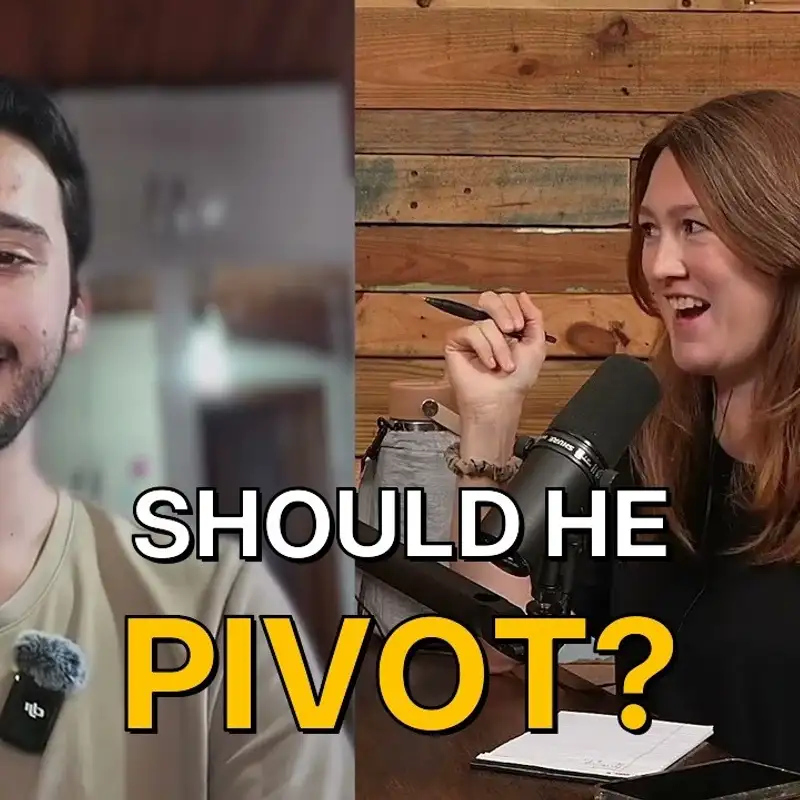
E05 w/ Laura Roeder: Scared to commit to his best customers
Download MP3Jason Cohen (00:00:00)
The star of today's episode of Smart Bear Live is a solo bootstrapped founder in Turkey, a digital nomad who quit his job to take on giants like Buffer and HootSuite, growing his social media scheduling tool to 4K in MRR. But he's stuck. The customers who love the product and never leave are agencies, and he's having trouble landing more of them. So today we're going to help him build a repeatable way to get to those agencies, or whatever we decide is the right customer base for him.
And so who is this "we" you might ask? Well, I'm Jason Cohen. I'm known online as Smart Bear, and I founded and ran two unicorns in the past 25 years. That's Smart Bear and WP Engine, and I've bootstrapped and raised hundreds of millions of dollars, and I've been writing for 20 years about startups, and I just wrote a book. So you can go in the description and buy that, and that'd be great, because we don't run ads. So that'd be pretty good.
Anyway, joining me today as co-host is the great Laura Roeder. Laura is the founder of Paperbell and several companies before that, and in particular, the founder of MeetEdgar. And that's amazing, because it's exactly the same category that our guest is in, and she bootstrapped that to five million in ARR and sold it. So Laura's done everything that Hasan is going to do next.
Now, the reason I'm so thrilled Laura is here, besides that, is that she runs companies almost the opposite way that I do. I go all in, ten hours a day, grinding for like literally fifteen years. And Laura builds one successful business after another in a completely different way, working only a few hours a day with incredible systems that are the envy of many bootstrappers everywhere. And while a lot of people say they do that, Laura actually does do that.
Laura Roeder (00:01:34)
That's true, that's true. And she's done it enough times that it's definitely a system and not luck or something like that.
Jason Cohen (00:01:38)
So I love that the two of us can probably give opposite advice to Hasan, and so that will be very confusing or useful. Or maybe we'll agree, in which case it's definitely right. So anyway, welcome, Laura.
Laura Roeder (00:01:52)
Thank you. Happy to be here. And yeah, I fully exited MeetEdgar now, just to be clear, I'm not a competitor. I'm not in the social media scheduling space. But hopefully I can give you some good insight about that space.
Jason Cohen (00:02:07)
This is awesome. So together, Laura and I are going to help the star of the show, which is Hasan Cagli, who will, of course, correct that pronunciation, with his company PostPlanify. PostPlanify is one place to manage all your social media.
Laura Roeder (00:02:21)
I've heard that before.
Jason Cohen (00:02:21)
Scheduling, content calendar, analytics, one inbox.
Laura Roeder (00:02:25)
Yes. Well, we all need it. That's another reason. It's very, very important.
Jason Cohen (00:02:27)
And it's built especially for agencies or brands that have a lot of accounts to manage. So, Hasan, thank you for being vulnerable and putting your business out here like this, and yourself. It's brave, and it's so helpful and generous to everybody who's listening. So we all thank you for that.
Hasan Cagli (00:02:46)
Yeah, thanks so much, and I also thank you for having me on this podcast. It's an honor.
Jason Cohen (00:02:52)
So Hasan, maybe you can kick us off by, besides correcting the pronunciation of your last name and filling in a little more detail about the situation — we don't need the entire history of the company, but what do we need right now to understand so we can help today.
Hasan Cagli (00:03:05)
Yeah, sure. I mean, the star name is, I think you can just call it Chagli. So, currently PostPlanify is like around 3 and 3.5K MRR. And in the last three months, I've been solely focusing on agencies, small business owners, and also brands looking to manage their social accounts, because before that, I was basically just building this tool for indie hackers, solo creators, like all these sort of kind of B2C-style users. And it was pretty hard, because the churn was pretty high, and also, I mean, those people were, yeah, liking the platform and all that stuff, but they were not really sticking, and they also, honestly, didn't really need the tool. But on the contrary, for example, social media agencies or marketing teams, etcetera, are using the tool daily. So it helped me get from one K to three K MRR much faster than the first one K.
Jason Cohen (00:04:05)
Right. So what many people don't understand, and maybe eventually learn, is that indie hackers are a terrible market, because they don't have any money and they don't really need anything, and they're going to build it themselves anyway. And anyway, they churn, because their stuff usually doesn't work. And if you actually get a company that needs it and has a budget — wow, guess what, that's better. We love hanging out with the indie hackers,
Laura Roeder (00:04:23)
selling to them.
Jason Cohen (00:04:25)
Indie hackers are friends, not customers.
Laura Roeder (00:04:29)
Okay. So you found agencies want it. And you seem to emphasize that you can manage multiple accounts, whether that's for a brand with multiple accounts, which is less common, I guess, or agencies where it is common. Is that right? Is that kind of the angle here, especially if you have multiple social media accounts, or no?
Hasan Cagli (00:04:47)
What do you mean exactly, by the way?
Jason Cohen (00:04:49)
So, I mean, obviously there's hundreds of software products that do what your product does, right?
Hasan Cagli (00:04:53)
Yep.
Jason Cohen (00:04:54)
So I'm just trying to go, like, what's special about yours — or at least, and it doesn't have to be unique, but just what's special. Is it for someone who's managing multiple accounts, that's where it's extra special, or no?
Hasan Cagli (00:05:00)
I mean, a lot of tools are doing that, as I said. So I think the differentiation point is that PostPlanify is much simpler than all the other tools. Because what I notice is, for example, on HootSuite, on SproutSocial, or tools like that — they've been in the space for, let's say, 10, 15 years, and the users are complaining about the complexity and also how hard it is to use the platform and all this stuff. And I think in PostPlanify, also from the feedback that I get from users, is that they find it actually simple and pretty easy to start with.
Jason Cohen (00:05:43)
Is it just one — agency feedback, or just kind of general feedback?
Hasan Cagli (00:05:49)
General feedback, I would say.
Laura Roeder (00:05:52)
Just when I think agency, I think, okay, that's a more sophisticated customer, right? There's social media experts who people have hired to manage maybe a more complex social media strategy. I don't really think agency, like — I mean, everyone likes software that's easy to use, of course, but I wouldn't put agency and simple at the top of the list together. I wouldn't think.
Hasan Cagli (00:16:16)
I assume. Yeah. Yeah, that makes sense.
Hasan Cagli (00:06:20)
And the other point would be that the customization options for the post, such as adding custom thumbnails or adding locations for Facebook, Instagram posts, like these little things — especially agencies or small teams are pretty much looking for these sort of things. I think that's also one more, and also, of course, the prices. I mean, of course, compared to — there's a lot of different tools, and compared to some it is more expensive, and compared to some it is cheaper. But I think prices are also more affordable compared to other agency-focused tools out there.
Jason Cohen (00:06:59)
And what's the pricing as of today?
Hasan Cagli (00:07:01)
Currently, it is $99, $199, and $399. And the $99 is basically 15 social accounts and some base features. $199, it's team collaboration features, reporting, and also 30 social accounts and 6 user seats. And the $399 scale plan is 100 social accounts, 50 workspaces, 12 user seats, and like white-labeling stuff. And there's also the enterprise plan, if someone would want to go beyond.
Jason Cohen (00:07:35)
And what's the relative distribution of that? Is it mostly the small, or the center the most, or what?
Hasan Cagli (00:07:41)
Yeah, it's the $99 plan.
Jason Cohen (00:07:43)
Yeah.
Hasan Cagli (00:07:43)
So the $99 plan is the most popular one.
Jason Cohen (00:07:47)
Is it like 60/30/10? Is that the ratio there?
Hasan Cagli (00:07:50)
I think I would say 70/20/10.
Jason Cohen (00:07:54)
Yeah, okay. Something like that.
Laura Roeder (00:07:55)
Yeah, these are typical.
Jason Cohen (00:07:56)
Um, and then when you said agencies — I'm just going back, I don't want to screw up the momentum, but when Laura said, "I don't understand, agency plus simple doesn't seem like it has an intersection" — how do you define agency? Like, if it's one freelancer who's doing it for a couple restaurants, is that an agency to you?
Hasan Cagli (00:08:15)
Uh, no. I think it would be small to mid-size agencies, such as, let's say, an agency who is handling social media for 20 clients, 30 clients — not necessarily more than that, because I think, for example, if an agency is managing hundreds of, a hundred clients let's say, they are more like an enterprise-ish customer, which would need some more features than that.
Jason Cohen (00:09:45)
So we have different definitions of things like "enterprise." That's not even close. That's like maybe mid, but probably still small.
Hasan Cagli (00:09:53)
Okay, yeah.
Laura Roeder (00:08:54)
Well, one thing I noticed right off the bat is that the way you just described the pricing plans to us, the tiers, is not really designed for agencies. Like, okay, there's an agency looking at, sure, I guess, the mass number of accounts, but they're not really thinking in the number of accounts. They're thinking the number of clients, which I assume is like what you called a workspace. Like, if I'm an agency, I'm like, okay, I have 10 clients, 20 clients, 30 clients, and I need all those to be siloed, right? What I can't do is have this hot mess of just a hundred social media accounts and they all belong to different clients — I need the workspaces, I need the right people on my team to access, I need the clients to access. So I would think that would be kind of the pricing that it would all be built around. And that was just sort of mentioned, I think only — isn't it only even in the highest tier that even mentions workspaces? Is that right?
Hasan Cagli (00:09:47)
In the highest plan, it is just custom pricing, and it is unlimited workspace, yeah.
Laura Roeder (00:09:52)
Does anyone on that plan right now?
Hasan Cagli (00:09:55)
I know. Yeah, let's — that plan is...
Laura Roeder (00:09:57)
Everyone has a theoretical highest plan. Like, sure, if you want to pay me more, come talk to me. But I think in such a crowded space — I'm sorry, I'm probably skipping to a solution too early, but —
Hasan Cagli (00:10:06)
You can do anything you want.
Laura Roeder (00:10:11)
Okay, you can do anything you want. Like, in such a crowded space, I think you need to be only laser-focused. Because social media tools — and actually, as we're recording this, the day before, there was something that went viral on Twitter that was like, "why does every indie hacker make a social media scheduling tool?" And I mean, I launched Edgar in 2014 — that's a long time ago now — it was the same way. It was a crowded space then, it's a crowded space in 2026. So if you're in a really crowded space like that, you don't need, like, "oh, there's also a plan for freelancers," and there's — you need to be just agency. So if you're going just agency, which we haven't dived into that yet, but on the surface definitely could be a good idea, I wouldn't have any pricing plans that are not for agencies. I wouldn't have anything on the website that's not for agencies. Maybe in a different business you can do that, but in this really crowded space, all the plans should be for agencies. They should all be divided by workspace, if I'm right that that's the way agencies think. That would just be kind of like my first thought for you — it's way too crowded of a space to be like, "well, we could do freelancers and creators too."
Jason Cohen (00:11:22)
Would you also strip out the marketing teams on companies, or just laser-focused on agencies?
Laura Roeder (00:11:26)
Marketing teams and companies are a whole different thing, with a whole different usage, whole different needs, for like, users and how — because they're only doing one brand. That's a very, very different use case than having multiple clients.
Jason Cohen (00:11:41)
Yeah, I mean, even "agencies" is not laser-focused. This is just — we're just beginning to cut the facets into the gem that you need to be. One huge one is agencies, or maybe that's a couple. We haven't even — we need five or ten of these. I'm not joking. And that would be fun to do, actually, because what would be really interesting is to say, okay, how do we together figure out your absolutely perfect ideal customer that you would focus on?
Agencies is like a — well, I mean, you could contradict this, but it seems like it's a non-negotiable, because you're already going there and you already like it. What else is something that we could figure out today? And one thing that's really important to remember is, let's suppose we already have the five or ten things — let's say we've done that, and you'd say, "oh my God, that's so specific," because it's just agencies in Turkey who have, you know, between 20 and 50 clients and between 2 and 3 employees — okay, let's suppose it was crazy like that. And you'd worry, "well, if I'm laser-focused on that, there's only like 20 agencies that fit that bill, so I can't just have 20 customers." But that's not what happens. What actually happens is when you're that laser-focused, then all your messaging, all your advertising, all your homepage messages, the pricing plans, of course, and the testimonials you get, the case studies you develop — all of that becomes completely aligned and clear.
And when that happens, number one, the people that are in the bullseye, they know it as soon as they see it, and they sign up, which is great — because that could get you, let's say, a 10K MRR right there. That'd be good. But then what happens is, of course, no one's perfect like that, but for every agency like that, there's a hundred agencies that are kind of like that — close enough, where your tool would still be a good trade-off for them. Right? Because there's literally hundreds, maybe thousands of tools they could buy. So why your set of trade-offs? Okay, so when you're really clear on what that is, they can make that decision — say, okay, it doesn't have this one thing, but man, that other stuff sounds good, and because you've been so clear, they can make that decision. So what actually happens is you have a hundred times the number of customers than your so-called focus area. And some are more perfect than others in your definition of perfect, and the majority of your customers aren't right in the center — because that's right, and that's okay, because you have retained that focus and clarity in everything that you do in alignment.
Then when the next feature request comes in, you know right away — either it helps that ICP, in which case it's at least on the list, or it's not, in which case you don't do it, because it's a distraction and it'll make the product not simple, which is one of the things you said. And that's one of the things you can hold on to — that it's simple.
Laura Roeder (00:13:26)
I love that. You're right. So don't be complex.
Jason Cohen (00:13:29)
Plus, you're a solo bootstrapper — you shouldn't make a complex product. You can't make it and support a complex product. So I like that you said it's simple — so that's another one in the facet, it's simple. Not everyone wants simple. What are you thinking, Hasan? I feel like you're thinking, "that would never — I could never go that narrow, it would never work." That's what I think you're thinking. Is that right?
Hasan Cagli (00:14:49)
Um, I think it would work. I'm just not sure that, for example, let's say a marketing team at a company just with my page — and let's say I also removed the lowest plan, $99 per month —
Jason Cohen (00:15:03)
Well, we're not getting to that, how you should charge for it. You don't need to jump right there and get worried about what's going to happen. What Laura's saying is you're not focused on any segment, and you need to be hyper-focused on a segment, because there's a hundred — there's a thousand competitors. And then once we figure out what that would be, that you think your strengths hit on your weaknesses — like, "I don't have feature X and Y is a weakness" — but for this segment, they don't even want that. In fact, as you say, they see that weakness as a strength. They're like, "oh good, my UI isn't corroded by all that complexity." Hooray, they say, to what other people would call a weakness, which is that you're missing a feature, right? So what we're trying to find out is who that is. And then we can ask ourselves, hey, what should we charge them, how should we morph what you're currently doing into that? That would come afterwards. Does that make sense?
Hasan Cagli (00:15:47)
Yeah.
Jason Cohen (00:15:49)
Because when you're worried, like, "what do I do with my lowest plan" — it's like, you're not wrong, but all that does have to be solved, but you're making it more complex to make the decision of who your target customers are by pulling in stuff that's not needed to make that decision. The decision's already really hard, so we don't want to involve extra considerations, like, "how will I transform my business to that?" Does that make sense?
Hasan Cagli (00:16:12)
Yeah, yeah, it does. So, I mean, since social media agencies are my best customer type, I think that will probably be the most reasonable option to go after. And that's what I am doing.
Jason Cohen (00:16:25)
And what is a social media agency? Like, if I'm a marketing agency that also does social media, does that count? Or do I exclusively do it? And do I do it for whom? Like, is your best customers — are they doing — are they running social media for Pfizer? Are they running social media for restaurants in Estonia? Like, what's happening here?
Hasan Cagli (00:16:46)
Yeah, not Pfizer, definitely. And I think it's just a social media agency, which could be anything that is doing social media marketing for clients as well. So this could be just one of their services, this could be just one specialized service.
Jason Cohen (00:17:04)
Okay. Well, you haven't narrowed it down yet, because all of your customers do social media. That's what it is. So that doesn't narrow it down at all.
Laura Roeder (00:17:11)
Well, also, social media now — a tool that's great at creating LinkedIn content is very different than a tool that's great at creating or managing Instagram stories, you know? So, I mean, yeah — you get to choose what you specialize in, which should be based on — one of the things it should be based on is what you actually want to specialize in and what you actually want to build, or what you have the background or talent to build. You know, like, what do you think you could do a great job building? Like, what slice of this social media use case — trying to get as specific as you can — what does that look like?
Hasan Cagli (00:17:54)
Can we say just, like, social media agencies managing up to 30 or 40 clients or more?
Jason Cohen (00:18:00)
No.
Laura Roeder (00:18:00)
No.
Jason Cohen (00:18:00)
Well, no, I mean, that can be one of the things.
Laura Roeder (00:18:04)
Well, though you said "up to," because I'm like, okay, up to 30 clients is 2 clients — you know what I mean? Um, yeah, that can be one of what — adjacent, call it like a facet. But, yeah, an agency that only does long-form, in-depth LinkedIn posts that are meant to drive to a sales demo and handling a bunch of DMs and cold outreach — that's a totally different product than someone who is having user-generated short-form content on TikTok. But both of those are called "social media."
Jason Cohen (00:18:36)
Yep.
Hasan Cagli (00:18:38)
Then in that case, I'm not really sure what that target customer would be.
Jason Cohen (00:18:44)
Um, when you think about — when I say your best five or ten customers — and that doesn't have to be an objective thing, a couple of names have probably already appeared in your head.
Hasan Cagli (00:18:54)
They basically have clients such as restaurants, or any businesses.
Jason Cohen (00:19:01)
There aren't "any businesses" — restaurants was better, and...
Hasan Cagli (00:19:04)
It doesn't really matter, though.
Jason Cohen (00:19:09)
You just said it's not — you just said it's not. I know it doesn't matter to you, because you're thinking about, "I know how to use all the APIs," but that's not what we're talking about.
Hasan Cagli (00:19:16)
Of course you do.
Jason Cohen (00:19:18)
So restaurants and also Pfizer?
Hasan Cagli (00:19:21)
No.
Jason Cohen (00:19:21)
So what businesses did they serve? Again?
Hasan Cagli (00:19:25)
Restaurants and — this could be farmers?
Jason Cohen (00:19:29)
No, not "could be." What is it that they do?
Hasan Cagli (00:19:31)
They do restaurants and — what else do those five best customers of yours?
Jason Cohen (00:19:35)
They do restaurants and farmers?
Hasan Cagli (00:19:37)
Well, one does food and restaurants business. One does, as I said, farmer or electrical company. It's just like a wide range of companies they are serving for.
Jason Cohen (00:19:54)
And yeah. And what does the electrical company do online? Are they doing TikTok videos? Are they on LinkedIn?
Hasan Cagli (00:19:59)
They are mostly on Facebook, Instagram, and LinkedIn.
Jason Cohen (00:20:08)
And?
Hasan Cagli (00:20:08)
And also, of course, Google My Business too, since most of these businesses — the customers of these social media agencies — are also local businesses we're trying to get more customers from.
Laura Roeder (00:20:21)
Well yeah, that's a huge difference, right? Like, a SaaS company is not on Google Maps — a restaurant, Google Maps and Yelp, and, you know, if there's another local one — are like their most important, quote unquote, "social media," which some — you know, my SaaS company doesn't even consider that social media, because we're not even on there. That's why it does matter when you're like, "why does it matter what type of business" — businesses are doing dramatically different things on social media, you know, like responding to Google reviews is extremely different than trying to get B2B sales DMs happening on LinkedIn. The same tool is not good at both of those things.
Hasan Cagli (00:21:03)
Yeah, I got it. Yeah, this is interesting.
Jason Cohen (00:21:06)
If I'm a sophisticated high-tech company, or even a sophisticated brand, like a large company brand, I may need sophisticated social media stuff — I do things. But I can understand why an agency that says "I run social
Jason Cohen (00:21:22)
Media for ten restaurants can use a really simple tool. Because what the hell's a restaurant doing? Not much. And so what is the restaurant doing, by the way? I mean, ads, but like, what are they doing? Do they just — are they basically not using social media very well? Like, are they using it as just another way to say, "we have a special on Thursday" and that's the end of it? They don't really have another plan other than that? Or is it better than that?
Hasan Cagli (00:21:49)
It is not, at least for the clients that I have. It's just organic posts, mainly on Instagram, TikTok, and whatever, and it's just there promoting.
Jason Cohen (00:22:01)
Yeah. Yeah, is it like you're just promoting?
Hasan Cagli (00:22:04)
Their reviews, their food in their restaurant, or like photo shoots of their beverages or things like that.
Jason Cohen (00:22:12)
So ads. That's ads.
Hasan Cagli (00:22:15)
Well, but not — it's not an actual ad that you're paying for. It's organic content. Well, it's just there is.
Jason Cohen (00:22:21)
Yeah, but like, I guess, what am I trying to say — a more sophisticated campaign would be, "we're going to be the restaurant that's all about farm to table." So we're going to tell the stories of farm to table. We're going to highlight farmers in the area. We're going to talk about how we transform that into dishes you can get. As opposed to, "on Thursday we have turkey."
Hasan Cagli (00:22:42)
I don't get where you're going with this, though. What is this?
Jason Cohen (00:22:45)
Well, those are also really different. So if I'm trying to tell a brand story and develop that — what metrics do I need? Is engagement important?
Laura Roeder (00:22:53)
If they're actually trying to develop their brand and have a story and a message, I would care about engagement of those stories. I would even care if the news picked up some of that. Whereas if it's like, "Thursday we have turkey, here's a coupon," I would then want to know if anyone redeemed that coupon later.
And do you see how that affects the features you have in the tool? That's where you can do really well when you get a specific use case. Because if they're all about — like you mentioned, they show reviews on social media — if that's a big part of their workflow, then you can have a specific workflow in your tool that automatically screenshots the latest Google review, makes a little graphic that looks nice, and pushes that as a video to Instagram, right? That's functionality that could be in PostPlanify, but it would only make sense to build it once you know what those customers are actually doing on social media.
Hasan Cagli (00:23:46)
Yeah, that would actually be amazing.
Jason Cohen (00:23:49)
Of course, replying to things is a thing a lot of these tools do, right? You don't just monitor and push, you respond. So if you responded to a Google review by just responding — which of course one should — that's fine. But just what Laura said: wait, how are we repurposing this review? Well, I guess if it's good — maybe we wouldn't always do this, but if it's a good review, I'm going to want to at least highlight it somewhere. Maybe just verbatim, maybe I do something else. I don't know, but that's part of the quote-unquote reply, right? Part of the reply is what am I actually saying in the Google review. Part of it is, "oh, I've queued this up because it's part of the reply" — quote-unquote — to the review, is repurposing that.
Is there also a widget on my website that has my favorite testimonials? Because in PostPlanify I can star them — like, this should go on the website, and then PostPlanify has a thing that's either an embed or an API. Who cares. Something where they can just have a thing of their testimonials that are actually managed in PostPlanify. In which case they could never leave PostPlanify — because Buffer doesn't have this. Now we're actually — because this is the thing, you're like, "oh, there's so many social media tools, they all kind of do the same stuff." They don't have to all do the same stuff.
Laura Roeder (00:25:01)
Yeah. Yeah. And also that agency would be amazing for them at that point, because look at all this the agency's doing for them at that point, right? The agency's doing more than just running Twitter. And they could never rip out PostPlanify, because you're driving something on their website.
Jason Cohen (00:25:18)
So, I mean, I say "never" — it's harder to leave because you're integrated into their website. So I made that up. Maybe people don't want that, but these are the kinds of things you could think of if you had this focus.
It's funny — you said it could be good for anything, and then you said restaurants and farms. I don't even know what "farms" means. But that's — so it's local, it's non-technical businesses. It makes sense to me why those agencies would want something simple, because they probably don't do anything. But you could perhaps have them doing more, as long as it's more value too, right? Not just more complication, like you said.
But of course, those folks don't need anything. So, is that right? Is this idea of agencies who serve local, non-technical businesses — is that right?
Hasan Cagli (00:26:06)
That's a good — yeah.
Jason Cohen (00:26:09)
And they care about simplicity? And then they're local, but are they everywhere in the world, serving their local businesses, or what?
Hasan Cagli (00:26:17)
The agency? No, they're just mostly local businesses.
Laura Roeder (00:26:20)
No, but the agencies are one or two locations. But the agencies are where?
Hasan Cagli (00:26:24)
Anywhere? Anywhere, yeah.
Jason Cohen (00:26:28)
No, you're not supposed to say "anywhere."
Laura Roeder (00:26:29)
Jason doesn't like it when you say "any."
Jason Cohen (00:26:31)
That was a trick question, Charlie. So if they're in China, it's okay? You have a lot of Chinese agencies on your platform right now?
Hasan Cagli (00:26:39)
There's Australian, there's from the United States, there's from the UK.
Jason Cohen (00:26:45)
So that's why, I mean...
Laura Roeder (00:26:47)
Oh, all those countries...
Jason Cohen (00:26:49)
They have something in common.
Hasan Cagli (00:26:51)
Yeah, that is true.
Jason Cohen (00:26:51)
Why don't you have a bunch of Turkish customers? I don't understand that.
Hasan Cagli (00:26:57)
I think it's because of the buying power. The countries like US, UK, Australia, whatever — they just tend to, um, they can just buy these kinds of tools and they can also justify the pricing.
Laura Roeder (00:27:16)
Yes, but your website — your website is in Turkish.
Hasan Cagli (00:27:18)
No.
Laura Roeder (00:27:20)
Well, that's why — that's why you don't have a lot of Turkish customers.
Hasan Cagli (00:27:24)
So I also don't want Turkish customers.
Laura Roeder (00:27:26)
Why, you don't like Turkish people or what?
Hasan Cagli (00:27:29)
No. It's all about buying power.
Jason Cohen (00:27:32)
I know, but why don't — I mean, from my own... Okay, so if you could have a hundred K in MRR right now, in Turkish customers, you would not want that?
Hasan Cagli (00:27:41)
I would want that.
Jason Cohen (00:27:42)
Oh, I thought you said you didn't want that.
Hasan Cagli (00:27:46)
That is pretty hard to do, compared to if I just go from the US, UK, or...
Jason Cohen (00:27:53)
Really? Because right now it seems pretty hard to do now. Like, it's not working now. So I'm not saying you should take down your English-speaking page — I hear you. I'm also pressing you on purpose, right? One thing that always baffles me is when someone is native somewhere, they don't use it. And I understand, "oh, people in America have more money to spend," I get it, you're not wrong. So, okay. But why would you not take advantage of something that almost no other company has, which is that you're legitimately, authentically Turkish?
Hasan Cagli (00:28:30)
Well, if I don't get it...
Laura Roeder (00:28:32)
I get it because I'm American, but I live in the UK, and it's — you just don't, these other countries are so tiny.
Jason Cohen (00:28:38)
Yeah, but he's at 3K MRR. I mean, if the question was how to go from ten million ARR to a hundred million, I would say you've got to probably leave Turkey alone.
Laura Roeder (00:28:47)
Well, the way I would put it is just that it's worth considering where you can have a business that can get to a hundred K, right? So, like, I have no idea what the Turkish social media marketing tool landscape is like — maybe it's bone dry. And so, yeah, maybe if you did focus on Turkish customers and put it in the local language, then that actually would be the easiest path to a hundred K. That's kind of how I'm thinking about it — not instantly throwing that out, but kind of considering it, again, because you are in such a crowded space.
Hasan Cagli (00:29:22)
We gotta find something. Like, the local agencies in America are gonna be better.
Laura Roeder (00:29:27)
They are, and they have a thousand choices.
Jason Cohen (00:29:30)
Here's what I just heard: someone who is one of the world's greatest experts in this subject matter doesn't know what the social media landscape looks like in Turkey. That's how unknown it is to other people. I mean, you want to talk about being different from a thousand companies?
Hasan Cagli (00:29:48)
What?
Jason Cohen (00:29:48)
Like, even if it's small, and you get 10% — and, of course, one should never use this thing of "there's this many people and I'll get 10%," that's actually a stupid argument. But when it's completely unknown to even world experts — even if it's small, if you could win pretty easily...
Laura Roeder (00:30:07)
I mean, again, it depends on your goals.
Jason Cohen (00:30:09)
If you're — but I would think if your goals are like, "geez, if I could just get to 10 or 20K MRR, I'd have more options, and I'd be more comfortable, and that business would be pretty solid" — with that kind of a thing, if you put your website in Turkish also, and tried even a little bit to get agencies there, even just as a test to see... I don't know, like, you can so easily win against 990 out of the 1,000 competitors. You can just win instantly. I mean, even in a small market, I would want to at least try that. Now, I may be wrong, because that could be a bad way to do it, but that's got to be an option, at least, to consider.
Hasan Cagli (00:30:54)
Yeah, I get it, I get it. But don't you think instead of location, just niching down on the target types would make much more sense?
Jason Cohen (00:31:03)
This is because of...
Laura Roeder (00:31:05)
Well, they aren't mutually exclusive either.
Jason Cohen (00:31:07)
No, no — this is niching down. It's niching down to Turkish speakers.
Hasan Cagli (00:31:10)
Yeah, no. And I'm not saying — what I'm saying is, instead of location or language, just by the Turkish-ICP side.
Jason Cohen (00:31:18)
Well, again, whatever — you can do many different things. There are many different ways to cut it. One of the ways that almost no one else can do is Turkish. And then you're saying, "yes, I can do that almost uniquely in the world." But — "no, I'm not going to do that." That's okay, because there are good reasons not to do it. So I get it. I get it. But that's why I wouldn't just throw that away because you assume there's no one there and you haven't even tried.
Hasan Cagli (00:31:49)
Yeah, I got it.
Jason Cohen (00:31:49)
So nobody does social media scheduling in Turkey? That doesn't happen? There's no agencies, and they don't do social media for local businesses in Turkey at all?
Hasan Cagli (00:32:00)
They do, but I think the customer type — especially from what I see — is that if people can do it manually, they just do it manually. For example, the customer type in Turkey, they don't want to pay for another solution, even if it will make their life much easier. They're not as tend to pay compared to US or UK customers, let's say.
Jason Cohen (00:32:31)
Well, at the moment, not many people are willing to pay.
Hasan Cagli (00:32:34)
Is it because I'm doing something wrong, or is it just because I'm liking something, or is it just because that's the way it is?
Jason Cohen (00:32:39)
Well, I don't know, but what I'm suggesting is maybe none of us know.
Laura Roeder (00:32:42)
Wait, I know, because I've looked at your website.
Jason Cohen (00:32:44)
Okay, never mind.
Laura Roeder (00:32:47)
The only — the only unique sort of thing that I found on your website is you were like, "I'm the founder, and you're going to work directly with me." I would say that was the only sort of thing I was able to get from your website as a specific angle. That, to me, is a very indie-hacker-market type of angle. I think a lot of people are going to run from a company where they're like, "oh, it's just me, don't worry about it" — you know, like Jason's pointed out, things are a positive for one person and a negative for another. That's probably like — and also, in such a crowded space, there are a lot of social media scheduling tools that are founder-run. So it doesn't, to me, feel like a differentiation that was really designed around your target customer. It feels like you were like, "I don't know, it's all I got." But now that we've had this conversation, and you know, to design something around the target customer, I think you can design something that's much more compelling.
But I would say that's, to me, what you're doing wrong — I look at your site and I just think, why would I? Why would I buy you? You have to give me some reason to buy yours among the thousands of others. You can't just hope that they're like, "I don't know, I'm tired of looking at sites and I landed on this one last."
But — and I hope this is connecting — this is why having a clear target market and differentiation, it all ties together. It's not just marketing BS, which I think is kind of what a lot of people think — "oh, it's just marketing BS that you put on your site." It's actually designing and crafting a product that will solve a specific problem better than all the others. And then you actually do have something specific to write on your site, and you have something to say when people are doing the demos and they ask, "why should I choose you?" You're like, "well, we actually have this functionality designed just for your specific use case, so we know we do it better, because that's in there and all the stuff you don't want is not in there."
Jason Cohen (00:34:49)
Yeah, that's a really good point.
Laura Roeder (00:34:50)
And also, I would intersect that with your price, because your price also says a message. So when you say it's 199 or 399 — and as you just said, "oh, in Turkey no one would pay that ever because they're like, I don't spend money to make money in Turkey" — I would say, okay, so those prices say, "I am a company you can trust, this is a real deal for people that do real work." And then they turn around and say, "oh, by the way, it's just me, I hope I don't get sick, because then tech support doesn't work." See? So it's contradictory to that pricing model.
And so the indie world wants to support other indies — so that's good if you're selling to indies, which, as you well know, you shouldn't. So that might be a vestigial leftover from that world that you now forgot.
Hasan Cagli (00:35:35)
Oh, wait — my clients right now actually would see that as a negative, because it means your company's not stable.
Jason Cohen (00:35:42)
I see. Yeah. Right.
Laura Roeder (00:35:44)
So I still think it's nice, on an about-us page, to be personal — that's good. "Our founders, you know, we ran into this problem and then we decided to solve it, and now we're so thrilled we have thousands of customers" — and, "I started on my own, I bootstrapped it up to this point, now we're solid." I like that on an about-us page. I think things that humanize — that's good, that doesn't detract from the idea that you should trust this company. So there's a time and a place for some of that stuff. But saying "I'm the only one here," so — "I guess you're going to depend on this tool, who knows what's going to happen" — that's not good for an audience who also wants to pay 300 bucks a month for a serious tool to manage things for hundreds of customers.
Hasan Cagli (00:36:33)
Yeah, yeah, got it.
So — so if I'm an agency, how do you think I can niche down, by the way?
Jason Cohen (00:36:40)
Well, that's what we're talking about, what we're getting at, what we're doing. So we already said a couple things, maybe. One is it's agencies, not anyone else — not direct.
Hasan Cagli (00:36:49)
Yeah.
Jason Cohen (00:36:50)
Simple, because, of course, it is — that's a description of the product, but what we really mean is customers who value simplicity.
Hasan Cagli (00:36:59)
Why do they value it?
Jason Cohen (00:37:00)
Okay, that's a good subsequent question, but we're saying it is niching down to say people that want a tool that's simple more than they want a tool that's full-featured. That's a decision, that's important, because it'll help say, well, who wants that? I think we've said local — we've talked about it, because when we asked what your best customers were today, you mentioned only local things and never anything else. You didn't say, "oh yeah, and also an agency that does social media for Zendesk." You didn't say that. So is that right? Is that a decision you want to make — that it's agencies who do social media for local, non-technical businesses?
Hasan Cagli (00:37:38)
I mean, at least so far, my entire experience is that — and those kind of big clients, sort of agencies...
Jason Cohen (00:37:56)
And why don't you want to make that decision? Are you scared there's not enough of them? Or, why — if it's your best customers, why do you not want to make that decision still?
Hasan Cagli (00:38:15)
I mean, it's hard to make a decision.
Jason Cohen (00:38:16)
I get it, but what is stopping you? Given your best customers do it, you're like, "but still, I don't want to do that." Why not? Why don't you want to do that? What's in your mind?
Hasan Cagli (00:38:26)
I think if an agency is managing, for example, social media for Zendesk, they will probably be more looking for more features — like more enterprise-level features, such as...
Jason Cohen (00:38:37)
And so — why is it difficult for you to say, "yes, agencies that serve local, non-technical businesses is what I want to focus on"? I realize it's hard to make a decision like that, but why — given that it's your best customer so far? What? So that means that's a vote for doing it. But you're like, "no, I don't want to decide, I don't want to do that." And so — what, even if it's emotional and not logical, that's okay, it's totally fine that the stuff is that way, and that's okay. I think, anyway — what, why are you like, "I don't know"?
Hasan Cagli (00:39:07)
I don't know. I'm just not sure which one — I'll say no.
Jason Cohen (00:39:11)
Why aren't you sure? There's all these reasons to do it, so why don't you? You're not going to have the data. All you have is your customers — that's what you have. The data — there's an infinite number of agencies, because they serve every kind of company that exists. That's the data. Then the only other data you have is your own customer base — that's all the data you're going to have. Then the most reasonable option is to just focus on the local type of client agencies. It's a reasonable option, but you don't want to do it, and why is that — that's what I'm trying to get to. You can think about it for a second.
Hasan Cagli (00:39:48)
I don't want to do...
Jason Cohen (00:39:50)
Yeah, you don't. You can tell. We can tell — "oh, that's the most reasonable option," you're not saying, "oh, what a relief, okay, great, you guys have given me permission to just focus on agencies." So there's something in your head that's thinking this is not going to work out. What is that, going on in your head? Or you don't want to? Is it closing a door? You can think about it for a second — this is hard, it's hard to figure out why we think stuff. I still don't know why I think half the things I think.
Hasan Cagli (00:40:14)
I think I'm just — still not sure what would be the target ICP for PostPlanify, if I...
Jason Cohen (00:40:21)
So, I know, but that's what we're trying to figure out. Why — just stay on this one question. When we say agencies, you said, "yeah, okay."
Hasan Cagli (00:40:31)
I mean, I kind of want to do the markers, but okay.
Jason Cohen (00:40:34)
You let go of that very quickly and said, "okay, yeah, agencies, okay" — that seemed like an easy decision for you earlier. Simplistic — you're like, "yes, simple, that's good, obviously the product is simple, it probably doesn't..." — so you immediately went, "yeah, yes, people who want simple stuff, I'm good with that facet, we can cut that off of the rock, I'm good." And then we said, "oh, local businesses — agencies that serve local businesses," because that's what you said your best customers were, and now we've asked like five times, and you're like, "no, no, no, no, no, no, don't like that one." So why don't you think about what's — what is actually, what's going through your mind when you say no?
Jason Cohen (00:41:13)
Are you afraid that it's too narrow, that they don't have enough money?
Hasan Cagli (00:41:16)
It's not that. It doesn't feel good enough. I'm just afraid it's not the right decision for the long-term play.
Jason Cohen (00:41:26)
Yes, but you could have said that about having a simple product, and you could have said that about choosing agencies, but you didn't. Why this one?
Hasan Cagli (00:41:36)
Of course, any decision you make might be wrong.
Jason Cohen (00:41:38)
We know. Why this particular facet are you like, "hmm"?
Hasan Cagli (00:41:43)
I don't know about that. It's my best customers, but I don't know if I want to focus on my best customers because...
Jason Cohen (00:41:50)
You worried it's too small? Of a market?
Hasan Cagli (00:41:53)
I don't think it's too small. I think there's a lot of agencies doing that.
Jason Cohen (00:41:56)
Okay.
Hasan Cagli (00:41:57)
I think most of the agencies are doing that.
Jason Cohen (00:41:59)
I mean, okay, awesome. Yeah. Okay.
Hasan Cagli (00:42:02)
Compared to other options.
Jason Cohen (00:42:04)
Cool.
Laura Roeder (00:42:06)
I feel like we should just acknowledge that this is an arbitrary decision. I think that's kind of one of the reasons you're struggling with it. And this is a really hard thing about business — I always say you do not become psychic by thinking about things more. We kind of have this fantasy, right, that if I think about this more, if I just keep thinking about what is the right target market, the answer will emerge. There is no correct answer. There is absolutely no correct answer. None of us can predict the future, right? This could be horrible. You can target agencies that serve local businesses and it could be a disaster, but then you would find out, right? You'd be like, "I've been busting my ass calling all these agencies all the time, and they're cheap, they don't want to pay for it" — but then you would have real info.
So I just want to acknowledge that there is not a correct answer. We are not going to come to a correct answer because it genuinely doesn't exist. And if this feels sort of arbitrary and random — I don't know, we're just talking, like — it is arbitrary and random, but not completely, because we do want to choose something that you like serving, that you feel like you can build a good product for them. But the right answer will never emerge from more thinking about it.
Hasan Cagli (00:44:19)
Yeah. Yeah, I totally agree.
Jason Cohen (00:44:20)
And yet it did come from somewhere — your best customers that you're already able to serve. That's why I'm so excited about it. It's already a strength. Can you lean into strength?
Hasan Cagli (00:44:31)
Well, maybe not, because maybe the market's too small.
Jason Cohen (00:44:33)
But you just said it's like the majority of the market.
Hasan Cagli (00:44:36)
Okay.
Jason Cohen (00:44:36)
So it's a strength of yours. You're already winning — to the extent that you're winning, you're already winning there. And yet you don't want to focus on that, which — maybe I should drop it, because I get it. And again, if the tables were turned into something else, I get it, I could be frozen and not know either. I get it. So I'm not — that's okay. I just, I'm trying to drive to it because whatever that is is important. It's something that you feel, something that you are, and we want to incorporate that too. That's why I'm driving it — not because I want to know everything about how you feel about this and what you're going to love doing, so we can try to design something for that. So we have to try to pull it out of you.
So, do we want to say, for the sake of argument, that we're going to include this facet and continue, or do you not want to, and you want to explore — because we're going to explore other facets regardless? Do you want to just say, "no, I'm just for whatever reason not comfortable with that"?
Hasan Cagli (00:45:29)
I think I'm comfortable with that. Also, just because of the fact that, as you said, I'm already a guy used to serving those kind of agencies. So that's totally cool.
Jason Cohen (00:44:41)
Who's your next best customer today who isn't serving local businesses — local, nontechnical businesses? And you don't have to name them.
Hasan Cagli (00:44:54)
There's a customer, but yeah, of course. There is a customer who is managing social media accounts for two of their businesses, and they're basically not an agency, just a business. And it's not a local business — no, I think it was an e-commerce business.
Jason Cohen (00:45:14)
Okay, you can't — okay, so —
Hasan Cagli (00:45:16)
And I don't remember, I don't remember the other business.
Jason Cohen (00:45:18)
And I know this is very, very rough, but as you're ranking your customers by how good they are, are they in like the top three, or are they like number six? Roughly speaking.
Hasan Cagli (00:45:30)
I think it's around seven.
Jason Cohen (00:45:32)
Okay, I would say — see, to me, that's data. Out of your top ten customers, this is not the use case you're already winning with.
See, what I find a lot of people do — and absolutely me too, so I don't want to speak for you, but I know a lot of people do this, and I do it — is every time I think about this kind of limitation, my mind just goes right past numbers one through six, who would all be thrilled. And you could get a whole lot more like one through six if you put this on your homepage, because other people don't. Hootsuite doesn't say "best for local business." Buffer doesn't say that, because they're not, by the way. And then eventually, soon, by the end of this year, you're going to have three features that are only good for that, that nobody else has. And so then when another agency, like numbers one through six, shows up on your homepage, they're like, "holy crap, where have you been my whole life?" See what I mean? That is what we're trying to create.
And you're looking at number seven, thinking, "well, what about them?" And I'm saying that as if you're being dumb or illogical, but I'm telling you, I do this all the time. Maybe it is dumb, maybe it is illogical, but it's also extremely human, and I do it constantly. That's part of what I think this — what we're doing right now — is useful for: for someone to hold the mirror up and say, "look, you're doing it." I need that too, just to be very clear — we all need it. The greatest sports people ever still need a coach to hold a mirror up, not because the coach is better than them at the sport — that's not why. It's because someone they trust holds a mirror up, and they can go, "yeah, yeah, okay, okay, okay, I see it, I see it, fine, fine, fine."
So is that the case here? I don't know, I'm projecting onto you, so I don't know. But it could be that when you're ignoring the power of one through six, and how to get a hundred more of them, because "what about number seven" — it's a really easy fallacy to fall into, if that's what's going on.
Hasan Cagli (00:47:31)
Yeah, got it. And do you think if I just niched down to agencies, would I just lose that customer type?
Jason Cohen (00:47:38)
Niching down to agency is not a niche. Agency is not a niche — that's one facet in a gem that then becomes your niche. Even "local agencies that want simple things" is much, much better, but that's still a market segment — a whole market segment with millions. There's millions of clients across hundreds of thousands, if not a million, agencies. That's still an enormous market, not a niche.
Hasan Cagli (00:48:07)
So you're saying I'm going to niche because I chose agencies?
Jason Cohen (00:48:10)
No. Well, but to answer your question — yes, you will lose some people who are not in the target market, because we're moving the tool to be built for those people. But I think it's like, now you have basically nothing — not in a rude way, I hope that doesn't sound rude. I just mean it in the way that, you know, you came here because you're like, "I'm not happy with it, I know it's not working." So you don't really need to worry about disassembling what you already have. And I know — I looked at your Twitter, I know you already started another business. I also feel like you're here being like, "I don't want this dumb social media business, I just want to do something else." I'm wondering how present that thought is in this hesitancy.
But yeah, you're going to lose — it's like, yes, if you focus on a new market and build a tool for a new market, you will likely lose some people from the other market. But we have so few people to lose right now. Don't even worry about what you have now — you can build something so much bigger and better. The mentality is: you're not winning anywhere right now, so you're not losing customers by moving to agencies, because you don't have them yet.
And so here's the other thing — the power of having a homepage, not to mention pricing and ads and everything else. When I'm an agency that serves local businesses and I want something simple, and I show up on your homepage, and I'm like, "oh my god, you're the only choice for me, you're clearly the best choice for me," because you have those extra three features we're imagining you'd build for this use case, plus that — literally the only social media product on earth that's right for that person. And that's legitimate, that's not just your marketing — you really are the best one on earth for that. The power of what you win in customers, because you capture them on the homepage, you can talk to them in the first place, and the ads, the word of mouth from them to other people, because it's true — the power of that is a thousand times more important than "oh, but there's a marketing agency with a thousand employees and one of their customers is Nike, and they're not going to buy you." We're giving that up.
Hasan Cagli (00:52:00)
Oh no.
Jason Cohen (00:52:01)
See what I mean?
Hasan Cagli (00:52:02)
Mm-mm.
Jason Cohen (00:52:02)
They're not a good fit anyway, so you're not losing them. You gotta carve out something that you can be the best at, which you totally can.
And "best" isn't just features — a lot of things we said just now aren't even features, though some are. But "best" means a lot of stuff. And we're so scared, like, "but what about number seven, we won't get them anymore." No — you won't get number seven anymore. Instead, you'll just have two hundred like one through six, and you'll actually get them, which you don't have yet.
And I know it's — actually, I love this, because the way you're feeling and reacting is exactly what everyone does, and again, I'm putting myself in it — maybe not Laura, she's much better at telling people no and telling customers to F off so she can just build the company she wants, so maybe Laura doesn't have this gene. But I have it — on my fourth chromosome it goes G-T-T-A-C, and what that does is it makes me never want to do anything that would let a customer leave and not stay on the website, not buy when maybe they could have bought.
I mean, I don't want to speak for most people, but surely most of us are like that. We just don't want to be specific, because that means we might lose somebody — not realizing that we'll get ten or a hundred times more of the ones that are best for us. They'll be profitable, they'll pay the three hundred bucks, and they'll stay forever. And they'll love you — and actually, Hootsuite is not a good option for them.
Hasan Cagli (00:59:59)
What? That's amazing.
Jason Cohen (01:00:02)
Right now none of that's true — you could create that. And sure, if the total addressable market is actually six customers, then okay, fair enough.
Hasan Cagli (01:00:09)
So you said Turkey might be more like that.
Jason Cohen (01:00:11)
Okay, maybe I'm wrong about that — okay, fine, I don't think that's true, but that's fine, what do I know, I don't know anything about Turkey, so who cares what I think about that. So, all right. But you said the local people could be even the majority of the market, so that's barely even niching down.
And then the other thing I said is also true in my experience, which is the other people will buy anyway.
So, uh, WP Engine — great, you know, my company, right — we've always been the more expensive thing in the market, always been "more for more." You pay more, you get more, but you get the best. And I've always said, look, if you don't care about your website that much, you shouldn't be a customer of WP Engine, because why would you pay extra if you don't care that much. If you don't care whether the website has high uptime and is fast and ranks high on Google — if you don't care, why would you spend twenty-nine, thirty-nine, forty-nine a month when you can spend literally two bucks a month at Bluehost?
Hasan Cagli (01:01:11)
You sure it's not as good? It's also two dollars.
Jason Cohen (01:01:13)
It's a freaking amazingly great ROI over there.
Hasan Cagli (01:01:17)
What are you talking about? How could anything be two dollars? It's amazing, what are you doing?
Jason Cohen (01:01:20)
And yet — how many of our customers are here anyway, even though, I'm just saying, look, I don't know why you're paying that much.
Hasan Cagli (01:01:28)
Well, various reasons — they still want the best. It's aspirational.
Jason Cohen (01:01:31)
But they don't buy if they're not on WordPress.
Hasan Cagli (01:01:34)
Oh, yeah, well, that's for sure.
Jason Cohen (01:01:36)
But that's a brave move — you're so used to it, but that's an extremely brave move, the fact that the vast majority of hosting companies, 99% of hosting companies, don't have any kind of specialty at all, right? If you think about GoDaddy or Bluehost, sort of for small business, maybe not really. WP Engine is like, "we are only for WordPress." And I can imagine you sitting in Hasan's shoes thinking, "that sounds insane, why would someone be only for a tiny slice of the internet?" It's actually a really scary, really bold move to say, "no, we're only for WordPress," because you're not getting all the people who aren't on WordPress — they're not your customers.
Hasan Cagli (01:01:57)
Yeah, yeah.
Jason Cohen (01:01:57)
And yet, so people have said we should support Drupal, because it's exactly the same stack — PHP, MySQL, blah blah blah, even things like caching are very similar, plus it's a CMS, "oh my god, it's the same thing." And we never have, because that would dilute what we are. And also, then we'd be competing against the people who do that for Drupal, and we'd be second-tier in that — our story wouldn't be as good, and in fact we wouldn't be as good, because that's not our roots, that's not our DNA, not our culture. We'd have to go to more conferences, everything's diluted — it would definitely be worse, so that would definitely be a bad idea.
Now you could say, but WordPress is 43% of the internet, which it is, and Drupal is only 2%, which is true — so that's a good reason. However, Acquia specializes in Drupal, and they have at least as much revenue as we do.
Hasan Cagli (01:02:23)
But wait. But wait, it's a twentieth of the size of the market.
Jason Cohen (01:02:27)
Yeah, but they're good at it, and they specialize in it — so they have the same revenue as we do.
Hasan Cagli (01:02:33)
Wait, what?
Jason Cohen (01:02:33)
And so this is what we're getting at for you — of course the analogy isn't exactly perfect, but that's what we're trying to get at: when you pick something you can be the best at, then you can really win there. Never mind what percent of the market — I don't even care, as long as the market's healthy and good and growing, which this is. Social media listening and reacting is obviously important still, maybe more so than ever, it's not waning. Obviously there's AI stuff you could put in there. It's obvious there's lots to do.
It's so funny — you yourself said maybe it's most agencies. Okay, maybe if it's not most, maybe it's 40%. Okay, well, there's literally millions of agencies in the world — millions — so you're going to only niche down to 40% of them? What? That's barely a niche. You see what I'm saying?
Hasan Cagli (01:02:57)
Yeah. And I have a question, by the way — so, for example, for WP Engine, why didn't you niche down further, to WordPress websites only for restaurants or whatever, but just for WordPress?
Jason Cohen (01:03:09)
Yeah, so we did niche down further, but we didn't do it by industry — industry is one way to do it. And by the way, companies have niched down like that. Toast niched down to just restaurants, and because they did, they were able to say, "wait a minute, let me run your whole back office, let me run everything, I'll run all your orders, so your menu will be online and we can take orders that way, your menu's also on an iPad and your server can take orders that way," which reduces errors, and we can take payments there — so it's all one thing, you have lots of data, the back office is good, etc. Because they chose just restaurants, they were in fact able to do that.
So could Toast have made more money if they'd also done that with another type of business? No — because by focusing on restaurants, that's how they won. And so we don't do a lot of websites for restaurants; Toast does, and they took all of our restaurant business — and thank goodness we didn't specialize in restaurants, because... well, I suppose if we had specialized, that'd be different, but since we didn't, and they did, they win. Now, these are all big-company things, so you could argue whether that does or doesn't apply, fair enough — but it does answer the question you asked about why we didn't do it. So I'm giving you examples from our world.
Same thing with e-commerce — WooCommerce, the WordPress commerce system, is the most popular in the world if you count domains, but Shopify makes a whole lot more money than WordPress people do in e-commerce. Shopify is an amazing juggernaut, because of course they specialize in e-commerce. So you can go down the line and you'll find people who specialized more than we did, winning wherever they specialized. Everywhere you look, you'll see that.
So where did we specialize, instead of an industry like restaurants? We specialized in being premium — meaning these particular four things. Ready? Here's what we did: sites fast, scalable, secure, and our service is amazing. Each of those means something — we have data, there's promises, maybe there's SLAs, where you just see what our support is like and find out for yourself. We even hired people who were well known in the WordPress community to be part of some of those teams — that's another example.
And so what would happen with agencies, for example, is agencies who build WordPress sites — they're going to recommend a host, because agencies never host; they want to be paid by the hour and not get woken up at two in the morning on a Sunday with some weird tech thing. They want someone else being that person, right? So agencies are going to put it somewhere they know we're going to do a great job to make them look good to their clients — because if we mess up, even though it's not their fault, that's going to make them look bad to their clients. So they need someone who's going to make them look great, and when something goes wrong, that we don't badmouth them to their clients — which many of our competitors did do, by the way — or other hosting companies that just simply say "we can't help." Maybe that's not badmouthing, but it's also at least not helping, if not making it worse. And so we never do that — we try to diagnose stuff, we talk to the agency directly, we try to work out what's really going on and how to fix it, and we fix it together. So what the client sees is, "oh great, my vendor just solved it, great" — everyone's happy about that. That's the kind of thing I mean by great service and premium.
And we charge for it, but agencies are willing to tell their clients, "look, you've got to get the best, you can't screw around — if you think this is expensive, you should see how expensive cheap is," and all those kinds of arguments, which are real, those are not false — but they'll be willing to make that case because it's great for literally everyone, including the customer at the end.
Now, that is niching down. How do I know that? Because almost every hosting company is completely generic and doesn't say that. Amazon doesn't say that, Google doesn't say that, Bluehost doesn't say that, GoDaddy doesn't say that. Companies like GoDaddy have literally millions of customers — all of those companies are many, many times, in fact orders of magnitude, bigger than us in customers, and in some cases, like the cloud companies, also an order of magnitude or more in revenue than us. So those choices we made about being a premium WordPress host made us many orders of magnitude smaller in terms of the number of customers we could ever have. That's niching down — that's orders of magnitude, that's a lot: a hundred thousand times fewer customers than we could have had if we'd just said "WordPress for everyone." And here's the thing — the alternative also starts at five bucks. So, massive niche-down, just not by industry like restaurants, but rather in this area of being premium, and all the things that then means, and then who that means we would sell to. There's more to it besides that, but yeah, we have to deliver a lot, but we can charge a lot, and all the consequences that come from that.
Jason Cohen (01:01:01)
So it still could be a restaurant, but now that's Toast's territory. But the homepage speaks to a mid-size company — and by that I mean, let's say, a company at $2,000,000 in revenue with maybe 400 employees. That's an example of a mid-size company whose homepage is on WordPress, and they want to go with us. But that's not an industry, right? It is, though, a set of consequences that narrows the thing.
One more thing I'll say: as a company matures, it can serve more than one little niche. It doesn't have to, but you can expand. So, for example, we started with mid-size companies. We eventually expanded to enterprises — we have a lot of enterprise customers now — but the reason we did that is we started to see success there. Not to take over the homepage of, let's say, McDonald's, but taking over the campaigns that McDonald's would run, where they still needed to be really good but they can't and won't pay their big global agency millions of dollars for the campaign, or put it on the big expensive hosting that McDonald's.com sits on. So McDonald's would buy, but for a different reason. And Wells Fargo would buy, but for a different reason. And some other big brand would buy for yet another different reason. So what we ended up doing was saying, "oh, enterprises will buy, but for a different reason," and then we invested tens of millions of dollars over a couple of years to serve them — technology, service, sales, marketing, account management — things we didn't have before. You could call some of that "service," but whatever.
So we didn't just say, "let's run some ads," or "let's write 'enterprise' on our pricing plan — call us, now we're enterprise." It was a complete transformation. I know I'm going on and on, but hopefully it's useful seeing what it actually takes to expand into another niche. Because it was such an investment, we could actually pull it off — and only because we saw the first signs and knew what message to use as we went into it. Even that was years in, and only because we saw certain things and then it took years to develop.
So that's a long way of saying: we absolutely niched down. And even now, though we're still small, we expanded somewhat — but only through all of that groundwork, not because we randomly decided to, but because we were ready. And I'm still trying to figure out what "ready" means so it's not just a generic answer. So — coming back to you, and stopping this soliloquy here — I think this is all convincing you that it's good to narrow as far as you can, and you'll still get plenty of customers anyway.
Oh, I should add — everything I just said about agencies applies here too: marketing teams also want to keep their jobs, they also don't want us bad-mouthed, and they also want to work with us. So that doesn't exclude the marketers. Still, I think you should say the pitch is best for, you know, agencies that serve local businesses. I think a headline like that would suddenly make you either unique or a close call — even before you add the other facets, which you should still do. We should still talk about that. And, honestly, that'd be incredible.
Hasan Cagli (01:04:11)
I should make a Turkish version just to see.
Jason Cohen (01:04:14)
Okay, where's your head at? Have fun.
Laura Roeder (01:04:17)
Don't make the Turkish version, okay?
Hasan Cagli (01:04:24)
Yeah, I got it. And how do you know when you've niched down enough, by the way? I mean, how did you find that? If I say that only social media agencies that serve local business clients — is that enough, or...?
Jason Cohen (01:04:40)
Well, there's not really going to be a good answer, but one thing you could do — I like using powers of ten to try to ascertain things like a quote-unquote market size. I also don't think market size is all that important at this stage, but anyway — okay, still, when you ask "is it too small," you're asking a market-size question. So okay, I like just using powers of ten because usually we can do that. How many social media marketing agencies do you think there are in the world who serve local businesses? And you're only allowed to answer as a power of ten — is it a million, a hundred thousand, ten thousand, or what?
Hasan Cagli (01:05:20)
I think it should be around 100,000 to one million.
Jason Cohen (01:05:24)
Okay, so I don't know the exact number. Well, let's see — how many local businesses are there in the world?
Laura Roeder (01:05:28)
It's in the hundreds of millions. Because the U.S. has something like — 50 million? 10, 10 million? Something like that.
Jason Cohen (01:05:38)
Yeah, I was going to say, if we make it just the U.S., to make it simpler.
Laura Roeder (01:05:41)
I feel like it's more like 100K than a million — in the U.S., yeah, in the U.S.
Jason Cohen (01:05:45)
Yeah. So the U.S. is probably around 100K, so the world's probably a million. It's unclear if you should use the world or not — there are so many languages in the world.
Hasan Cagli (01:05:53)
True.
Jason Cohen (01:05:54)
Okay, so which one do you want to use?
Hasan Cagli (01:05:58)
Let's say a million.
Jason Cohen (01:05:59)
A million? Okay. So clearly, if you said "serving agencies who serve local businesses," you've quote-unquote niched down to a million possible customers — which is a magnitude more than you would need. So I like it. I already like it, and you're nowhere near the floor — nowhere near niching down too much. Whereas, let's say we went through the same exercise and started adding other filters — "also simple." You're too simple. Do they all want something simple? Or would you say only 10% want something simple, and the other 90% want something more complicated? What do you think?
Hasan Cagli (01:06:33)
I don't have data.
Jason Cohen (01:06:34)
Well, I know that, but nobody has this. Well — Laura knows, but...
Laura Roeder (01:06:39)
I know.
Jason Cohen (01:06:39)
What's the answer?
Laura Roeder (01:06:41)
I actually think that everyone says they want simple, but then magically wants all the functionality. So that's kind of a hard thing — that's what I saw in my business. They're like, "the others are too complicated, I just want it to be simple," but then they're also like, "I want really advanced email marketing campaigns." But we just don't give that to them. That's literally what we do about this — we do not give them the complicated stuff they ask for, because we know that's literally why they told us they quit the last tool.
Jason Cohen (01:07:05)
Right.
Laura Roeder (01:07:06)
— it was too complicated.
Jason Cohen (01:07:08)
That's kind of another thing. What did MeetEdgar focus on?
Laura Roeder (01:07:13)
MeetEdgar focused on recurring content. So that was a whole different type of niche — kind of interesting, because it was more of a workflow, a functionality-type niche. The idea was: if the way you think about social media is that you want a library of content that recurs, then you choose this tool. Which, by the way, is where I think we should have figured out — who actually is the type of use case and buyer that wants that functionality? I think the business could have done a lot better if we'd figured out why people want it to repeat, what business outcome they're actually trying to get from that. Because I actually think we kept it too vague at the end of the day.
And another mistake we made was trying to target people who didn't want that and convince them that they should. We spent a lot of time and money trying to convince people — "oh, you know how you're just sending things out one at a time? Wouldn't you rather have a recurring library?" No — people didn't want that. Most people don't want that. To me it seemed like such an obvious way to do it — that's still how I do my own social media — I figured surely everyone would want to do it this way. I was wrong about that. Most people obviously don't want to do it that way, because they don't choose tools to do that.
But yeah, I think we could have made the business better if we'd figured out why people want that, what business outcome it's important for, and then made it really clear — instead of asking, "do you do social media, but wish it were more recurring?" and they'd say, "no, not really," and we'd say, "you should try it." And I was like — so, you know, again, this comes back to niching down: you want to reach people who are already looking for that.
This is just another huge thing that I think people waste a lot of time and energy on in marketing. What you're looking for is someone to land on your homepage and think, "finally — it says it's just for small agencies who work in a local area, serving restaurants in that local area, and it does the reviews, it does the Google Maps, it does the replies." You're not trying to convince them you've come up with something super innovative — they're just thinking, "ah, finally, someone who does the things I'm looking for, and I can pay for it and it'll work."
Jason Cohen (01:09:31)
Yeah, yeah. That makes so much sense. So, we said 100,000 to a million people, because we were being wishy-washy — me too. And then we guessed that most people say they want simple, so they'd be attracted to that, but some of those don't actually want simple, so not all of those would stay. So what if we said it's a million, but we're going to go down to the 100,000 who actually want simple for real — they want simple, and they'd stay for simple? So let's just call that 100,000. Does that sound right, or do you not like that?
Hasan Cagli (01:10:04)
Yeah, that sounds right.
Jason Cohen (01:10:05)
Okay. So, again, this is still a lot — because remember, you're going to get customers who aren't in this target. We're making the target small, but that's not the only people who will sign up. Most people who sign up will miss one or two of these facets — they'll mostly be like, "oh, that sounds really good, except..." and then they'll buy anyway. Just like you do when you buy almost anything — you're like, "this is perfect for me except this one thing, but, you know, that's pretty good." That's most things.
So, okay — but we're trying to get to that perfection, just so we're clear, so you can make everything clear. And even people for whom it's a good trade-off will still buy. This is why it sounds scary — like you're cutting people off — but you're not really cutting them off. Now, I think what you were saying is right, though: there may be some words you use that cut people off completely, and others that don't. For example, "for agencies who serve local businesses" — okay, if I'm in the marketing department at WP Engine, I'm going to immediately bounce off that.
Hasan Cagli (01:11:01)
You're right.
Jason Cohen (01:11:02)
That cuts them off completely — let's just say, "I'm never going to buy that." On the other hand, you and I also agree that a marketing person at WP Engine shouldn't use PostPlanify. They probably have different needs. Of the thousand tools they could pick, there's probably legitimately, honestly, a better one for that, right?
Hasan Cagli (01:11:22)
Yes.
Jason Cohen (01:11:23)
So it's good that they bounce off. It's good for the customer, and it's good for you, because you didn't get a customer who's unhappy with your product and asking you for features that pull you in a different strategic direction — which is confusing, and which would confuse your good customers. So it's good for you that they never showed up to confuse the matter and then quit anyway, because it wasn't right for them. That's good — it's good for them and it's good for you, and it protects the people you're actually for.
Hasan Cagli (01:11:49)
So I agree that saying "agencies, local" does something — but saying it's really simple and integrates with a few things, that probably doesn't cut off very many people.
Jason Cohen (01:11:59)
A few — but again, if someone says "no, I need every feature," then once again we'd all agree: well, if you come here, you'll just cancel because it doesn't have that, so it's a good thing you didn't come here, right? So — all right, so just "agencies, local, who want simple for real" — which means not only will they be attracted to that message, but they'll stay, they'll stay forever.
Okay, but we're still not as small as we could be, because we could do a few more things that make it even clearer, where it's okay if someone doesn't want that — it would still be a good fit for them. Like, Laura had the idea before — well, there's reviews on sites like Yelp and Google. Could you pull those in, and could there be a workflow for responding to those? Since if we think about "social," or really just "online" more broadly, that's a reasonable thing to do. And there may even be integrations, like we were saying — repurposing — that would be amazing for the tool to do. Those kinds of features sound good. Would that be exciting and fun to build, do you think?
Hasan Cagli (01:12:59)
I think it's pretty obvious what features to build for now. It could be like social listening, which I'll explain if I have time. It could be a few other review platforms, as you said — such as Yelp, which also came in as a customer feature request a few days ago. So this could be one thing.
Laura Roeder (01:13:24)
Yeah, yeah. And that feature request didn't come from a high-tech company. Yeah — Paperbell's not on Yelp. Yeah, WP Engine's not on Yelp either.
Jason Cohen (01:13:35)
Again, but see, that's good — because now you know that feature should go on the "might-do" list, the "I should really consider that" list, because it would be consistent with everybody else in this niche we're defining. Whereas, if WP Engine said, "I need you to be on G2," you would say no.
Hasan Cagli (01:13:56)
Because that's not where restaurants go.
Jason Cohen (01:14:00)
Yeah. So this makes your life a lot easier. This is a flywheel that keeps making your life easier, because you know what to build, and then the things you build are actually the right things.
Hasan Cagli (01:14:12)
Yeah, and there's 100,000 people for whom everything we said is ideal — it's not even a trade-off yet, it's ideal. What about overlapping intent of features, though? Let's say a marketing team also needs team collaboration, publishing to Facebook, Instagram, whatever, and responding to a few comments. Did you say a marketing team needs that?
Jason Cohen (01:14:38)
Yes. Then we don't care anymore. That was easy.
Hasan Cagli (01:14:43)
And you just cut that off?
Jason Cohen (01:14:45)
But see how easy that is? So now we can make some decisions.
Laura Roeder (01:14:47)
You clearly are not believing us about the agencies, though, right? Yeah, we're not — it's interesting that this is still in your head, like some part of you is going, "but what about..." Is it because you have a real marketing team now, and you're worried about losing this one customer?
Hasan Cagli (01:15:01)
No, what I meant is that a marketing team needs that, and a different marketing agency, a social media agency, whatever, also needs these same features as well. Yeah, but see, my tool would be...
Jason Cohen (01:15:14)
The only part of that that matters is the second part — that an agency wanted it. I've probably said this three or four times now: you will do things that other people who aren't your target will also want.
Hasan Cagli (01:15:25)
Yep.
Jason Cohen (01:15:26)
So what you're saying is, "but wait a minute, some marketing teams might still want this product." And I'd say, yes, and they'll buy it — isn't that great? But you won't get confused about what you're doing. And when they start pulling you toward more things that only marketers want, you'll know to say no.
Laura Roeder (01:15:44)
So, my company Paperbell serves life coaches, and we get these random other businesses signing up. I can't always figure out why, but sometimes random businesses sign up — because, when you look under the hood, we're doing payments, we're doing scheduling, and there's an infinite number of businesses that kind of do the type of stuff we do. But we build it just for coaches.
We got a lot of emails from one customer that was a local table tennis club — they did table tennis after-school classes for kids, in person. We do online coaching. They were a customer for a few months, and I know because they sent in a lot of emails, and their requests were very bad fits for Paperbell — they'd say, "oh, we have an in-person club, we need to schedule when the teachers come," and Paperbell doesn't do that. We're like, "correct."
But you can see how we could have been led astray if we'd thought, "oh my god, we got this table tennis club and they're paying us $57 — we have to build all this stuff." Because we have a clear market, it's really easy for us to say, "guys, I don't think you should be using Paperbell — I'm sure there's much better tools for your after-school tennis club." They wanted to use us for three months, we took their money, fine — we're self-serve, we can't stop them from signing up — but we're also not sad at all when they leave, and it makes it very easy for us to say, "no, we're not listening to your feature requests, because that's not what we're building here."
Jason Cohen (01:17:09)
Yeah, there's another thing that might be going on here too. When you only have ten customers — and I know you have more than ten, I'm exaggerating for effect — but if you only have ten customers and two of them get upset about something, that feels awful: "oh no, I'm cratering my business." When you have a thousand customers and 15% are clearly, like, you don't even know why they signed up — which is true of all software, by the way — it's real easy to just go, "yeah, yeah, yeah, I don't know what they're doing, it's fine." And that's still the case right now. Remember, you said your top six are already in the niche we're talking about — it's number seven you're really worried about. So you're actually in the exact situation I just described, just with different absolute numbers. When the N is small it's hard to make that call; when it's big, it's just, "why did they sign up? They walked right through the firewall on my homepage that basically told them not to sign up, and they did it anyway" — like the table tennis club. It's so obvious they shouldn't be here, but they do it anyway.
And in your case, you were never specific, so of course you got a motley crew — of course you got a bunch of random stuff, because you weren't specific. Okay, fine. But if you fast-forward your mind: say you've got a thousand customers, and 85% are perfect, and every feature request they ask for is at least plausible — at least it's a reasonable idea — and they all stay a long time because it's the perfect product for them and they love you. And then 15% are wacky. It's just so much easier at that point.
This reminds me — there's a book called Innumeracy, a play on "illiteracy," about people who don't know how to do math. The idea is that nobody can do math even to a first approximation. There are all these stories about talking to people on the street in America and how little they understand — which, yeah, no kidding. There's one really funny story about probability — everyone's bad at probability, even people who are good at probability in math are bad at it intuitively; they just know the rules. The example from the book: they'd tell people the chance of dying in a car accident is something like one in 50,000, and the chance of dying in a plane crash is like one in 3 million, so why would you be scared of flying — you should be scared of driving your car every day. And there was this one woman they talked to who said, "no, no, no, I'm definitely more scared of an airplane." And they said, "but dying in a plane is three million to one," and she said, "yeah, but what if you're that one?" Well — yeah, but what if you're that one out of the 50,000 in the car? It's still true you could be that one. But somehow it just doesn't compute, because — whatever — "you're that one."
So this conversation, where you're stuck — and again, it sounds like I'm somehow calling you out or blaming you, and you just, sadly, volunteered to be in the hot seat — but I'm telling you, I've gone through this so many times, I can't even tell you, because you just don't want to say no to anybody. So, I am you too — you're just the one getting the mirror held up right now. Whenever you say, "yeah, but what about that one marketing customer," I'm thinking, "what if you're that one?" But there are a million other times where it's not them — what are we even talking about here, stop it, right? And again, I'm exaggerating a little, but — yeah, yeah — the point is, you want a thousand of those 100,000, not worried about that one marketing person. When you build your product for those 100,000 so you can earn a thousand of them, your product won't be good for that marketer.
Hasan Cagli (01:20:52)
Exactly, it won't.
Jason Cohen (01:20:54)
And you're saying, "but maybe some of them would" — sideways, sure, some of them would, even though they wouldn't use this feature. But I know they'll sign up anyway — I'm telling you, you're going to get some of them anyway.
Hasan Cagli (01:21:05)
Yeah, I get it.
Jason Cohen (01:21:06)
Yeah, so it's not — sometimes the door shuts a little bit when you say "agencies." Okay. But it's not as shut as you think. I think there's some confusion here because we consume so much media from really huge companies — we love reading interviews from Uber and Apple, listening to podcasts about all the greatest businesses of all time. And I think we hear all that and think, "well, Uber doesn't niche down." Like, yes, Uber is aiming to be a hundreds-of-billions-of-dollars company — correct. I mean, of course they niche in their own way — you obviously have reasons you'd ride Uber versus something else — but yes, Uber is basically trying to serve every last man, woman, and child. So is McDonald's, in some ways — though in other ways they have a very specific niche, right? But it's like — I think sometimes we get led astray looking at these huge businesses and thinking, "I'm going to take advice..."
Jason Cohen (01:22:02)
From Steve Jobs — super inspirational person, amazing, right? But we're not trying to do a Steve Jobs situation with our bootstrapped software businesses. It's a completely different thing. It's like beating your cat horse food, right? It's just the wrong thing.
Laura Roeder (01:22:22)
So I love the theme that has emerged this episode, because I feel like this is just what I see constantly in indie hacker businesses and small bootstrapped businesses — this absolute terror of niching down and specificity. It's so, so common that people do not want to do it. They don't want to draw the line in the sand. They're so scared of it. And it's such — if you look at it logically, like we were talking about, having the flywheel of the features and the marketing and having people be able to say an easy yes — I think if you look at it logically, it makes a lot of sense. You can't really deny it. Oh yeah, all those things would be better and easier if I had this one specific target market. But it's absolutely universal that people do not want to do it.
Jason Cohen (01:23:03)
It's true. And, you know, I think that's right about the big companies as we see them. But here's the other thing about them. First of all, they do have a niche. Apple sells fewer smartphones than Android, because they're premium. And most people don't take Uber.
And then the other thing is, we like to talk about the companies as they are now, or at least when they were mature. But we're not talking about what you'll be like when it's mature — besides the fact that also you're not building Uber. And by the way, I raised $300 million for WP Engine eventually, and we still didn't think we were Uber, and we still didn't think we were for everyone, right? We never had that kind of hubris. Me neither, right?
But the other thing is, you're not in the position of Apple as it is 10 or 20 years old. You're in the position of what were they when they started? And when they started, Apple was an extremely tiny niche — much smaller than the niche we're talking about for you — which is hobbyist computer assemblers in the '70s. That's what the Apple I was. There were not a lot of those guys in the '70s, almost none. So the niche for Apple was excruciatingly tiny. It took decades for them to be like, "we're for everybody" — except still not everybody. In fact, still not for most people, actually. But okay, fine — that's not what they started as.
And neither did Uber. Uber did not start to do taxis for everyone. They had the vision — okay, so that's a difference, I never had that vision — for WP Engine, you don't have that vision here, okay, fine — but that's not where they started. They did not start taxis for everyone. They started as a black car service. That's why it was called UberCab — because black car is, you know, there's taxis, and then there's black car, and there's limousine, and then there's Uber black, and that's us: the most exclusive, New York City only. So location specific, super expensive, and replacing limousines. That's how they started. That's a super tiny niche. Now, they had a vision of where that could go — okay, fine — but they did not start with it. They started with the niche.
So even these examples of the companies people say don't niche — yes, they did. Now, Google didn't niche down, fine, but you're not going down their path. But even a lot of these companies started in a little niche. So that's just even more reason to be in a niche.
Anyway, so, okay, how are you feeling? Are you feeling any better now that we've just lectured your ear off about this — about our selection of agencies that serve local, non-technical businesses?
Hasan Cagli (01:25:35)
Yeah. I think that's pretty comforting to know that, just to simplify things. And the questions that I have in my mind are: should I also change the pricing, and should I also focus on the marketing more, or building more features, for that kind of ICP and all that?
Jason Cohen (01:25:57)
These are good questions, but — had we not? I mean, by the way, this is still not niched down enough. This is just really good progress.
Hasan Cagli (01:26:04)
Yeah.
Jason Cohen (01:26:06)
But okay, still — we could set that aside in the waning minutes, just because we've beaten that horse to death. But do you see how much easier it's going to be now to have a pricing discussion? Because if your customer was anybody, I don't know what to set the price at. I don't know what their alternatives are, I don't know what their attitude is, I don't know how they value it. So I don't know anything.
Whereas doing this, I start wondering things like: how much are they charging those local businesses? Are they charging monthly, probably, because it's a monthly service? And is this going to be a pass-through to their client — the client's paying you directly, which is what we do at WP Engine — or is this more like a white-labeled, or not even white-labeled, internal tool for the agency, where the agency is footing the bill?
And I'll give you — and Laura really should be the one talking here — but I'll give you one example from the WP Engine agencies. At WP Engine, agencies don't pay us directly, generally — some do, but generally not. Generally the client signs up with us, so the agency doesn't care that much what it costs. For example, if we just charge everybody the same, which we do, then the agency doesn't care if that's one client or a hundred. They're like, all right, fine.
Whereas for agencies we also work with, where they buy the hosting from us and it's a complete "do everything for you" service for their clients — the clients don't even know we exist, they don't know our name — those agencies do not accept a pricing model where one site is fifty bucks and a hundred sites is five thousand bucks. They don't accept a linear model, whereas the first kind does, because they don't care. The second kind says, no, no, this is coming out of my gross margin — they use other words, but that's the answer. I need to scale somehow so that I'm making more profit every month than I was making as a percentage of revenue. So they need a different pricing thing.
So you see, depending on how the agency is set up — whether the client's buying or the agency's buying — they need a completely different price. And that's why I'm bringing it up: it goes to price. Your answer on price can be very different depending on what's happening. Laura's going to have a lot more to say, but that's just an example of what we can now do — because, by the way, marketing teams inside big businesses don't think about anything I just said, right?
Well — think about how different the product is. That's what I was thinking about: a product where the end user, where the local restaurant, is logging in, is a completely different product than one where the restaurant is not logging in. So that's like two paths for you to see, and all this stuff ties directly together. And so now you need to start talking to people, finding out which way you want to go. Which do the agencies want? Do they want their end user logging in, or are they like, absolutely not, we would never let our end user log in? And there's probably both kinds of agencies.
Hasan Cagli (01:28:51)
I mean, I know there are — not probably, I know that there are both types of agencies, right? Some of them, the restaurants like creating their own content through the platform. Some of them — the ones that charge more — the agency's doing all the content creation and handling everything for them. So again, that's going to have a very different price, depending on which one of those you're working with.
Jason Cohen (01:29:12)
I mean, as you said, it's just two of them, makes sense as well, at the same time. So some agencies want to invite their clients as users, so they can just approve the posts before things go live, and some just schedule the posts and don't. And here's what's really cool — you get to choose which one you think is the better customer.
Laura Roeder (01:29:34)
Yeah, here comes another niche decision, right? And that's so cool, because it's like, yeah, they both exist. So is one — can you charge them more? Do you enjoy working with them more? Do you get to build a more simple product for one? Like, this is your — as Derek Sivers says — this is your utopia, right? This is your utopia, where you get to choose whatever you want.
So it's like, yes, we're looking at sort of market conditions, but as Jason pointed out, it's not like you're going to look at the data and be like, okay, there's exactly this many agencies that do it that way and this many that do it this way — that data doesn't actually exist anyway. We can forget about it.
So what you want to start doing is getting on the phone — if you already have two agency customers that do it both ways — and really diving deep into how those workflows look, what they're looking for, how they're thinking about the pricing, and which one you want to build for. Do you have an idea of which one you'd want to build for? And some of that's pricing and some of that is features — like, when the end user is a restaurateur, how easy is it to use, what does tech support look like? Very, very different than the agency, which is high-tech and can learn something.
Jason Cohen (01:30:42)
So do you have an idea there of which you would want? I mean, just setting aside markets and pricing — which one do you want to do?
Hasan Cagli (01:30:51)
I mean, just to understand — by the way, it doesn't matter, again, because if they wanted to invite their clients, they can just invite them; if they don't want to, they just don't.
Jason Cohen (01:31:02)
No, that's not true. Why? Because, let's say you're pricing by logins — they could do that, but now they're paying way, way more, and they may not want to do that. Okay, but these are very — I don't think you're seeing how different these things are, because if their users aren't logging in, why would you build that? Right? There's a whole incredibly complicated part of the software here, because if the restaurant is the end user, they might have ten or twenty different people who need to log in, even though it's only one local restaurant, because the way they do their social media is the waiters and waitresses take random photos of people giving a thumbs up, and they all need to be able to submit it into the system. So now this one local restaurant, with a really low budget, wants twenty end users just for them, and you have to build for that, and you have to price for that. That's totally different, and they're calling you, because they're using PostPlanify — the waiter is calling PostPlanify saying, "I can't get the photo to upload from my phone." That's such a different path than not having built any of that functionality because you don't have those end users logging in.
Again, the good news about that model, where the end users are logging in, is you're really hard to rip out — people have been trained, stuff's happening, that's really nice. The bad news is you're doing tech support for just humanity — people who are not technical users at all, almost none of whom are technical. Is that what you want to do, or would you rather support agencies?
Hasan Cagli (01:32:38)
Yeah. By the way, the team collaboration is already built in, so people can already come into the workspace and stuff.
Jason Cohen (01:32:46)
But I feel like you're thinking of doing kind of crappy versions of it, to be totally honest — saying "oh, team collaboration's already built" — I know, because you didn't target it. Whatever you've built now isn't designed for a restaurant that has forty staff, where every day all forty of them take photos and you need to know whose photo was taken, because they run a little bonus program where if your photo gets shared and gets a bunch of likes... There's no way you have all that. There's an approval queue, so the manager makes sure nothing goes out unapproved. Does the manager have to approve it? How can they take it back down? Is AI checking it for typos? Is AI writing the captions? There's an infinite number of options here. So saying "oh, I've already built that" — you've built something, and maybe it's perfect for someone, maybe it's perfect for now, and it's just kind of a checkbox you can point to on a demo. But this is where, when you're on the demo, you can say, "oh, you serve restaurants, look at what we've built," and they say, "wow, we'll be able to charge more as the agency once we can deliver all this functionality." We're not talking about "oh, I've already built that, it's fine" — we're talking about making very, very different product decisions.
Just imagine it's two years from now, and whatever these decisions are, you've focused on only that for two years and built all kinds of functionality around it — it's really sophisticated and amazing, legitimately the best in the world at that thing. Imagine that's already happened. Now the question is, what should I charge for it? Because it doesn't matter what you should charge now — I don't know, for the product now, I don't know, it's just like all the other thousand products out there — we don't know what it should be, because there's nothing to base the decision on. So what we're getting at is, what should the price be — because you asked, if I were to niche down, then how would I think about pricing and things? That's what we're answering.
Hasan Cagli (01:34:42)
Yep.
Jason Cohen (01:34:43)
Okay, so imagine you've either taken one fork in the road, where the clients are logging in and doing stuff and you have this rich feature set for that, which is amazing and unique — or you say, no, no, no, this is just for agencies who do it for you, they charge their clients more, you're going to charge the agency more, maybe, maybe not, but anyway, your customer is the agency and the people who work at the agency. Which one of those do you want to do?
Hasan Cagli (01:35:08)
I mean, what I'm experienced with is that agencies buy the plan, and they just schedule the content themselves, and they only invite clients if they want to get an approval — that's pretty much it.
Jason Cohen (01:35:21)
So you can see already, that means they're not inviting the clients to be a user — they're inviting the clients into an approval process, which is a different thing.
Hasan Cagli (01:35:29)
That's true.
Jason Cohen (01:35:30)
There are many products, including ours, by the way, where there's a special role, which is the finance person. So often what happens is everything else in the product is done by some team, but then there's someone in finance who needs to approve this, or look at that, or have access to some kind of report — whatever finance has to do. And that finance person should be allowed to do nothing but that. But they have to be authenticated — I mean, it's finance, so we have to be careful here, right, this isn't a public URL — so it has to be a human that's authenticated, but it's a completely different sort of role. That's the finance role. There are many, many products that have this concept of a finance role. I'm just giving that as an example — so, you know, when you say "with approval" —
Laura Roeder (01:36:10)
I love that. How awesome, for an agency, to have an approval pattern in which they can invite whoever they know should do the approval. Of course, the agency is in control of that.
Jason Cohen (01:36:20)
But that person is not a full-fledged user — a person who has this tiny little window of approval, whatever it is. And that thing, we would call an American Fisher-Price — the simplest, most boneheaded thing you can imagine. It works well when you're on a phone with a tiny low-res screen on a 3G network, right? It still works great, because that's what they're going to have out at the farm — the farms are back, okay, at the farm, that's what they're going to have. So it's the simplest thing in the universe. Even the code is simple in this — the rendering is simple, so it works on low-power devices. Oh my gosh, that flow is a completely specialized thing for approvals, for example. So you see how different that is than "I just invited another user" — no, that's not what approvals are, right, if you're really thinking about doing this and doing it well for this use case.
So, okay — agencies do that, maybe there's an approval flow, okay, cool. So are you saying that's what you want, and not a version where the client is super involved in content creation and management?
Hasan Cagli (01:37:32)
I don't think clients are super involved for social media agencies.
Jason Cohen (01:37:36)
Okay, I might be wrong about that — I'm just asking what you want to build.
Hasan Cagli (01:37:40)
Yeah. I think the version that I already have — no, the agency just invites their users to it.
Jason Cohen (01:37:47)
I'm not asking whether they should invite their users. Do you want to sell to agencies where they control everything, maybe with some features like approval? Or do you want to build a product where the end client is managing and doing a lot of the work themselves? A or B?
Hasan Cagli (01:38:08)
A.
Jason Cohen (01:38:09)
Okay. Yay. Boom. A decision's been made. Decisions being made.
Laura Roeder (01:38:14)
Love it. And you know how that client works — this is what I love. It's like, yeah, we have to start somewhere, right? Again, there are infinite options, none of them are "right." But what's cool about this is you're like, "oh, here's what they do" — maybe it's one person, maybe it's more than one, but you actually know how it works. You're like, this is what the agencies do, they have one person on the client team go in and approve everything, and all they need to do is yes or no. So you already know that, so you can actually build a really excellent feature for them. Whereas where you don't know — like when I was talking about the restaurants and the photos — you don't know how that works. If that were your passion, and you really wanted to do that, you could go find out. But let's just start with what you already know, because now you can build a really good product for them and keep talking to them and keep making it better and better.
Hasan Cagli (01:38:57)
Yeah.
Laura Roeder (01:38:57)
And also, there's one other interesting thing. Had you said B — had you said "I want to serve these other folks" — I would have pushed back a lot, because another decision you made was that it's simple. And you know it's not simple — I've got this whole universe of agencies who do all these things and I need to do a great job for them, and then I've got this whole other universe of people who are only half engaged in the product, half of whom don't even want to do it, who knows what languages they speak, nobody knows how to use tech, the wireless doesn't work half the time, so I need to build things that buffer up locally and sync later — which an agency in an office doesn't need. The amount of stuff you'd have to do for that is insane, actually. On the one hand, that's a strength if you did it anyway, because no one else does it — you'd have a unique product, and that'd be freaking great. So sometimes there are things like that, where it's really hard and complicated, but if you do it, you have something really special. So should you do those things? You should do one or two of them, only because they're hard — you don't want to do ten hard things, that's too much. But if you did a couple, because it earns you something super special and unique and valuable — well, then the fact that it's hard means other people usually won't do it. But if it won't earn you that much, or you don't want to do it anyway, then it's just hard for the sake of being hard, and that's not good.
So you could have said B, but then I'd say, okay, then you have to give up being simple — and also, how are you going to do all that by yourself? You chose the right answer, right — the one Jason wanted you to choose. Well done. Only because it's not consistent with your other decisions and facts — like being by yourself, right? You could still have chosen it, and said, "no, I'm going to choose that, but I'm going to give up simplicity, and I'm going to get a co-founder," and then I'd say, oh, great, this is a good strategy, I love it. It would just be self-inconsistent to pick one of these but not the others, and that's definitely bad — being internally inconsistent is bad. There are lots of correct answers to this, if everything's aligned to it, right? So anyway, you pick the one that's aligned, I think, to the things you're already strong at, the things you're capable of doing well without having to change the whole business or give up other decisions. So that's why I like that — because it's consistent.
So, great — the clients don't log in themselves, so it's strictly just for agencies, with maybe some simple workflows for clients, like approvals. Okay, cool. So that helps with pricing, because we wouldn't include those approvals and client stuff in there unless it was, say, something you get in the middle tier and not the first tier — that I could see. But what we would do is have seats or approvals or something — that's too weird. Whereas if you'd picked option B, we would need pricing that includes the customers, I don't know, we'd need to include that somehow. So this decision has helped us with pricing too. And maybe the pricing is priced per workspace, and maybe the workspaces include a certain amount of seats, or maybe it's workspace plus seats — but I think a big way that agencies are thinking about it is how...
Laura Roeder (01:41:34)
Whereas if you had picked option B, we would need pricing that includes the customers -- I don't know, we'd need to include that somehow. So this decision has helped us with pricing too. And maybe the pricing is priced per workspace, and maybe the workspaces include a certain amount of seats, or maybe it's workspace plus seats, but I think a big way that agencies are thinking about it is how many clients do they have, right? They're generally charging a bulk amount per client. Obviously that will be variable depending on exactly what they're doing for the client, but it might make more sense to charge by workspaces rather than by social media accounts. Maybe that doesn't really matter, because it's one client, one brand — whether they have four or seven doesn't really matter that much. It's more that we're serving, doing all the social media for this client.
Jason Cohen (01:42:26)
Yeah, a good rule of thumb — not a rule. There are no laws when it comes to pricing. In fact, sometimes having weird pricing is an advantage, because it's a way to be different, right? But one rule of thumb with pricing is you want to make money when the customer makes more money, in lockstep with that as much as possible. Because if you're charging more and they're not making more, that feels bad for them — it may be straight-up bad for them. Whereas if they make more money and then you end up making more money — especially if it's lagging, like they make more money first and then your price goes up a little to match — that feels good and fair.
So, number one, it's a rule of thumb, not a law. Number two, it could be roughly true — hard to say precisely, but nice to have in mind. So when does an agency make more money? Certainly when they bring on a new client. So that's a moment where you could charge more, and that supports the idea of a workspace model that Laura just said. Or they lose a client, they take away a workspace, and their bill goes down a little bit. That also feels fair — they're not locked in. It's in lockstep with how they make money, and therefore it already feels fair and something they can afford.
Now, that may mean it's right or wrong — I'm just giving my mindset, why I think that sounds good specifically. The way they think is in workspaces, and the way they make money is in units of workspace. Now, maybe you have a small, medium, and large workspace, and they start with a small workspace, but if they have a big client of their own, for whatever reason they have to buy a large workspace for them. So maybe it's two axes in that sense — number of workspaces is one axis of usage, and then within that you can pick. Right now, you probably just say, oh, you have a lot more clients, you're going to go to a bigger tier — and that could be okay, but that jump is really hard to—
Laura Roeder (01:44:20)
I don't like that. I don't like it. Yeah. I just always think it's weird when there's a random group cutoff. It's like, if you get 10 workspaces and then they're like, okay, well I need eight, so I'll choose that one — and then they feel screwed when they have to bump to the next one. I just think it makes way more sense — it's like Jason said — of course, when they get a new client, if they're paying $200 per workspace and charging $10,000 a month per client, it's like, yeah, duh, I'll pay $200 more to add the new client to the system. It just makes a lot of sense. Because that's how they're thinking about their business — how many clients — it's weird for them to have to group four clients together because that's what fits in this plan.
Jason Cohen (01:45:01)
Yeah, yeah, yeah. And you get all these conversations you don't want — like, well, I have 11 clients, but wait, maybe I can get away with not using your tool with one client just to get me to the next tier, because it's such a big jump. And then people do weird things, like they stick clients together on the same workspace because they don't have the right number of workspaces. And then they're managing the number of workspaces to some threshold that you made up in the first place — you don't even care about it, you just put a line in the sand, and you don't even know why it was there. Ten, because I don't know, there's another digit, and we have ten fingers, so that's why ten — there's no real reason.
So, by the way, WP Engine to this day has this challenge. We often try to move people to a per-site model for this very reason, but we still have that challenge. We have these conversations and it's annoying. So, we're not doing this as well as what you could do.
Laura Roeder (01:45:49)
Yeah, I'll tell you what was hard at Edgar. At Edgar, our customers were not agencies — they were single brands. So it didn't really matter — one brand, some number of social media channels. Some social media tools price per channel, but that's kind of weird, because you're often just sending the exact same content to multiple channels. You're not actually doing more work if you have four versus three, or five versus two. So what we wanted to price on was — okay, we just want to give you as many channels as you want for one brand. So we called it — first we were like, well, let's just do unlimited. But you can't actually do unlimited, because now you're just a spam factory — everyone signs up and wants to send unlimited social media spam. So we said, okay, we can't actually be unlimited, we'll make it like 25 accounts, because that's way more than you'd ever need. And the problem with that is people all the time would go, well, I'm not using 25 accounts, why am I paying for 25 accounts? They felt like we had given them 25 t-shirts and they were trying to buy one t-shirt — I want to pay a 25th of this price. And I'll tell you, it's a problem we never solved.
I think what Buffer does now is they just do it per channel, but then they also have different tiers and stuff. It's a hard problem. But Buffer is targeting brand-new individuals who are new to social media — they're not targeting who you are. Which is good, because that means you're not really competing. And I'm not giving away any secrets there, because of course the founder is extremely transparent about that, including the strategy — including what I just said, in an open letter on his own blog. So I'm not dealing any secrets here.
Jason Cohen (01:47:33)
Yeah, so that's a good thing. There's always some things — you could say something like your first workspace is $200 a month, but then each subsequent workspace is $100 a month, some slight thing like that, so that if someone has just one it's still a substantial amount, but if you add more, okay. You could do something like that, or not — that kind of detail you'll probably have to work out from your experiences as you talk to real people. But you're already getting people to spend $199 and sometimes more, and I know that maybe includes multiple clients, so maybe these exact numbers will be different. But it still could be something like $99 for the first workspace, and then $20, $30, $50 after that for each additional workspace, or whatever the right thing is.
I wouldn't care too much about your current customer base — again, I wouldn't get trapped in "but I have these people." Half of those people aren't the right people. Half of them probably think you're too expensive already, and half of them think you're not expensive enough and are laughing because you're too cheap, and we don't know. So I wouldn't put too much stock in whatever's happening now — other than if you talk to them and learn these things from them, that I would care about. But what they're doing right now in terms of price, we don't really know how they feel about that.
You could talk to them about it — would it be okay if you said, "I'm thinking about changing my pricing, how would you feel about paying per workspace, paying per client, and within there it's unlimited" — or, okay, it's limited, but it's pretty big limits, so unless you were doing some super-duper thing, it would basically be that — how would you feel about that? You can ask that kind of stuff.
Hasan Cagli (01:49:13)
I see. Yeah. Um.
Laura Roeder (01:49:16)
Do we need to do a lightning round now? We're at—
Jason Cohen (01:49:19)
Yeah, see, we don't do any tricks. There's no lightning rounds. There's no...
Laura Roeder (01:49:23)
I don't know, I was trying to make a lightning round.
Jason Cohen (01:49:25)
Oh, okay, okay — lightning round, brought to you by Laura Roeder.
Laura Roeder (01:49:27)
Well, we're at two hours. Each answer can only be what?
Jason Cohen (01:49:32)
It's your rules. Each answer can only be one sentence, or yes or no. What did we not cover that you want to know?
Hasan Cagli (01:49:39)
Marketing.
Jason Cohen (01:49:41)
Oh, God. It's a good idea — around marketing.
Laura Roeder (01:49:43)
You should do marketing. Try social media, I heard it works.
Jason Cohen (01:49:47)
Market. Yeah, let's give our sixty-second marketing answer. The sixty-second marketing answer is: you can't just make a website and hope to God that someone discovers it. That is not marketing — it doesn't count. Read The Ultimate Sales Machine by Chet Holmes. Have you read that?
Laura Roeder (01:50:04)
I don't think so, no.
Jason Cohen (01:50:05)
Okay. What's great about that one is, I'm pretty sure that's the one that has the Dream 100, where you make the list of your 100 perfect clients. You see how it's all circling together with a niche now. And also, you can charge more, you can do sales calls, with a type of pricing model like we're talking about. Once you know exactly who your tool is really good for, you can reach out to all those people and talk to them — and I mean, especially because we're talking about switching, at the very least, learn something about what they're happy with, what they're not happy with, what the gaps are, how they're pricing, how they think about their business.
After that initial step, you do need to put some muscle in — that's not just posting on Twitter, that's not just making landing pages. Put some muscle in to figure out this new niche. After that, you can start running ads and doing more scalable things. But for now, you need to find these perfect customers, actually set up calls with them, actually talk to them, and try to convince them to buy your thing. Don't just chat to them — be like, my thing is really good, it's way better than the thing you have, and you need to sign up for it today.
Would you do cold outreach?
Laura Roeder (01:51:23)
Yes, yes. I mean, I would start on LinkedIn — I know the Twitter people don't love LinkedIn, but I would start posting. This is a LinkedIn thing. I would start posting and friending on LinkedIn. I would look for mutual introductions — instead of just going cold, I'd start by asking for intros through people I know already, or people I don't know that I'm randomly LinkedIn-connected to. There are a lot of tools and AI stuff now where you can be like, okay, who am I already connected to on LinkedIn that's connected to agency owners? There's also — I don't know if people still chat in LinkedIn groups, I don't know, but whatever people are doing like that — there are groups of agency owners you can join and hang out in. Let's put it that way.
Jason Cohen (01:52:12)
Yeah. So, first, you're going to write down, in bullet-point form, all of these things you are now doing. You are selling to agencies who do social media for local, non-technical businesses — and by "do social media," I mean they own all the social media, they do it all themselves, with a possible exception of like an approval, but basically it's all done for you. And who wants a simple product and keep it simple — I never want it to become complex. There's probably more bullets to go, but you're going to write that down, because you've got to get clearer — that's what it is.
Then your positioning is going to be like that — your homepage headline, the subtitle. You're going to think about pricing — maybe you'll talk to them first — but the pricing will include some kind of tiers, like the workspaces, that make sense for this person. Then, what kinds of ads and hooks would that person want to see? That's my next question — rhetorical, right now, because there's something going on. They're frustrated because Buffer doesn't dot dot dot, Hootsuite doesn't dot dot dot — and they may be saying that right now on Reddit forums, in reviews of those other products. There's something they're dissatisfied with, or they're doing it themselves and it's too much work — dissatisfied in some way, which is why they're going to buy you next. Those are the only people that are going to buy you — the people who are looking, because they're dissatisfied.
So you're going to figure out what they're dissatisfied about — you're going to do better because you're built only for them, and those other ones aren't. You'll figure that out by looking at social media listening, Reddit reviews, to find out what they're dissatisfied about — there'll be an inciting event, a reason why they need to switch, so they can switch to you, because that's what you're going to put in your hook. Whatever they're dissatisfied about: "Are you tired of..." then you've got to get PostPlanify. And that's going to speak to them because you know they're already saying it. And of course, your product better actually do something about that — so at minimum, your marketing will say you do something about it.
That's good for now, but there's probably going to be one to ten features — maybe a couple of big ones and a couple of little ones — that really pay that off, that fulfill your promise, and you're going to talk about those things. That'll be part of your positioning too — "didn't you always wish you had this? Well, now you can." Hootsuite doesn't do it, right? So that'll be part of your positioning — marketing is positioning and ads too.
Now, my next question is: where does your target market hang out already? Laura was getting at this already. Are they on Reddit — is there a "social media for restaurants" subreddit? Are there podcasts the agencies go to — remember, it's not the clients, it's the agencies you need to get to talk about you. Are there newsletters they read, Substack or otherwise? Are there social media groups or platforms they're already on and talking in? Are there private Slack channels you could somehow become part of because you joined a club or something? There's a lot of "where could they be" — oh, conferences. And by the way, when I say conferences, you might think, oh my god, conferences are dead, nobody does conferences. I was just talking to someone who owns a bunch of automotive repair shops, and they're trying to sell those people things like AI to answer the phone — this is a hard-scrabble job. Guess what? There are multiple conferences where people who own auto repair shops go to find out about running an auto repair shop business, multiple, and people get on those stages talking to a thousand people who each own their own auto repair shop. Holy moly, did you know that? I didn't. So I guarantee you, there are things like conferences, in person and virtual, and all the other things I listed — that stuff exists. So you've got to go find it, because those are your people. And now that we've said who your people are, now you know what you're going to look for.
Laura Roeder (01:56:05)
Yay.
Jason Cohen (01:56:06)
And so you'll have this new positioning, a couple of features to back it up. Then you're going to go to all those places, wherever they are already, to tell your message — that's what you're going to do to do marketing. And then when they say, "what about Buffer," you'll say, oh, that's easy — didn't you just tell me you had ten restaurants? Well, we do X and Y, Buffer doesn't do any of the things I just said. Buffer is really made for people brand new to social media — go read their founder's post, you can see, he admitted it. So, of course, that's a great product, just built for somebody else — I'm built for you, and you can see that in my features, and it's easy peasy. It's easy when it's face to face and you've got the stuff locked in. It's easy, because it'll be true.
Laura Roeder (01:56:51)
Let me tell you some Nathan Barry lore. You know who Nathan Barry, from Kit — ConvertKit — is? Do you know who that is?
Hasan Cagli (01:56:58)
No.
Jason Cohen (01:56:59)
Okay. Oh — it's like the new generation of indie hackers here, he hasn't heard of him.
Laura Roeder (01:57:03)
Nathan Barry. Okay, so his company — his "Kit" — used to be ConvertKit, a bigger email marketing company. And I think, the last they shared public numbers — I don't know if they still share them — it was like, let's say, 40 million in annual recurring revenue. I don't know, right now it could be way bigger. So I used to go to a lot of conferences with Nathan, and he would ask everyone he met, "do you like your email tool?" And if they said, "yeah, I love it," he'd just move on with the conversation. But if they said, "no, it sucks," he'd say, "well, can I show you ConvertKit and what it can do?" And he'd chat a bit there, and say, "let's set up a time later." And I remember someone else was like, "that guy, he's always pitching everybody" — they were a bit jealous, I think, that this other person was like, oh, Nathan's always pitching everybody. But I think this is also what a lot of developers do — they go to a conference and, you know, maybe they even say, "oh, I have something called PostPlanify," but they don't actually say, "do you want to use it, are you a good fit for it?" And that's what Nathan was great at doing. If people weren't interested, he definitely wasn't being pushy — he wasn't roping people into conversations they didn't want to be in. But if they said, "yeah, actually my email tool sucks and I'm open to hearing about it," he would tell them about it.
And that's what you want to be doing, whether it's offline or online — it's not just hanging out in the space, it's not just sharing value, that's part of it, but it's also sending a DM to the person who's posting, saying, "my tool sucks, and you're like, can I please show you how much better this is, I know you'll love it."
Jason Cohen (01:58:39)
Yeah, going there and selling is great — just hallway conferencing, or "lobby con," as they sometimes call it, when you stand in the conference lobby and just sell from there. Of course, even better is getting on stage. How do you get on stage — how do you have something actually interesting to say? Well, because you've decided who your target is, you could develop a couple of things to say about that. I'm not saying you have to be a super evangelist and thought leader — you could decide that'd be fun, you don't have to. If you just had 20 minutes' worth of stuff, because there are like three pretty good points you can make with a couple of customer examples to back them up — not to sell your product, I mean, of what can work. Yeah, there's this farmer in Estonia, you know what they did — just 20 minutes of decent content. Then you can get on stage, and of course once you're on stage it's so much easier, because right at the end you say, "and I have a tool made for people like this, that's where these stories come from, in case you're interested." And that little drop at the end, it sells, but it's the right kind, because you haven't pitched the whole time, and people will come talk to you afterwards. So that's ideal, but you don't have to hold out for that necessarily — you can just show up and see what's going on, talk to people.
Okay, well, I know we're at time — the marketing question's a really good one, hopefully that was helpful. See, that was a lightning round, wasn't it — lightning round, sales and marketing, all the things. For me it is, because I like talking for 17 minutes at a go. So.
Man, this was — again, Hasan, as much as we — if it probably felt like we were beating you with a hammer most of the time — I'm telling you, everybody needs it, including me, and you were just the recipient. And also, everyone listening also got the benefit of the hammer invisibly hitting them, even though they weren't in the seat having to take it. And so we really appreciate that you're doing this, and I'm telling you, thousands of people will listen and really appreciate you. One of the fun things about these is, whenever someone posts, I think the person on is like, "what if I look bad, what if it looks stupid, what if a customer sees it" — and what actually happens is this mountain of love, because they're like, "that was so hard, I can't believe you did it, you're a hero." Love comes out of it, "oh my gosh, wow, thank you" comes out. So I'm trying to give you a preview of that right now, because I get it. And so I super appreciate it, and I know a lot of other people will too. And if you're watching this and your sister runs a social media agency, introduce her to Hasan — he's got a great tool for you.
Okay. So, thanks so much — any parting words?
Hasan Cagli (02:01:20)
Yeah, thanks so much, I really appreciate you taking the time, man. Yeah, I think it's really valuable for the community and all the other builders as well, as you said. And thanks so much, Laura, as well.
Laura Roeder (02:01:30)
Thanks so much, Jason. This is fun.
Jason Cohen (02:01:34)
Go niche down without fear.
Laura Roeder (02:01:36)
Well, okay, with fear.
Jason Cohen (02:01:37)
Go niche down with bravery.
Laura Roeder (02:01:40)
Be afraid to niche, and do it anyway.
Jason Cohen (02:01:42)
Exactly. Good luck.
Hasan Cagli (02:01:46)
Why? Thanks so much.
Jason Cohen (02:01:47)
Bye bye.